
Listen to this Post
Introduction
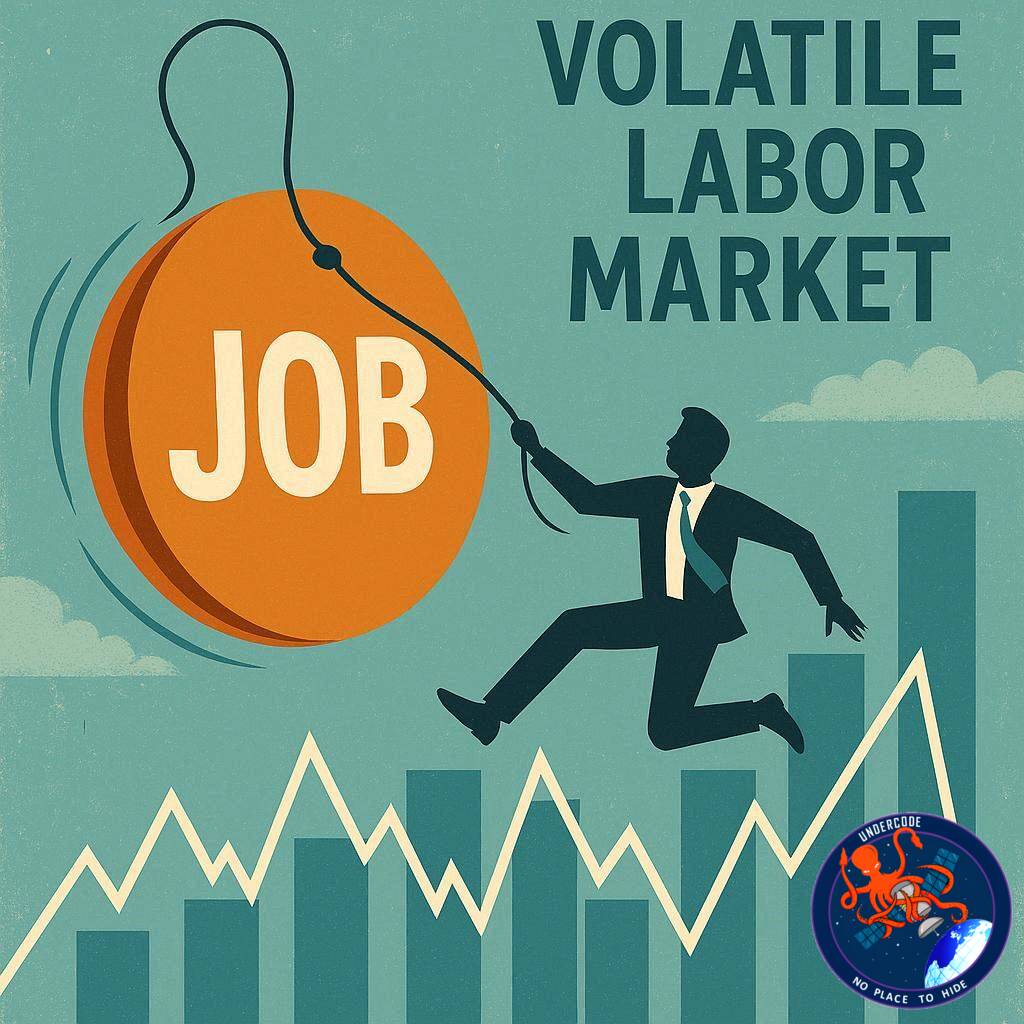
The global labor market is no longer following a predictable rhythm. Instead, it has entered a phase of sharp reversals, uneven job creation, and conflicting economic signals that make it difficult to interpret the true health of employment conditions. What once was a steady pattern of monthly job growth has now transformed into a volatile “yo-yo” dynamic, where gains are quickly followed by losses, and optimism is often short-lived. This instability is shaped by geopolitical tensions, structural changes like AI adoption, shifting immigration policies, and fluctuating demand across key industries.
Summary of the Original
Over the past year, the labor market has behaved unpredictably, swinging between job gains and losses in a pattern described as a “yo-yo job market.” While previous years saw consistent monthly job growth, recent data shows alternating months of expansion and contraction, resulting in nearly zero net job growth over the past year.
March recorded a strong gain of 178,000 jobs, reversing a revised loss of 133,000 jobs in February. However, much of March’s growth came from temporary or concentrated sources, particularly the health care sector, which alone contributed 76,000 jobs, representing 43% of total gains. This surge was partly influenced by workers returning after a strike.
Other sectors such as construction and transportation added a combined 47,000 jobs, while federal government employment declined by 18,000 positions. Despite these fluctuations, the unemployment rate remained relatively stable, moving between 4.2% and 4.5% over the past year, and slightly declining to 4.3% in March.
However, this decline was influenced by a shrinking labor force, with nearly 400,000 people leaving the workforce. Participation among prime-age workers (ages 25–54) also dipped slightly to 83.8%, although it remains historically high.
Economists highlight that the labor market is being shaped by multiple opposing forces, including AI-driven job displacement, immigration restrictions, tariff uncertainty, and geopolitical shocks such as the Iran conflict and its impact on energy prices. These pressures have contributed to a “no hire, no fire” environment, where companies avoid both large-scale hiring and layoffs.
The Federal Reserve now faces difficulty interpreting these mixed signals. While labor stability suggests caution in cutting interest rates, geopolitical inflation risks further complicate policy decisions. Following the jobs report, Treasury yields rose, reflecting reduced expectations for near-term rate cuts.
What Undercode Say:
The current labor market is not simply unstable, it is structurally transitioning into a new phase where traditional employment indicators no longer provide clear direction.
The “yo-yo effect” in job creation reflects deeper economic fragmentation rather than temporary volatility.
Sector concentration, particularly in health care, suggests a narrowing base of job growth rather than broad economic expansion.
The reliance on a single sector for nearly half of job gains raises concerns about resilience.
Labor force contraction is quietly masking underlying weakness in employment dynamics.
The decline of nearly 400,000 workers exiting the workforce is not neutral, it directly impacts unemployment calculations.
A stable unemployment rate in this context may be misleading rather than reassuring.
Prime-age participation remaining high suggests that core workforce engagement is still strong.
However, marginal workers appear to be withdrawing due to uncertainty and structural shifts.
AI adoption is beginning to reshape entry-level employment pathways.
This could create long-term bottlenecks in workforce development.
Immigration restrictions are simultaneously tightening labor supply, intensifying wage and hiring distortions.
Energy shocks linked to geopolitical conflict introduce external inflationary pressure.
The labor market is therefore influenced by both internal structural change and external global instability.
The “no hire, no fire” equilibrium reflects corporate risk aversion rather than confidence.
Companies prefer operational stability over expansion in uncertain conditions.
This reduces upward mobility for workers seeking new roles.
At the same time, job security improves for those already employed.
Such duality creates a divided labor experience across the workforce.
Federal Reserve policy becomes more complex under these mixed signals.
Interest rate decisions must now account for inflation risk, labor contraction, and geopolitical instability simultaneously.
Bond markets interpret stability cautiously, not optimistically.
The rise in Treasury yields suggests reduced expectations for monetary easing.
Overall, the economy appears to be in a transition zone rather than a recovery or downturn.
Fact Checker Results
✔️ Job market alternation between gains and losses aligns with reported labor volatility trends
✔️ Unemployment stability alongside labor force decline is consistent with statistical interpretation risks
⚠️ AI and immigration impacts are plausible but vary by sector and are not uniform across the economy
Prediction
The labor market is likely to remain uneven in the short term, with continued sector-driven job growth rather than broad-based expansion. Volatility may persist as geopolitical tensions and technological disruption reshape employment patterns. If labor force participation continues to decline, unemployment rates may remain deceptively stable even during underlying slowdown phases.
🕵️📝Let’s dive deep and fact‑check.
References:
Reported By: axioscom_1778256515
Extra Source Hub (Possible Sources for article):
https://www.digitaltrends.com
Wikipedia
OpenAi & Undercode AI
Image Source:
Unsplash
Undercode AI DI v2
Bing
🔐JOIN OUR CYBER WORLD [ CVE News • HackMonitor • UndercodeNews ]
📢 Follow UndercodeNews & Stay Tuned:
𝕏 formerly Twitter 🐦 | @ Threads | 🔗 Linkedin | 🦋BlueSky | 🐘Mastodon


