
Listen to this Post
Introduction: Why DDoS Defense Matters More Than Ever
The digital world of 2026 is built on extreme connectivity, real-time services, and always-on infrastructure. Unfortunately, that same connectivity has created the perfect environment for cybercriminals to launch massive, automated attacks at unprecedented scale. Distributed Denial of Service (DDoS) attacks are no longer blunt instruments used for disruption alone. They are now precision weapons, powered by AI-driven botnets, rented cheaply and deployed effortlessly. In seconds, these attacks can overwhelm networks, cripple applications, and shut down essential services.
For modern businesses, basic protection is no longer sufficient. The question is no longer if an attack will happen, but how prepared an organization is when it does. This article explores the most resilient DDoS protection solutions available in 2026, focusing on platforms that combine sheer network power with intelligence, automation, and expert human response.
How the Best DDoS Solutions Were Selected
Selecting the top DDoS protection platforms required more than marketing claims. Each vendor was evaluated using an EEAT-based framework—Experience, Expertise, Authoritativeness, and Trustworthiness—combined with real-world technical capabilities.
Global Network Capacity as the First Line of Defense
Modern DDoS attacks routinely exceed multiple terabits per second. Vendors without massive global anycast networks simply cannot absorb this volume. Solutions were prioritized based on their ability to disperse attack traffic globally without introducing latency for legitimate users.
Time-to-Mitigation as a Critical Metric
In 2026, mitigation speed defines survival. Even a few seconds of downtime can cause financial damage and reputational loss. Solutions offering sub-second or near-instant mitigation SLAs ranked significantly higher.
AI and Behavioral Intelligence Over Static Rules
Signature-based detection has become obsolete. Advanced attackers mimic legitimate user behavior to bypass traditional filters. Platforms using machine learning and behavioral modeling to identify anomalies at Layers 3 through 7 were favored.
Integration Across Hybrid and Multi-Cloud Environments
Most enterprises no longer operate in a single environment. The best solutions integrate seamlessly with on-premise infrastructure, private data centers, and public clouds such as AWS, Azure, and Google Cloud.
Human Expertise When Automation Isn’t Enough
Automation handles scale, but human expertise handles complexity. Vendors offering 24/7 Security Operations Center support and real-time expert intervention were weighted heavily.
Summary of the Original Analysis
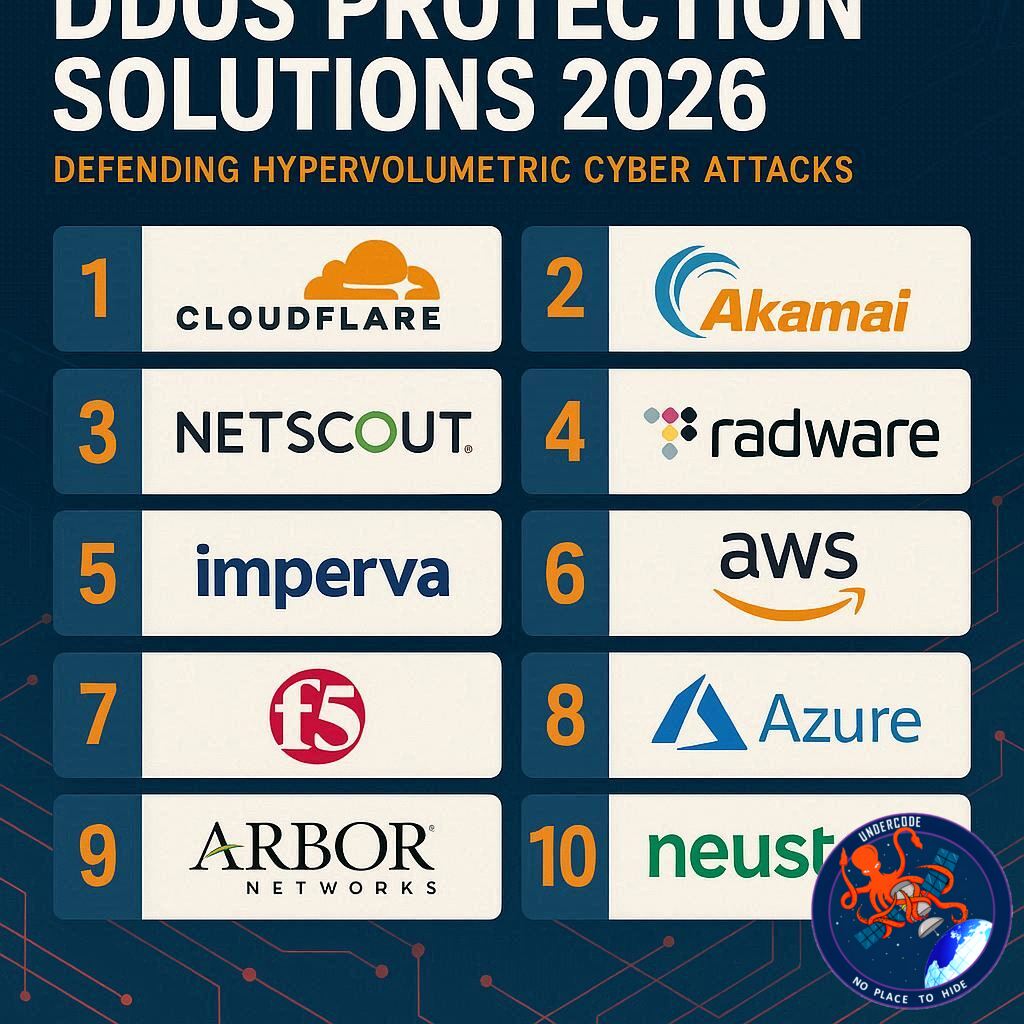
The original article presents a comprehensive ranking of the top ten DDoS protection solutions for 2026, emphasizing the rapid evolution of cyber threats driven by AI-powered botnets. It highlights how DDoS attacks have shifted from simple bandwidth floods to multi-vector campaigns targeting networks, applications, and even encrypted traffic simultaneously.
Each solution is evaluated through a structured framework focusing on network capacity, mitigation speed, intelligence capabilities, deployment flexibility, and managed support. The article explains how global anycast networks and cloud-based scrubbing centers have become essential to absorb attacks exceeding several terabits per second. It also underscores the importance of behavioral analysis and machine learning in distinguishing legitimate traffic surges from malicious activity.
The comparison table provides a clear snapshot of features such as free tiers, unmetered mitigation, on-premise hardware support, managed SOC availability, and cost-refund guarantees. Vendors like Cloudflare and AWS Shield stand out for accessibility and native cloud integration, while Akamai Prolexic and Radware are positioned as premium, enterprise-grade solutions for high-risk environments.
The article further breaks down each provider’s technical architecture, strengths, and limitations. It explains how some platforms focus on simplicity and native cloud protection, while others emphasize hybrid defense models combining on-premise hardware with cloud scrubbing. The conclusion stresses that there is no single “best” solution for everyone—optimal choice depends entirely on infrastructure, risk profile, and operational maturity.
What Undercode Say: The Strategic Reality of DDoS Defense in 2026
DDoS Has Become an Economic Weapon
DDoS attacks in 2026 are not just technical disruptions; they are economic attacks. By targeting scalability mechanisms, attackers force organizations to burn cloud resources, inflate operational costs, and trigger cascading failures across dependent services.
Scale Alone Is No Longer Enough
While raw bandwidth absorption remains essential, it is no longer sufficient on its own. Attackers increasingly blend volumetric floods with low-rate application attacks designed to exhaust backend logic rather than network pipes.
Behavioral Intelligence Is the New Firewall
The most effective solutions are those that understand normal behavior at a granular level. Behavioral baselining allows platforms to block attacks that look legitimate on the surface but deviate subtly from expected user patterns.
Always-On Architectures Reduce Human Error
Trigger-based mitigation introduces risk. Always-on DDoS protection removes the dependency on human reaction time, ensuring attacks are absorbed automatically without configuration changes during a crisis.
Cloud-Native Integration Is a Competitive Advantage
Native integration with AWS, Azure, and GCP reduces friction, lowers latency, and enables faster response. Cloud-native solutions also benefit from the immense telemetry these platforms generate globally.
Managed Services Are Undervalued Until an Attack Happens
During large-scale attacks, internal teams are often overwhelmed. Vendors offering direct access to experienced SOC analysts provide a decisive advantage when automated defenses encounter novel attack patterns.
Hybrid Defense Models Still Matter
Despite cloud dominance, many critical systems remain on-premise. Hybrid solutions like Radware and NETSCOUT Arbor remain essential for organizations that cannot rely exclusively on cloud-based mitigation.
Cost-Protection Guarantees Change Risk Calculations
Refund guarantees for attack-related scaling costs fundamentally shift financial risk away from the customer. This makes solutions like AWS Shield and Azure DDoS particularly attractive for high-traffic applications.
Visibility and Forensics Are Strategic Assets
Real-time logging and detailed analytics are no longer optional. Understanding attack origin, method, and evolution is critical for long-term resilience and regulatory reporting.
SMBs Are No Longer Ignored by Attackers
Affordable, managed solutions like AppTrana reflect a growing reality: small and mid-sized businesses are now frequent DDoS targets. Fully managed protection lowers the barrier to serious defense.
The Market Is Moving Toward Predictive Defense
The next phase of DDoS protection will focus on prediction rather than reaction. Vendors with global telemetry and AI-driven forecasting capabilities will define the next generation of defense platforms.
Fact Checker Results
✅ DDoS attacks exceeding multi-terabit scale are documented and increasingly common.
✅ Major cloud providers do offer cost-refund guarantees tied to DDoS incidents.
❌ No single solution universally fits all architectures or threat models.
Prediction
🚀 DDoS protection will evolve from mitigation to preemptive disruption of botnets.
🔐 Behavioral AI will replace static rule-based defenses as the primary detection method.
🌐 Global traffic intelligence sharing will become a defining advantage among top vendors.
🕵️📝✔️Let’s dive deep and fact‑check.
References:
Reported By: cyberpress.org
Extra Source Hub (Possible Sources for article):
https://www.digitaltrends.com
Wikipedia
OpenAi & Undercode AI
Image Source:
Unsplash
Undercode AI DI v2
Bing
🔐JOIN OUR CYBER WORLD [ CVE News • HackMonitor • UndercodeNews ]
📢 Follow UndercodeNews & Stay Tuned:
𝕏 formerly Twitter 🐦 | @ Threads | 🔗 Linkedin | 🦋BlueSky | 🐘Mastodon


