
Listen to this Post
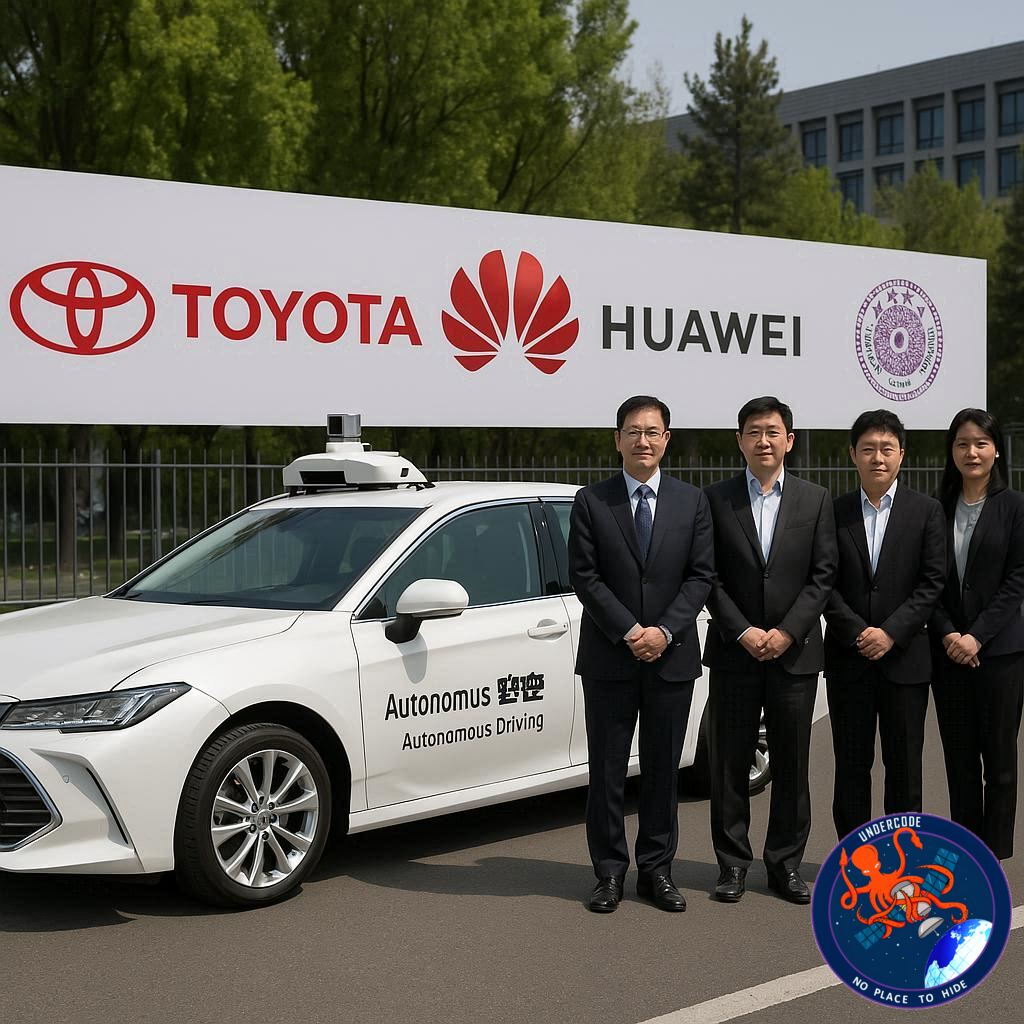
The Future of Traffic Merges: Toyota’s Ambitious Collaboration in China
In a bold step toward redefining intelligent mobility, Toyota Motor Corporation has announced a groundbreaking joint experiment with China’s tech giant Huawei, Tsinghua University, and several leading Chinese automakers. The project focuses on one of the most delicate maneuvers in driving—vehicle merging—and aims to make it seamless and safer using cloud-based data sharing and real-time vehicle communication.
The experiment was unveiled at an international automotive technology conference held in Chongqing on October 22. During the event, Hiroki Nakajima, Toyota’s Executive Vice President, presented the results of a six-company collaboration under a project known as “Project Jiashuo Action” (甲所行動). The project’s goal: to connect vehicles, infrastructure, and cloud networks so that cars can “talk” to each other, exchange real-time road conditions, and automatically coordinate merging behaviors without sudden stops or collisions.
This collaboration represents more than a technical test. It is a symbolic bridge between Japanese and Chinese automotive innovation, uniting Toyota’s mastery in vehicle engineering with Huawei’s dominance in communication systems and Tsinghua University’s advanced research in artificial intelligence and smart transportation.
The experiment simulated multiple traffic merging scenarios—such as highway on-ramps and busy intersections—where vehicles from different manufacturers shared their speed, position, and route data via a unified cloud network. This enabled cars to predict each other’s movements, allowing smoother integration into traffic flows without driver intervention.
Toyota’s role was central in coordinating the test framework and integrating vehicle control logic. Huawei provided V2X (Vehicle-to-Everything) communication modules, enabling fast and stable data transmission between vehicles and cloud servers. Meanwhile, Tsinghua University oversaw the AI algorithms that analyzed the data, calculated safe distances, and proposed optimized merging sequences in real time.
The results were impressive. Vehicles managed to merge smoothly with minimal braking or acceleration, reducing potential traffic congestion and improving overall road safety. It demonstrated that with effective data-sharing infrastructure, autonomous or semi-autonomous vehicles could handle complex driving tasks like merging, which even human drivers often find stressful.
While Toyota has long been known for its hybrid and hydrogen technologies, this move signals a strategic expansion into intelligent connected mobility, an area increasingly dominated by Chinese firms. By collaborating rather than competing, Toyota positions itself within China’s rapidly evolving smart vehicle ecosystem, ensuring it remains relevant as the industry transitions from mechanical excellence to data-driven intelligence.
This experiment also reflects the growing global interdependence in mobility innovation. Automakers can no longer work in isolation; the future of driving relies on cooperation among technology firms, universities, and governments. Through joint testing and data exchange, these entities are paving the way toward fully connected, safer, and more efficient transportation networks.
If scaled successfully, the technology could be applied to urban traffic systems, where autonomous taxis and delivery vehicles share limited road space. It could also assist in emergency vehicle routing and improve fuel efficiency by reducing unnecessary braking and idling during merges.
In essence, Toyota’s partnership in this Chongqing experiment symbolizes a shift from competition to collaboration, from mechanical to digital intelligence, and from national borders to shared global progress.
What Undercode Say:
This experiment represents a strategic inflection point for Toyota and for the global auto industry. For decades, Toyota’s strength was in precision engineering and manufacturing efficiency. Yet, as mobility becomes increasingly data-driven, even the most established automakers must evolve into software-integrated tech companies.
By joining forces with Huawei and Tsinghua University, Toyota is acknowledging a truth that Western manufacturers are slower to accept: China is now the center of intelligent vehicle development. The partnership is pragmatic, not political—it’s about survival in a market where the speed of innovation matters more than heritage or brand prestige.
The merging experiment may seem narrow in scope, but its implications are massive. Vehicle merging is a microcosm of all autonomous driving challenges—it involves communication, prediction, and trust. If cars can merge intelligently without human input, then broader functions such as autonomous lane changes, traffic coordination, and cooperative driving become not only possible but inevitable.
Moreover, this collaboration hints at a new type of industrial diplomacy. Toyota gains access to China’s vast testing environment and AI ecosystem, while Chinese companies learn from Toyota’s safety culture and automotive precision. It’s a trade of strengths—a data-for-experience exchange that could shape global standards for vehicle communication.
From a technological perspective, the experiment also validates V2X technology as a critical backbone for autonomous mobility. Instead of relying solely on onboard sensors like radar and cameras, V2X allows cars to see beyond their line of sight—detecting vehicles hidden by obstacles or predicting movements before they occur. That’s the missing link between human-level intuition and machine-level precision.
What’s fascinating is that this type of project is emerging in China, not in the U.S. or Europe. It shows how policy alignment, rapid prototyping, and state-backed research can accelerate innovation far faster than fragmented regulatory systems in the West. The Chongqing test might soon serve as a model for urban smart traffic infrastructure worldwide.
If Toyota plays its cards right, this alliance could become a foundation for global V2X standards, enabling cross-brand communication between vehicles—a concept once seen as science fiction. The experiment’s success also strengthens Toyota’s long-term vision for “Mobility for All,” a philosophy that blends sustainability, accessibility, and safety through advanced technology.
In the coming years, the real challenge won’t be the technology itself but the governance of shared data. Who owns the data exchanged between vehicles? How is it protected from misuse? Those questions will determine whether intelligent mobility becomes a utopian system of safety or another battleground for digital control.
For now, Toyota’s step in Chongqing is more than a demonstration—it’s a declaration. The road to the future isn’t about horsepower; it’s about bandwidth, algorithms, and cooperation.
🔍 Fact Checker Results
✅ Toyota confirmed the experiment took place in Chongqing with Huawei and Tsinghua University.
✅ The project focused on vehicle merging using V2X and cloud-based systems.
✅ Results indicated improved merging efficiency and safety outcomes.
📊 Prediction
🚘 Within five years, Toyota may integrate cloud-assisted merging into production vehicles in China.
🌏 Global automakers will likely adopt similar cross-industry partnerships to accelerate connected car technologies.
📡 By 2030, V2X-driven coordination could reduce urban traffic accidents by more than 30%, reshaping city mobility forever.
🕵️📝✔️Let’s dive deep and fact‑check.
References:
Reported By: xtechnikkeicom_fcf240a833f0584d943d1bfe
Extra Source Hub (Possible Sources for article):
https://www.reddit.com/r/AskReddit
Wikipedia
OpenAi & Undercode AI
Image Source:
Unsplash
Undercode AI DI v2
Bing
🔐JOIN OUR CYBER WORLD [ CVE News • HackMonitor • UndercodeNews ]
📢 Follow UndercodeNews & Stay Tuned:
𝕏 formerly Twitter 🐦 | @ Threads | 🔗 Linkedin | 🦋BlueSky | 🐘Mastodon


