
Listen to this Post
Introduction: A Growing War Against Digital Crime
The global fight against cybercrime has entered a new phase as governments begin targeting not just individual hackers, but the entire infrastructure behind large-scale fraud. In a decisive move, the United Kingdom has taken aim at a key pillar of Southeast Asia’s scam economy. By sanctioning a major illicit marketplace and a massive scam compound, authorities are signaling a broader strategy to dismantle the financial and operational backbone of organized digital crime.
Summary: A Deep Strike Into the Scam Ecosystem
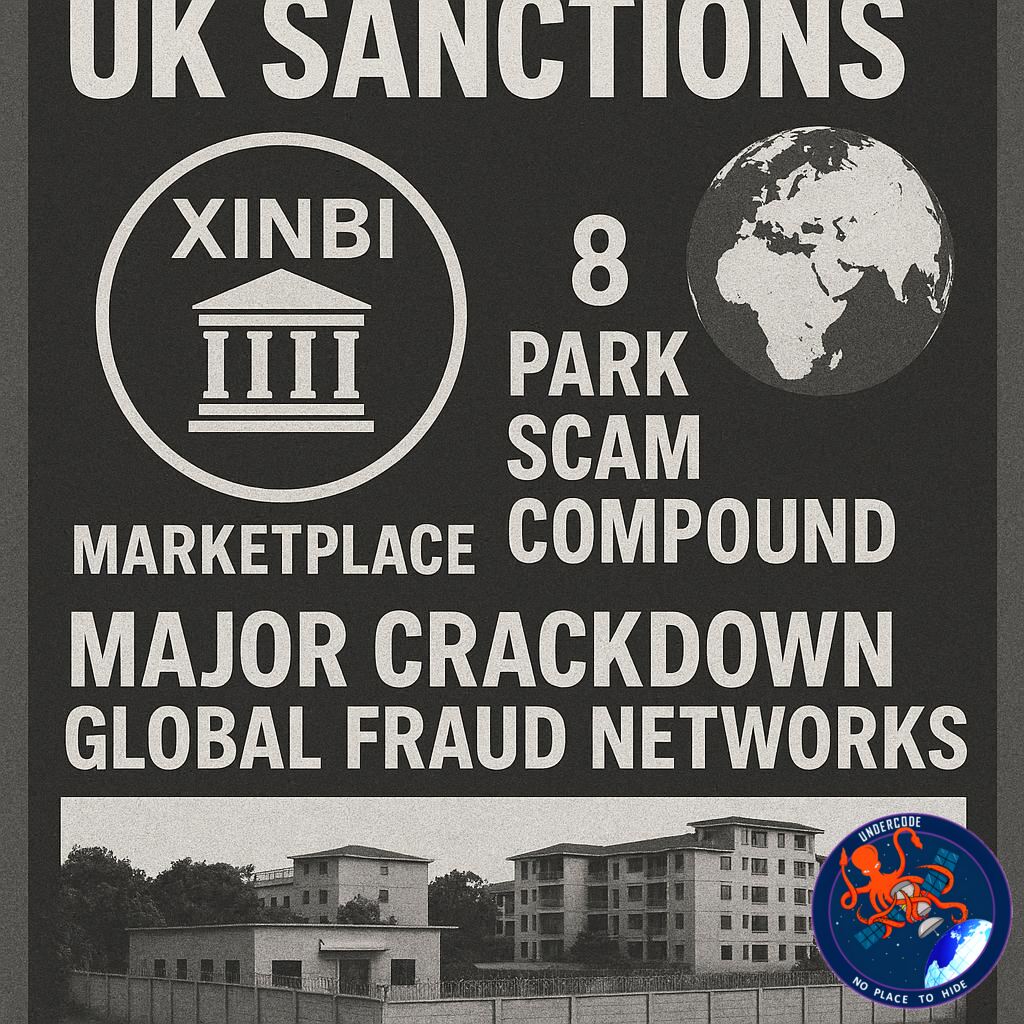
The United Kingdom’s Foreign, Commonwealth and Development Office (FCDO) has imposed sanctions on Xinbi, a Chinese-language online marketplace known for facilitating cybercrime activities, including the sale of stolen personal data and tools used by scam networks. Xinbi has also been linked to laundering cryptocurrency for North Korean threat actors, further amplifying its global risk profile. According to blockchain analytics firm Chainalysis, the platform processed over $19.9 billion in transactions between 2021 and 2025, spanning activities such as money laundering, unlicensed over-the-counter trading, and trafficking of compromised data.
Alongside Xinbi, the UK has sanctioned the massive scam compound known as “8 Park,” believed to be the largest of its kind in Cambodia, with the capacity to house up to 20,000 trafficked workers. The compound is linked to the Prince Group crime syndicate and operated by Legend Innovation Co. These facilities are part of a broader network of scam centers across Southeast Asia, particularly in regions like Cambodia, Myanmar, and Laos.
These scam centers rely on forced labor, coercing individuals into participating in elaborate fraud schemes that target victims worldwide. Common tactics include cryptocurrency investment scams, often referred to as pig butchering or romance baiting. Victims are approached via social media, messaging apps, and dating platforms, using stolen personal data acquired from marketplaces like Xinbi. Once trust is established, victims are convinced to invest in fake opportunities, only to have their funds redirected into accounts controlled by the scammers.
The sanctions aim to cut Xinbi off from the legitimate cryptocurrency ecosystem, making it nearly impossible for the platform to process transactions. This approach mirrors previous enforcement actions, such as the shutdown of the Byex Exchange following similar sanctions. UK officials emphasized that these measures are intended not only to protect citizens from financial fraud but also to combat severe human rights abuses associated with scam compounds.
The move builds on earlier coordinated efforts between the UK and the United States. In October 2025, authorities targeted the Prince Group crime network and its leader, Chen Zhi, with sanctions, asset freezes, and law enforcement actions. The U.S. Department of Justice also seized $15 billion in Bitcoin tied to these operations, although Zhi remains at large. The UK has pledged to continue pushing for international cooperation, including at upcoming global summits focused on illicit finance.
What Undercode Say: The Real Impact Behind the Headlines
This action is more than just another sanction announcement. It represents a shift in how governments approach cybercrime at scale. Instead of chasing individual scammers, authorities are now targeting the ecosystems that make these crimes possible. Xinbi is not just a marketplace. It is infrastructure. It connects stolen data, laundering services, and scam operations into one efficient pipeline.
What makes this particularly significant is the financial scale involved. Nearly $20 billion flowing through a single illicit platform reveals how industrialized cybercrime has become. This is no longer a fragmented underground economy. It is structured, interconnected, and deeply embedded in global financial systems. Cutting off such a hub can create ripple effects across multiple criminal networks.
Another critical layer is the human cost. The exposure of compounds like 8 Park highlights a darker reality. These are not just scam offices. They are often forced labor environments where individuals are trafficked, threatened, and exploited. By targeting these facilities, sanctions are addressing both financial crime and human rights violations simultaneously.
The involvement of state-linked actors, particularly North Korean groups, adds geopolitical weight to the issue. Cryptocurrency theft has become a key funding mechanism for sanctioned regimes, and platforms like Xinbi act as bridges between cybercrime and state-sponsored operations. Disrupting these channels can have implications beyond fraud prevention, potentially affecting national security dynamics.
However, the effectiveness of sanctions depends on enforcement and global cooperation. While the UK’s move is significant, cybercrime networks are highly adaptive. They can migrate to new platforms, shift jurisdictions, and adopt new laundering techniques. Without coordinated international action, the impact may be temporary.
There is also a technological dimension to consider. Blockchain transparency, often seen as a vulnerability for criminals, is becoming a powerful tool for investigators. Firms like Chainalysis are playing a crucial role in mapping illicit flows and identifying key nodes in these networks. This suggests that future crackdowns will increasingly rely on data intelligence rather than traditional law enforcement methods.
At the same time, scammers continue to evolve their tactics. Social engineering remains highly effective because it exploits human psychology rather than technical vulnerabilities. Even with platforms like Xinbi disrupted, the demand for stolen data and fraud services will persist as long as victims can be manipulated.
Ultimately, this crackdown signals a broader transformation. Governments are beginning to treat cybercrime as a systemic threat rather than isolated incidents. The focus is shifting toward dismantling entire ecosystems, combining financial sanctions, intelligence sharing, and technological tools. Whether this approach can keep pace with the rapid evolution of cybercriminal networks remains an open question.
Fact Checker Results
✅ Xinbi processed billions in illicit crypto transactions, confirmed by blockchain analysis.
✅ 8 Park is identified as a large-scale scam compound tied to organized crime networks.
❌ Full disruption of global scam operations is unlikely with sanctions alone.
Prediction
The next phase of cybercrime enforcement will focus on infrastructure-level takedowns, not individuals. 🌐
More countries will adopt blockchain intelligence partnerships to trace and freeze illicit funds. 📊
Scam networks will shift toward decentralized and harder-to-track platforms, increasing complexity. ⚠️
🕵️📝✔️Let’s dive deep and fact‑check.
References:
Reported By: www.bleepingcomputer.com
Extra Source Hub (Possible Sources for article):
https://www.reddit.com
Wikipedia
OpenAi & Undercode AI
Image Source:
Unsplash
Undercode AI DI v2
Bing
🔐JOIN OUR CYBER WORLD [ CVE News • HackMonitor • UndercodeNews ]
📢 Follow UndercodeNews & Stay Tuned:
𝕏 formerly Twitter 🐦 | @ Threads | 🔗 Linkedin | 🦋BlueSky | 🐘Mastodon


