
Listen to this Post
 Introduction: A Breach That Highlights Hidden Risks in Digital Ecosystems
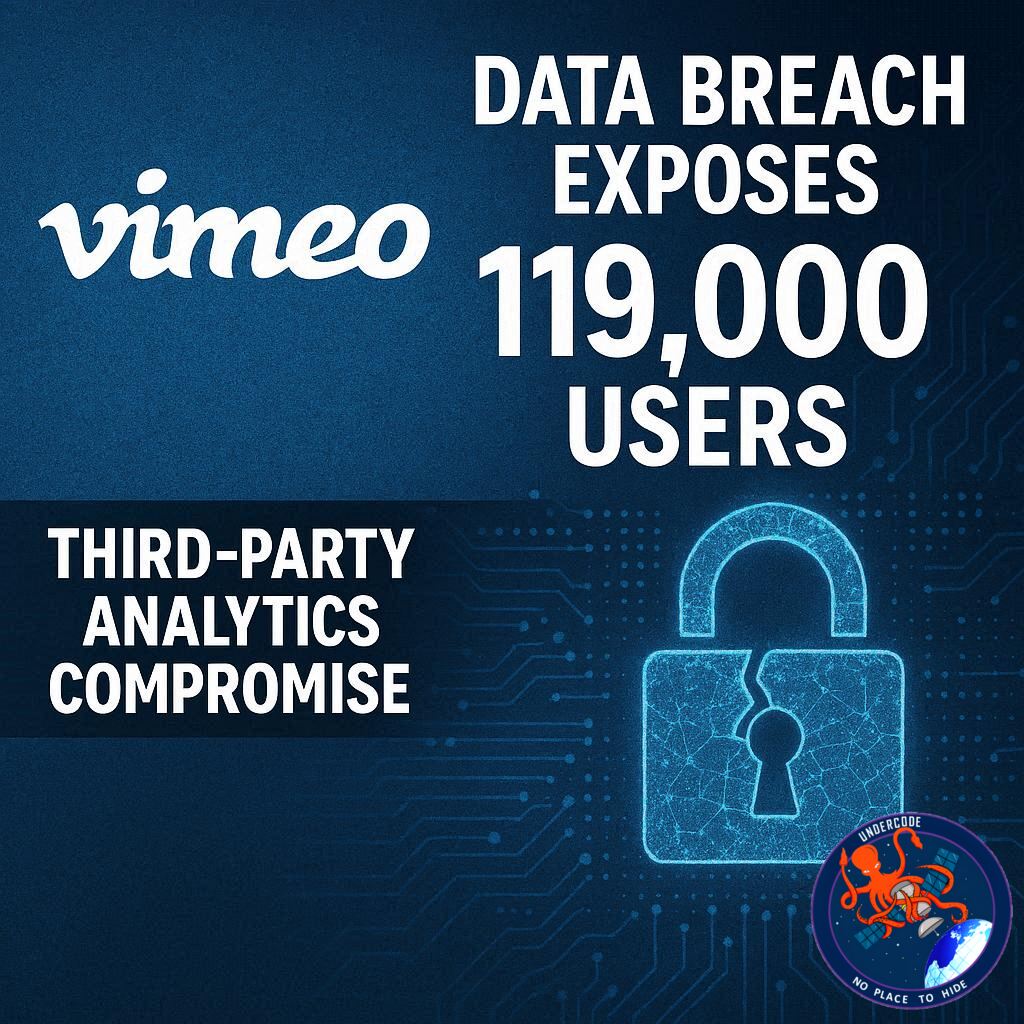
In April 2026, a significant cybersecurity incident shook the video hosting industry as Vimeo confirmed a data breach affecting thousands of users. While the company reassured customers that sensitive financial and login data remained secure, the incident exposed a deeper issue that continues to haunt modern digital infrastructure, the growing dependency on third-party vendors. The breach, tied to analytics provider Anodot, reveals how even indirect vulnerabilities can cascade into major security failures, raising urgent questions about trust, oversight, and accountability in interconnected systems.
Summary: How the Vimeo Breach Unfolded and What Was Exposed
The breach came to light after the cybercriminal group ShinyHunters listed Vimeo on its extortion portal as part of a broader “pay or leak” campaign. According to Have I Been Pwned, the attackers published hundreds of gigabytes of stolen data, primarily consisting of video titles, metadata, and technical information. Among the exposed data were approximately 119,000 unique email addresses, sometimes paired with user names.
Vendor Compromise: The Entry Point Through Anodot
Vimeo clarified that the breach did not originate directly from its internal systems but was instead linked to a compromise at Anodot, a third-party analytics vendor used by multiple organizations. Through this vulnerability, an unauthorized actor gained access to certain Vimeo user and customer data. The exposed databases mainly included non-sensitive technical records, though the presence of personal identifiers such as email addresses elevated the seriousness of the incident.
Official Response: Vimeo’s Immediate Containment Measures
In response to the breach, Vimeo acted quickly by disabling its integration with Anodot and removing all related access points. The company also engaged external cybersecurity experts to investigate the incident and coordinated with law enforcement agencies. According to Vimeo, no video content, valid login credentials, or payment card information were compromised, and the platform’s core services remained fully operational during the incident.
Intelligence Insights: External Reports and Attribution
Vimeo referenced findings from Google Threat Intelligence, which linked the breach to an unauthorized actor associated with the Anodot compromise. This external validation reinforced the company’s claim that the breach was part of a broader attack campaign rather than a targeted failure within Vimeo’s own infrastructure.
Data Leak Escalation: ShinyHunters Publishes 106GB Archive
Following Vimeo’s disclosure, ShinyHunters escalated the situation by releasing a massive 106GB archive of stolen documents on its Tor-based leak site. This move is consistent with the group’s typical strategy, leveraging public exposure to pressure victims into paying cryptocurrency ransoms. The leaked dataset reportedly included structured and unstructured information, amplifying the potential for misuse despite the absence of highly sensitive data.
Threat Actor Profile: The Rise of ShinyHunters
ShinyHunters is widely recognized in cybersecurity circles as a prolific and aggressive hacking collective. Often linked to a loosely organized network known as “the Com,” the group consists largely of young, English-speaking individuals who specialize in breaching large organizations. Their operations frequently rely on social engineering tactics, particularly voice phishing, to obtain credentials and infiltrate SaaS platforms such as Salesforce, Okta, and Microsoft 365.
Expanding Target List: A Pattern of High-Profile Attacks
The Vimeo incident is not isolated. ShinyHunters has previously targeted major entities including the European Commission, Odido, Figure, Canada Goose, Rockstar, and SoundCloud. In each case, the group demonstrated a consistent pattern, gain access, extract large datasets, and leverage public leaks as a coercion mechanism when ransom demands are not met.
Ongoing Investigation: Unanswered Questions Remain
Despite initial findings, Vimeo confirmed that the investigation is still ongoing. The company has committed to providing updates as more information becomes available. Key questions remain unanswered, including the full scope of the compromised data and whether additional third-party vulnerabilities may have been exploited.
What Undercode Say: The Real Threat Lies Beyond the Surface
The Vimeo breach is not just another cybersecurity headline, it is a textbook example of how modern digital ecosystems are only as strong as their weakest external dependency. Companies often invest heavily in securing their own infrastructure, yet overlook the silent risk posed by third-party integrations. In this case, Anodot acted as a bridge, unintentionally opening the door to attackers without directly compromising Vimeo’s core systems.
This incident exposes a structural weakness in how organizations approach security. Vendor relationships are typically built on trust and efficiency, not continuous verification. Once integrated, third-party tools often operate with elevated access, making them attractive targets for attackers. The reality is simple, compromising one vendor can unlock access to dozens of companies simultaneously.
Another critical observation is the evolving sophistication of groups like ShinyHunters. Their reliance on social engineering, particularly voice phishing, signals a shift away from purely technical exploits toward human manipulation. This makes traditional defenses less effective, as the attack vector is no longer just code, but people. Employees, support teams, and even executives become potential entry points.
The scale of the data leak also reflects a psychological strategy. Even when the exposed data is not highly sensitive, its sheer volume creates pressure. Organizations fear reputational damage more than technical loss, which is precisely what these groups exploit. By publishing massive datasets, attackers amplify perceived impact, forcing companies into difficult decisions regarding ransom payments.
There is also a broader industry implication. SaaS platforms like Salesforce, Okta, and Microsoft 365 have become central hubs for enterprise operations. When attackers gain access to these environments, they do not just steal data, they gain visibility into entire organizational workflows. This transforms a single breach into a multi-layered intelligence operation.
From a risk management perspective, the Vimeo case underscores the need for continuous vendor auditing. One-time security assessments are no longer sufficient. Organizations must adopt real-time monitoring of third-party access, implement strict privilege controls, and enforce zero-trust principles across all integrations.
Furthermore, transparency in breach disclosure plays a crucial role. Vimeo’s acknowledgment of the incident and its attribution to Anodot reflects a growing trend toward openness. However, transparency alone is not enough. Users increasingly expect proactive protection, not just reactive communication.
Ultimately, this breach is less about what was stolen and more about how it was stolen. It reveals a shift in the cybersecurity battlefield, from isolated system defenses to interconnected risk landscapes. Companies that fail to adapt to this reality will continue to face similar incidents, regardless of how secure their internal systems may appear.
Fact Checker Results
✅ Vimeo confirmed the breach and linked it to Anodot’s compromise
✅ No payment data or login credentials were exposed according to official statements
❌ The attack did not originate from Vimeo’s internal infrastructure directly
Prediction
📊 Cyberattacks targeting third-party vendors will increase sharply as attackers exploit interconnected systems
📊 Groups like ShinyHunters will continue using data leaks as psychological pressure rather than purely financial leverage
📊 Companies will accelerate adoption of zero-trust security models to reduce dependency risks
🕵️📝Let’s dive deep and fact‑check.
References:
Reported By: securityaffairs.com
Extra Source Hub (Possible Sources for article):
https://www.stackexchange.com
Wikipedia
OpenAi & Undercode AI
Image Source:
Unsplash
Undercode AI DI v2
Bing
🔐JOIN OUR CYBER WORLD [ CVE News • HackMonitor • UndercodeNews ]
📢 Follow UndercodeNews & Stay Tuned:
𝕏 formerly Twitter 🐦 | @ Threads | 🔗 Linkedin | 🦋BlueSky | 🐘Mastodon


