
Listen to this Post
Introduction
The premium smartphone market in India has become more competitive than ever in 2026. With flagship-level devices now offering DSLR-style cameras, AI-powered software experiences, and batteries capable of lasting well beyond a day, consumers are no longer simply buying a phone. They are investing in an ecosystem, a camera experience, and a long-term digital companion.
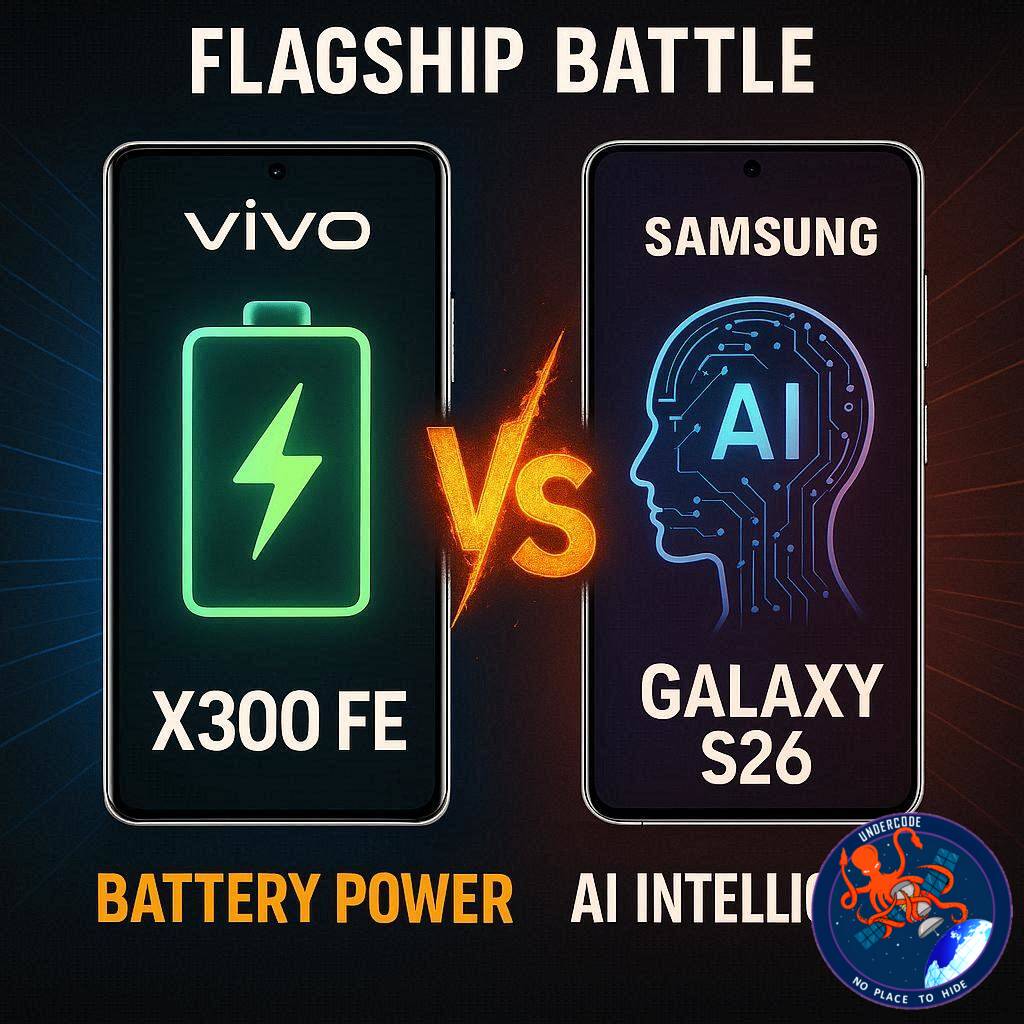
Two devices currently dominating discussions are the Vivo X300 FE and the Samsung Galaxy S26. Both smartphones arrive with the exact same starting price tag of Rs 79,999, yet they target completely different types of users. Vivo is aggressively pushing photography and battery endurance, while Samsung continues to strengthen its AI software ecosystem and long-term Android support strategy.
For buyers planning to spend nearly Rs 80,000 on a flagship smartphone, the choice is not easy. Each device excels in specific areas, and the final decision depends entirely on how you use your smartphone daily.
Same Price, Different Philosophy
The Vivo X300 FE officially launched in India on May 6, 2026, while Samsung’s Galaxy S26 has already been available in the market since March. Even though both smartphones cost the same, their design philosophy is noticeably different from the moment you look at the specifications.
Vivo appears focused on users who consume heavy multimedia content, travel often, and depend heavily on smartphone photography. Samsung, on the other hand, continues to target users deeply invested in productivity, ecosystem connectivity, and AI-enhanced software experiences.
Both phones feature compact flagship designs with nearly identical screen sizes. Vivo offers a 6.31-inch LTPO AMOLED panel with a 120Hz refresh rate, while Samsung equips the Galaxy S26 with a 6.3-inch Dynamic AMOLED 2X display. In real-world usage, both displays deliver flagship-level brightness, smoothness, and color quality.
However, the differences begin to emerge once users dive deeper into camera performance, battery efficiency, and long-term software value.
Vivo Dominates in Camera Hardware
The camera setup is arguably the biggest reason many users may lean toward the Vivo X300 FE. Vivo has packed the device with a 50MP primary sensor, a dedicated 50MP telephoto lens, and an 8MP ultrawide camera. On the front, the phone also includes a powerful 50MP selfie shooter.
What makes the Vivo particularly interesting is its ZEISS partnership and telephoto extender system. Portrait photography benefits heavily from this hardware combination, especially when capturing subjects at longer focal lengths. The DSLR-like background blur effect creates a more professional appearance than what many smartphones currently achieve.
Travel photographers and Instagram creators will likely appreciate Vivo’s strong zoom capabilities and natural image processing. Portrait edges appear cleaner, and skin tones remain balanced even in difficult lighting situations.
Samsung’s Galaxy S26, meanwhile, uses a more familiar triple-camera arrangement with a 50MP primary camera, 12MP ultrawide sensor, and 10MP telephoto lens. While the hardware may appear less aggressive than Vivo’s, Samsung compensates heavily through computational photography.
Its Nightography AI system continues to improve low-light photography performance, helping users capture clearer images in restaurants, city streets, concerts, and indoor environments. Samsung’s image consistency is also a major advantage. Photos often require less editing before being uploaded to social media platforms.
For users who prioritize portrait photography, zoom quality, and hardware-focused imaging, Vivo clearly has the upper hand. For casual users who want reliable AI-assisted photography in almost every scenario, Samsung still remains extremely competitive.
Battery Difference Is Massive
Battery performance may become the deciding factor for many buyers.
The Vivo X300 FE includes a massive 6,500mAh battery paired with 90W wired charging and 40W wireless charging support. In comparison, Samsung ships the Galaxy S26 with a significantly smaller 4,300mAh battery and slower 25W wired charging.
The difference on paper already looks dramatic, but in practical use it becomes even more noticeable.
Heavy users who stream videos, play games, navigate with GPS, and spend hours on social media may find the Vivo lasting substantially longer throughout the day. Frequent travelers and business users could comfortably survive an entire workday without reaching for a charger.
Samsung’s smaller battery is not necessarily poor, but expectations naturally rise when buyers spend nearly Rs 80,000. Many users expected Samsung to adopt faster charging technology and larger battery capacities in 2026, especially while Chinese competitors continue pushing aggressive hardware improvements.
Charging speed also matters more than ever today. Vivo’s 90W charging allows users to rapidly refill the battery during short breaks, while Samsung’s 25W charging feels noticeably slower in comparison.
For users who hate battery anxiety, the Vivo X300 FE becomes extremely difficult to ignore.
Samsung Wins the Long-Term Software Battle
While Vivo dominates battery and arguably camera hardware, Samsung confidently takes the lead in software longevity.
The Galaxy S26 promises seven major Android updates alongside extended security support. That means buyers could theoretically keep the phone updated until 2033, which is exceptional even by flagship standards.
Vivo’s promise of four Android upgrades and seven years of security updates is still respectable, but Samsung’s commitment remains unmatched in the Android world.
This matters more than many consumers realize.
Long-term updates improve security, add new AI features, maintain app compatibility, and extend device resale value. Buyers who plan to keep a smartphone for five or six years may find Samsung’s software strategy significantly more attractive.
Samsung also benefits from its broader ecosystem. Users who already own Galaxy Buds, Galaxy Watches, Galaxy Tabs, or Samsung laptops will enjoy tighter integration across devices. Features like seamless syncing, AI assistance, and productivity tools continue to strengthen Samsung’s ecosystem advantage.
AI Features Are Becoming a New Battlefield
Artificial intelligence is no longer just a marketing term in smartphones. In 2026, AI now directly shapes how users edit photos, write messages, search content, and organize daily tasks.
Samsung has aggressively positioned the Galaxy S26 as an AI-first smartphone. Features like AI-assisted photography, contextual search, live translation, note summarization, and smart productivity tools create a more intelligent software experience overall.
Vivo’s approach is different. Instead of aggressively branding every feature as AI, the company focuses more on photography enhancement and performance optimization behind the scenes.
This creates an interesting divide between the two brands.
Samsung appeals more to productivity-focused users who enjoy smart software automation. Vivo appeals to users who care more about visible hardware benefits like camera quality and battery life.
Compact Flagships Are Making a Comeback
One positive trend visible in both devices is the return of compact flagship smartphones.
For years, premium phones became increasingly large and difficult to use with one hand. The Vivo X300 FE and Galaxy S26 both prove that manufacturers are finally listening to consumers who want flagship power without oversized dimensions.
Despite their compact form factor, both phones still deliver high refresh rate displays, flagship processors, premium build quality, and advanced camera systems.
This balance between portability and performance may become one of the biggest smartphone trends moving forward.
What Undercode Say:
The comparison between the Vivo X300 FE and Samsung Galaxy S26 highlights a much larger shift happening inside the smartphone industry. Consumers are no longer impressed by raw specifications alone. Instead, brands are competing on ecosystem strength, battery endurance, software longevity, and AI integration.
Vivo’s strategy is aggressive and straightforward. It aims to win buyers through visible hardware superiority. A massive 6,500mAh battery instantly attracts attention because users directly feel the advantage every single day. Similarly, the dedicated telephoto hardware creates tangible photographic improvements that consumers can immediately notice on social media platforms.
Samsung’s strategy is more long-term and ecosystem-oriented. The company understands that software support, AI tools, and cross-device synchronization build customer loyalty over many years. Seven years of Android updates is not simply a technical specification. It is a trust statement directed toward premium buyers.
Interestingly, Samsung’s conservative hardware choices may eventually become a weakness if Chinese manufacturers continue pushing innovation faster. Consumers paying flagship prices increasingly expect both excellent software support and cutting-edge hardware simultaneously.
Battery capacity has become one of the clearest examples of this changing consumer expectation. Users today spend more time on mobile gaming, AI tasks, video streaming, and content creation than ever before. A 4,300mAh battery no longer feels truly flagship-level in 2026, especially against competitors crossing the 6,000mAh mark.
Camera philosophy also differs sharply between the two brands. Vivo focuses heavily on optical performance and portrait realism. Samsung prioritizes AI-assisted consistency and ease of use. Neither approach is wrong, but they appeal to completely different audiences.
Another important factor is charging speed. Chinese smartphone brands continue normalizing ultra-fast charging technology, while Samsung and Apple remain comparatively conservative. Over time, consumer expectations may pressure traditional flagship brands to adapt faster.
The software update debate is equally important. Samsung currently leads Android manufacturers in long-term support, and that advantage heavily influences purchasing decisions among users who upgrade less frequently. Vivo still has room to improve in this area if it wants to compete more aggressively in the premium segment globally.
From a market perspective, the Vivo X300 FE represents how Chinese brands are rapidly closing the premium experience gap. A few years ago, Samsung dominated the Android flagship conversation almost uncontested. In 2026, buyers now genuinely hesitate between Samsung and emerging competitors like Vivo, Xiaomi, and Oppo.
AI may become the next major battlefield. Samsung already invests heavily in AI branding and productivity tools, while Vivo currently emphasizes camera intelligence. The next generation of flagship smartphones will likely merge both hardware innovation and intelligent software assistance more deeply.
One particularly interesting aspect is consumer psychology. Many buyers still associate Samsung with reliability and prestige, while Vivo is increasingly associated with value-packed innovation. That perception gap still matters in premium purchasing decisions.
Thermal performance and gaming optimization will also likely influence real-world experiences between these two phones, especially for power users. Vivo’s larger battery may provide better sustained performance under heavy workloads.
For photography enthusiasts, Vivo’s dedicated telephoto capabilities could become a decisive advantage, especially as mobile photography continues replacing standalone cameras for casual creators.
Meanwhile, Samsung’s ecosystem remains one of the strongest lock-in systems in the Android world. Users already invested in Galaxy products may naturally lean toward the S26 simply because of ecosystem familiarity and continuity.
The smartphone market is entering a fascinating phase where brands can no longer rely on one single advantage. Consumers now expect flagship cameras, excellent battery life, fast charging, AI integration, premium displays, and long-term software support all at once.
Ultimately, the Vivo X300 FE feels like the better hardware-focused flagship, while the Samsung Galaxy S26 feels like the smarter long-term ecosystem investment.
Fact Checker Results
✅ Both smartphones reportedly launch at the same starting price of Rs 79,999 according to the original comparison article.
✅ Vivo X300 FE does feature a significantly larger battery and faster charging solution than the Samsung Galaxy S26.
❌ Samsung Galaxy S26 does not outperform Vivo in raw battery specifications, despite its strong software and ecosystem advantages.
Prediction
🔮 Vivo could gain major traction among younger content creators and power users if its camera and battery performance matches real-world expectations.
🔮 Samsung will likely maintain stronger long-term sales due to software reliability, AI ecosystem integration, and brand trust among premium buyers.
🔮 Future flagship competition may force Samsung to finally adopt larger batteries and faster charging speeds in upcoming Galaxy generations.
🕵️📝Let’s dive deep and fact‑check.
References:
Reported By: zeenews.india.com
Extra Source Hub (Possible Sources for article):
https://www.github.com
Wikipedia
OpenAi & Undercode AI
Image Source:
Unsplash
Undercode AI DI v2
Bing
🔐JOIN OUR CYBER WORLD [ CVE News • HackMonitor • UndercodeNews ]
📢 Follow UndercodeNews & Stay Tuned:
𝕏 formerly Twitter 🐦 | @ Threads | 🔗 Linkedin | 🦋BlueSky | 🐘Mastodon


