
Listen to this Post
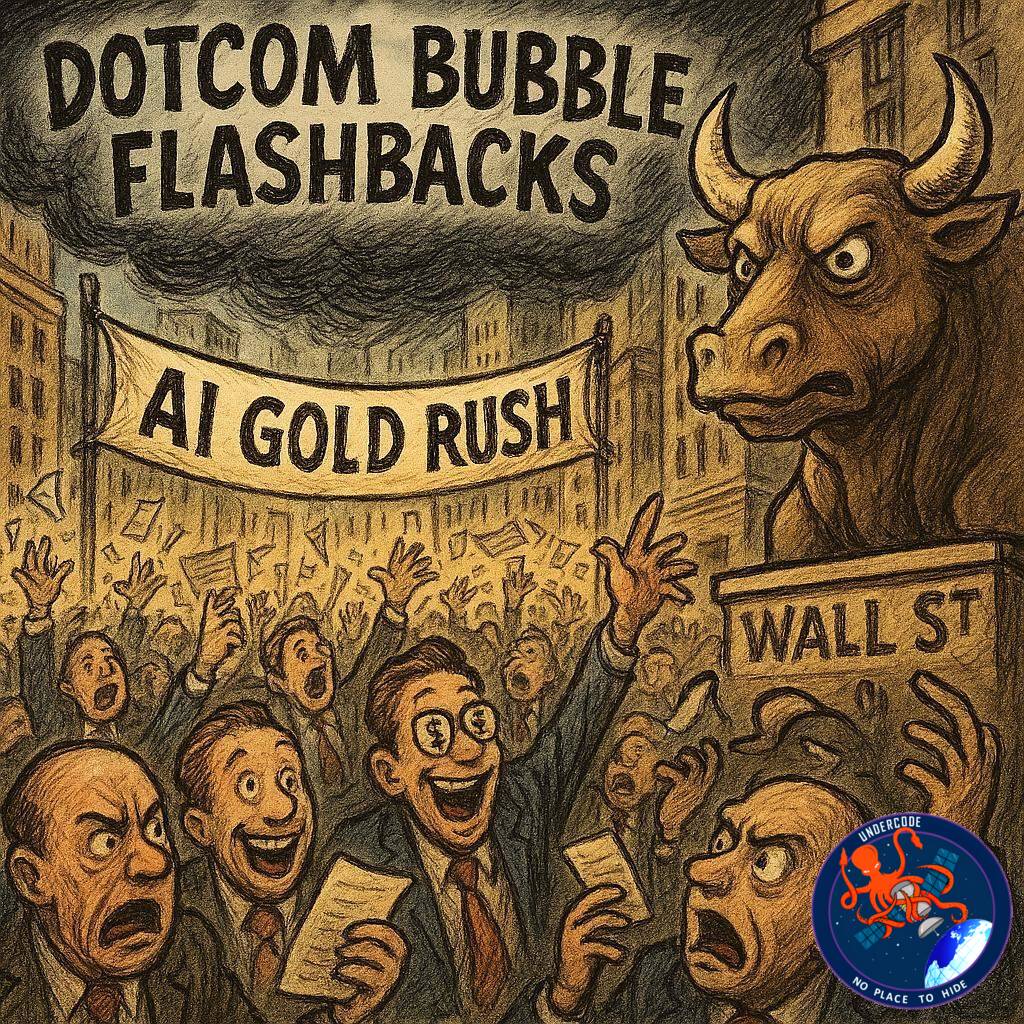 The Return of Market Euphoria in the Age of Artificial Intelligence
For many veteran investors on Wall Street, today’s stock market feels disturbingly familiar. Massive investments in artificial intelligence infrastructure, sky-high tech valuations, and relentless optimism are reviving memories of the late 1990s dot-com frenzy — a period that ended in one of the most painful market crashes in financial history.
Back then, internet companies promised to change the world. Investors poured billions into tech stocks regardless of profits, fundamentals, or sustainability. Today, AI is playing a similar role. Companies tied to artificial intelligence, semiconductors, and data centers are seeing explosive growth, while traders rush into anything connected to the AI revolution.
Some analysts believe this is the beginning of a new technological era. Others warn that the market is showing dangerous signs of irrational behavior. The debate has intensified as global instability, inflation concerns, and slowing economic growth collide with an almost unstoppable rally in technology stocks.
Veteran strategist Steve Sosnick believes there is a clear generational divide in how investors see the market. Older traders who lived through the dot-com collapse are growing increasingly nervous, while younger investors — many of whom only experienced years of market recoveries — continue buying every dip with confidence.
The comparisons to 1999 are becoming harder to ignore. Social media discussions among longtime market analysts are filled with warnings and eerie reminders of the final months before the tech bubble burst. Market technician Helene Meisler recently remarked that younger investors are finally experiencing what the late-1990s mania actually felt like.
The similarities are not just emotional. The numbers are also raising eyebrows.
Despite geopolitical tensions in the Middle East and Eastern Europe, rising oil prices, high inflation, and weakening consumer sentiment, technology stocks continue climbing aggressively. The Nasdaq has surged more than 20% since late March, while the Philadelphia Semiconductor Index jumped roughly 70% in only a few months.
Such explosive gains would normally occur during periods of strong economic confidence. Instead, they are happening while investors remain worried about inflation, interest rates, and slowing growth.
One particularly alarming market signal recently appeared when the S&P 500 reached a record high even as 5% of its listed companies simultaneously hit 52-week lows. Analysts note this rare phenomenon has only happened three previous times in modern history: July 1929 before the Great Depression, January 1973 before a severe bear market, and December 1999 shortly before the dot-com collapse.
Still, supporters of the rally argue that the current AI boom differs fundamentally from the internet bubble. Unlike many unprofitable dot-com startups of the 1990s, today’s leading AI companies generate enormous cash flows and dominate their industries globally. Giants involved in semiconductors and cloud computing are already profitable businesses with real demand driving their growth.
Tech bull Dan Ives insists the AI revolution is still in its earliest stages. According to him, artificial intelligence will transform nearly every industry and create trillions of dollars in future economic value. Investors betting on AI leaders today believe they are positioning themselves ahead of a generational technological shift.
However, critics warn that even transformative technologies can create dangerous financial bubbles when expectations become detached from reality.
The rapid construction of AI data centers, for example, is happening at an unprecedented scale. Companies are spending billions of dollars building infrastructure capable of supporting advanced AI systems. Some analysts fear investors are assuming endless demand growth without considering potential oversupply, competitive pressure, or future economic slowdowns.
Another key difference between today and the late 1990s involves the Federal Reserve. During the Y2K era, the Fed flooded markets with liquidity to prepare for potential computer-related disruptions entering the year 2000. That wave of easy money helped fuel the final stages of the dot-com bubble.
Today’s rally, however, is occurring despite high interest rates. The Federal Reserve has not significantly eased monetary policy, yet investors continue pushing tech stocks toward record highs. Rising bond yields, stubborn inflation, and weak consumer confidence have done little to slow the momentum.
Markets are also reacting emotionally to geopolitical headlines. Since military tensions involving Iran escalated earlier this year, investors have repeatedly rallied on rumors of ceasefires or diplomatic agreements. Yet when those hopes fail to materialize, the market often ignores the negative implications entirely.
This behavior worries experienced traders because it suggests investors are becoming increasingly conditioned to believe stocks will always recover regardless of economic or political reality.
Famous investor Michael Burry, known for predicting the 2008 housing market collapse, recently compared the current environment to the final months of the dot-com bubble. According to Burry, stocks appear to be rising simply because they have already been rising — not because underlying economic conditions justify such optimism.
At the center of this frenzy lies a simple two-letter narrative: AI.
For many investors, artificial intelligence has become the ultimate growth story capable of overriding concerns about inflation, war, interest rates, or slowing economic activity. The fear among skeptics is that markets may once again be pricing perfection into a rapidly evolving technology sector.
History may not repeat exactly, but Wall Street is beginning to wonder whether it is rhyming once again.
What Undercode Says:
AI Mania Is Being Fueled by Fear of Missing Out
The current market environment is not driven solely by technology innovation. It is heavily driven by psychology. Investors are terrified of missing the next trillion-dollar opportunity, and that fear is creating extreme concentration in a handful of AI-related companies.
This resembles the emotional atmosphere seen during previous speculative bubbles. In nearly every financial mania, investors convince themselves that “this time is different.” During the railroad boom, the internet boom, the crypto surge, and now the AI explosion, the same narrative appears repeatedly: revolutionary technology changes everything, therefore traditional valuation metrics no longer matter.
Artificial intelligence absolutely has transformative potential. That part is real. But markets often overestimate short-term impact while underestimating long-term complexity.
The Semiconductor Explosion May Become a Double-Edged Sword
Chipmakers have become the modern equivalent of internet infrastructure companies during the late 1990s. Demand for AI computing power has triggered a massive spending wave across the semiconductor industry.
Right now, investors are rewarding nearly every company associated with AI hardware, cloud infrastructure, or advanced computing. The danger is that supply growth could eventually outpace actual commercial adoption.
If companies overbuild AI infrastructure based on unrealistic expectations, margins could collapse later. This happened during the telecom expansion era when enormous investments in fiber-optic infrastructure eventually created oversupply and financial disaster.
Markets are assuming that AI demand will remain exponential indefinitely. History suggests that no growth cycle remains infinite forever.
Retail Traders Are Treating Volatility as Entertainment
One of the biggest differences today compared to 1999 is the rise of social-media-driven investing culture. Retail traders now operate inside a nonstop digital ecosystem where memes, influencer opinions, and viral narratives can move billions of dollars instantly.
Many younger investors have never experienced a prolonged bear market. Most entered the market during years dominated by central bank support and rapid recoveries. This creates dangerous confidence because many traders assume every decline is temporary.
That assumption works — until it suddenly does not.
When sentiment eventually shifts, modern digital trading platforms could accelerate panic just as quickly as they currently accelerate optimism.
Geopolitical Risks Are Being Ignored by Investors
Markets appear strangely disconnected from geopolitical reality. Ongoing conflicts in the Middle East, tensions involving global shipping routes, and persistent instability in Eastern Europe should normally create caution.
Instead, investors are brushing aside nearly every negative development.
This disconnect often appears near the late stages of speculative rallies. Investors become so focused on future profits that they temporarily ignore systemic risks. The market starts rewarding optimism while punishing caution.
Such behavior creates fragile conditions where even a relatively small economic shock can trigger outsized reactions.
The Federal Reserve Is No Longer the Market’s Safety Net
Another major concern is that this rally is occurring without aggressive monetary support from the Federal Reserve. Interest rates remain elevated, inflation remains problematic, and policymakers are still hesitant to ease aggressively.
In previous years, investors relied on the expectation that the Fed would quickly intervene during market weakness. That assumption may no longer hold true.
If economic conditions deteriorate while inflation stays elevated, central banks could face limited flexibility. This creates a far more dangerous backdrop than the easy-money era that fueled many previous rallies.
AI Will Change the World — But Not Every Company Will Survive
The internet did eventually transform the global economy. However, most dot-com companies disappeared completely after the bubble burst.
The same pattern may emerge with artificial intelligence.
A handful of dominant firms could become enormously successful, while countless smaller companies attached to the AI narrative may fail once speculative enthusiasm fades. Investors currently treat AI exposure itself as enough justification for higher valuations.
That rarely ends well over the long term.
Market Concentration Is Becoming Increasingly Dangerous
A small group of mega-cap technology companies is now carrying much of the broader market’s performance. This concentration creates systemic vulnerability.
If even one or two major AI leaders disappoint investors with slower growth, weaker earnings, or regulatory challenges, the impact could spread rapidly across indexes and investor sentiment.
Healthy bull markets typically involve broad participation across industries. Narrow rallies led by a handful of dominant stocks often indicate speculative excess.
Speculation Is Replacing Fundamental Investing
The most concerning signal is the growing disconnect between stock prices and macroeconomic conditions. Consumer confidence remains weak, borrowing costs remain high, and many economic indicators are slowing.
Yet investors continue behaving as if economic gravity no longer applies.
When markets become dominated by momentum rather than fundamentals, price action itself becomes the primary reason people buy stocks. This creates self-reinforcing bubbles where rising prices attract more buyers until reality eventually intervenes.
That does not mean a crash is guaranteed tomorrow. Bubbles can continue inflating far longer than skeptics expect.
But history repeatedly shows that markets driven primarily by euphoria eventually face painful corrections.
🔍 Fact Checker Results
✅ AI Investments Are Reaching Historic Levels
Major technology companies are spending hundreds of billions of dollars on AI infrastructure, semiconductor expansion, and cloud computing capacity. This trend is publicly documented in corporate earnings reports and capital expenditure forecasts.
✅ Market Concentration in Tech Stocks Is Real
A small number of mega-cap technology firms account for a disproportionately large share of gains in major US stock indexes, raising legitimate concerns among analysts about market imbalance.
❌ Not Every AI Company Will Become Profitable
While AI technology itself has enormous long-term potential, history shows that speculative investment booms often create unsustainable valuations for weaker companies attached to the trend.
📊 Prediction
AI Stocks Could Continue Soaring Before Reality Hits
The AI rally may continue for months or even years as investor enthusiasm, corporate spending, and technological breakthroughs keep fueling momentum. However, the higher valuations climb, the more vulnerable markets become to disappointment.
If economic growth weakens further, geopolitical tensions escalate, or AI revenue growth fails to match expectations, the market could experience a violent correction similar to previous speculative eras.
Artificial intelligence will almost certainly reshape the global economy over the next decade. But the road ahead may include extreme volatility, failed companies, and brutal investor losses before the winners fully emerge.
🕵️📝Let’s dive deep and fact‑check.
References:
Reported By: edition.cnn.com
Extra Source Hub (Possible Sources for article):
https://stackoverflow.com
Wikipedia
OpenAi & Undercode AI
Image Source:
Unsplash
Undercode AI DI v2
Bing
🔐JOIN OUR CYBER WORLD [ CVE News • HackMonitor • UndercodeNews ]
📢 Follow UndercodeNews & Stay Tuned:
𝕏 formerly Twitter 🐦 | @ Threads | 🔗 Linkedin | 🦋BlueSky | 🐘Mastodon


