
Listen to this Post
🎯 Introduction: Rising Tension Between Automation and Public Trust
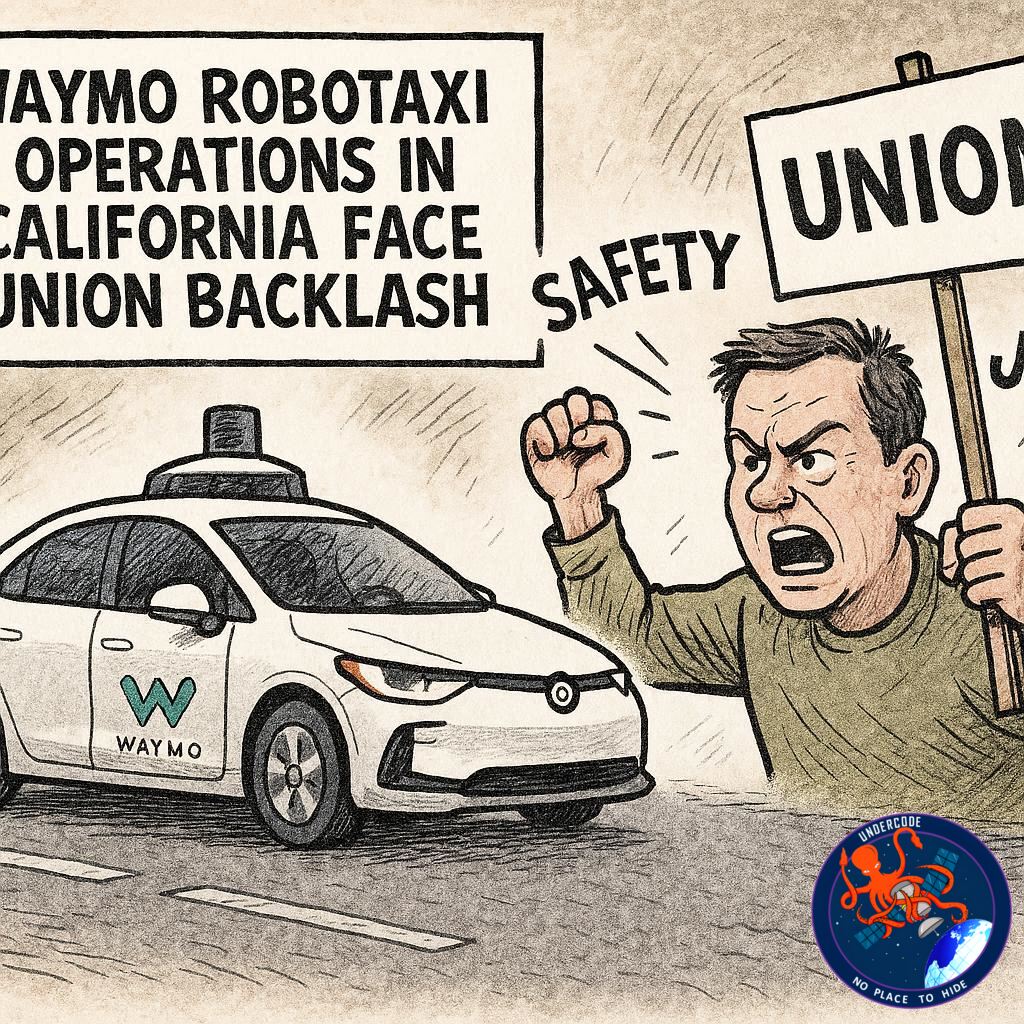
California’s experiment with autonomous vehicles is hitting a critical moment. Waymo, Google’s self-driving car subsidiary, is now under intense scrutiny after a recent collision involving a child near an elementary school in Santa Monica. The incident has reignited long-standing concerns around safety, regulation, and the future of human labor. With powerful labor unions stepping in and federal investigators involved, the debate over robotaxis is no longer theoretical. It is becoming a real-world test of how far automation should be allowed to go before public trust breaks.
Union Demands Trigger Regulatory Pressure
Waymo is facing calls to halt its autonomous taxi operations across California after the Teamsters of California, a labor union representing more than 250,000 workers, formally urged state regulators to revoke the company’s operating license. The appeal was submitted to the California Public Utilities Commission, requesting an indefinite suspension of Waymo’s robotaxi services.
Child Collision Sparks National Investigation
The demand follows a troubling incident in which a Waymo self-driving taxi struck a child near a Santa Monica elementary school. The National Highway Traffic Safety Administration has since launched an official investigation into the crash, adding federal weight to the growing list of concerns surrounding autonomous vehicle safety.
Teamsters Call Incident a Policy Failure
Union leaders described the collision as a disturbing signal that regulators have underestimated the risks of robotaxis. According to the Teamsters, the incident represents a broader pattern of red flags that have been ignored in favor of rapid technological deployment.
Waymo Defends Its Safety Models
Waymo responded by stating that its internal, peer-reviewed safety models suggest a fully attentive human driver in the same scenario would also have made contact with the pedestrian, estimating an impact speed of around 14 mph. The company reiterated its commitment to improving overall road safety.
History of Technical Failures Raises Alarm
This is not the first time Waymo has faced scrutiny. The company has previously been investigated by the NHTSA and issued recalls following other collisions. In December 2025, a power outage caused multiple Waymo vehicles to stall and block streets in San Francisco, highlighting vulnerabilities during emergency scenarios.
Emergency Preparedness Under Question
Union representatives raised concerns about how autonomous vehicles would behave during natural disasters such as earthquakes. Immobilized robotaxis during evacuations or emergency responses could worsen already chaotic situations, according to the union.
Job Security at the Center of the Debate
Beyond safety, the Teamsters argue that autonomous vehicles threaten the livelihoods of Californians who rely on driving jobs. Taxi drivers, delivery workers, and truck operators are seen as particularly vulnerable as companies seek to cut labor costs through automation.
Public Anxiety Over Automation Grows
A statewide poll conducted by Teamsters California revealed that more than 80 percent of respondents worry about AI and automation reducing job availability. The union frames the Waymo incident as part of a larger struggle between Big Tech and working communities.
Automation Expands Beyond Robotaxis
Waymo is not alone in pushing autonomous technology. Kodiak AI is developing self-driving semi-trucks, while Tesla continues to invest in robotaxi platforms and autonomous cargo vehicles. Elon Musk has publicly outlined ambitions for fully self-driving freight transport.
Legislative Push for Human Oversight
In response, Teamsters California is leading a legislative effort to require a human operator in autonomous commercial delivery vehicles at all times. The union argues that trucks and delivery vehicles raise even higher safety and employment risks than passenger robotaxis.
Regulators Accused of Falling Behind
Union leaders claim that agencies like the CPUC and the Department of Motor Vehicles have not kept pace with the rapid deployment of autonomous systems. They argue stronger oversight is needed before these technologies become deeply embedded in everyday infrastructure.
What Undercode Say:
The Waymo controversy highlights a structural problem in how emerging technologies are regulated. Innovation is moving faster than accountability. Autonomous vehicles are being tested in live urban environments, effectively turning cities into experimental zones where the public absorbs the risk.
From a technical standpoint, comparing autonomous systems to hypothetical “fully attentive human drivers” misses the point. The real comparison should be between real-world human behavior and real-world machine behavior over millions of unpredictable edge cases. One child struck is not a statistical anomaly. It is a system-level failure that exposes limits in perception, decision-making, or contextual awareness.
There is also a growing credibility gap between tech companies and the public. Each new incident, power failure, or recall chips away at the promise that autonomy is inherently safer. Safety claims backed by internal models mean little when lived experience tells a different story.
On the labor side, the union’s concerns are not anti-technology, they are anti-displacement without safeguards. History shows that automation rarely eliminates work entirely, but it often redistributes risk and wealth upward. Without regulatory intervention, driving jobs could disappear faster than replacement roles are created.
The emergency response argument is particularly compelling. Autonomous systems thrive in controlled environments. Disasters are the opposite. If robotaxis freeze during blackouts or earthquakes, they become obstacles rather than solutions. Resilience, not just efficiency, should be a regulatory requirement.
Finally, the broader issue is governance. California has positioned itself as a testing ground for AI-driven mobility, but testing without clear red lines invites backlash. Trust is earned through restraint, transparency, and consequences. Until regulators prove they can enforce all three, resistance to robotaxis will only intensify.
🔍 Fact Checker Results
✅ The NHTSA has opened an investigation into the Waymo child collision.
✅ Teamsters California formally requested suspension of Waymo operations.
❌ No final regulatory decision has yet been issued by the CPUC.
📊 Prediction
🚦 California regulators are likely to impose stricter operational limits rather than a full suspension.
🤖 Autonomous vehicle rollouts will slow as safety audits and public pressure increase.
⚖️ Labor protections tied to AI deployment will become a central issue in future legislation.
▶️ Related Video (84% Match):
🕵️📝✔️Let’s dive deep and fact‑check.
References:
Reported By: timesofindia.indiatimes.com
Extra Source Hub (Possible Sources for article):
https://www.stackexchange.com
Wikipedia
OpenAi & Undercode AI
Image Source:
Unsplash
Undercode AI DI v2
Bing
🔐JOIN OUR CYBER WORLD [ CVE News • HackMonitor • UndercodeNews ]
📢 Follow UndercodeNews & Stay Tuned:
𝕏 formerly Twitter 🐦 | @ Threads | 🔗 Linkedin | 🦋BlueSky | 🐘Mastodon


