
Listen to this Post
 Introduction: The Hidden Crisis Behind the AI Boom
The story of artificial intelligence is often told through chips, models, and breakthroughs in computing power. Yet beneath that narrative lies a quieter force shaping everything: electricity. As AI expands into factories of intelligence, robotics, autonomous systems, and edge devices, the demand for energy is accelerating faster than most national grids can evolve. In this widening gap between computation and capacity, a new frontier is emerging from an unexpected place, the ocean. What was once seen as a distant renewable dream is now being reshaped by companies like Eco Wave Power, using AI systems and digital twin technology powered by NVIDIA infrastructure to turn waves into a scalable energy source for the AI era.
The Core Idea: Energy, Not Compute, Will Decide AI’s Future
The original article argues a shift that is already becoming visible across industries. AI growth is no longer limited by processing power alone. Instead, the true bottleneck is energy availability. Data centers powering AI workloads require massive and constant electricity, and many regions struggle to expand grids quickly enough to match demand.
This creates a structural tension. AI systems scale in months, sometimes weeks, while energy infrastructure scales in years or decades. Permits, transmission lines, environmental approvals, and capital investment all slow the process. The result is a widening gap between digital ambition and physical reality.
Ocean Energy Reimagined Through Eco Wave Power’s Approach
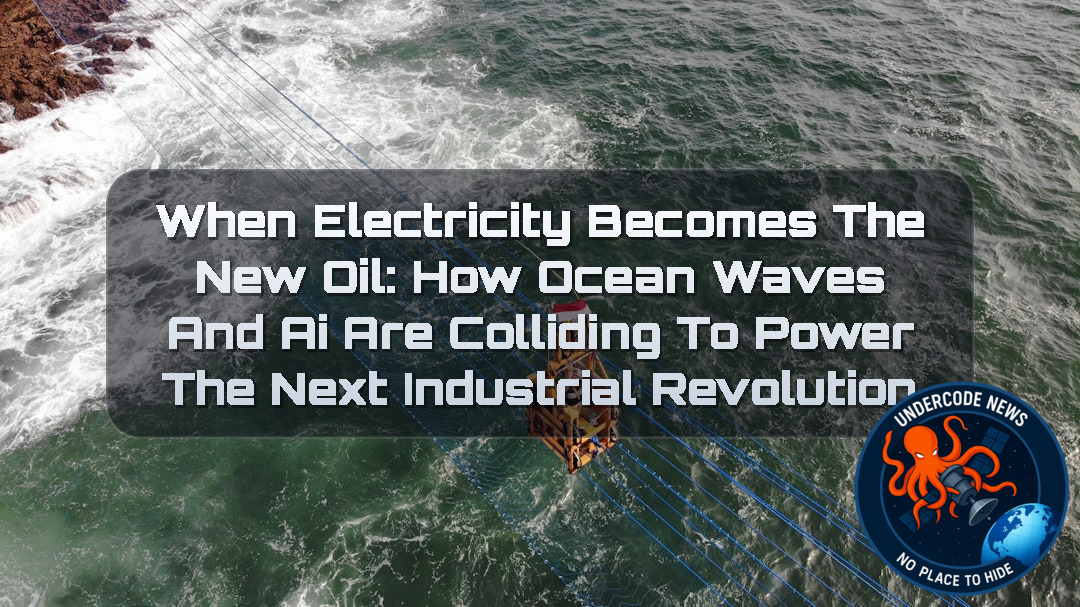
At the center of this story is Eco Wave Power, a company developing wave energy systems designed for practical deployment rather than experimental promise. Instead of building massive offshore machines, their approach uses existing coastal infrastructure like breakwaters and ports.
This method is deceptively simple. Floating devices capture the motion of waves, converting kinetic energy into hydraulic pressure. The heavy and sensitive equipment stays on land, reducing exposure to storms and lowering maintenance risk. This design choice solves one of wave energy’s historic failures: durability in harsh ocean conditions.
CEO Inna Braverman describes wave energy as abundant but underutilized, arguing that the challenge has never been potential, but practicality.
Why Waves Matter More Than Solar and Wind in Certain Contexts
Solar and wind dominate renewable energy conversations, but wave energy introduces a different advantage: consistency. Unlike solar, it does not depend on daylight. Unlike wind, it is less seasonal and less geographically unpredictable.
The density of water makes this even more compelling. Ocean waves carry significantly more energy than air movement, meaning smaller physical devices can generate meaningful power output.
This positions wave energy as a strong candidate for coastal industrial zones, especially ports where heavy infrastructure already exists and energy demand is rising rapidly.
AI Meets Energy: The Role of NVIDIA Omniverse and Digital Twins
A major evolution in this ecosystem is the integration of AI simulation and predictive modeling. Using NVIDIA Omniverse libraries, engineers can create digital twins of wave environments and energy systems before physical deployment.
These simulations model everything from wave intensity to structural stress and energy output. The goal is not just visualization but optimization, reducing failure risk and improving efficiency before hardware is installed.
On the operational side, NVIDIA’s accelerated computing systems enable real-time monitoring of energy production, predictive maintenance, and anomaly detection. AI models continuously evaluate ocean conditions and adjust system behavior accordingly.
This transforms wave energy from a mechanical system into an adaptive, data-driven infrastructure layer.
From Energy Production to Energy-Aware Computing Systems
A more advanced concept emerging from this integration is energy-aware computing. Instead of treating electricity as static supply, AI systems can dynamically adjust workloads based on energy availability.
For example, if wave activity increases, more computationally intensive tasks can be scheduled. When energy dips, systems scale down or shift workloads elsewhere.
This creates a feedback loop between natural energy cycles and digital computation, something previously impossible in traditional grid systems.
Real-World Deployment: Ports Becoming Energy Hubs
Eco Wave Power has already deployed projects in locations such as Jaffa Port in Israel and the Port of Los Angeles in collaboration with EDF Power Solutions and Shell.
Additional developments are underway in Portugal, Taiwan, and India, signaling a global push toward coastal energy systems.
Ports are becoming strategic hubs not only for logistics but for power generation. Their proximity to cooling water, infrastructure, and now renewable wave systems makes them ideal candidates for future AI data centers.
The Vision of Ocean-Powered Data Centers
One of the most striking ideas in the article is the possibility of fully wave-powered data centers. In pilot projects at the Port of Los Angeles, systems are being tested to run computing workloads entirely on wave-generated electricity.
AI software plays a central role here, predicting energy availability based on weather and wave forecasts. Compute tasks are then aligned with expected energy peaks, creating a synchronized system between nature and computation.
This is not a theoretical model. It is already being tested in controlled environments.
What Undercode Say:
The energy bottleneck is becoming more limiting than silicon innovation
AI scaling is now directly tied to national infrastructure maturity
Wave energy offers a geographically distributed alternative to centralized grids
Ports may become dual-purpose hubs for logistics and computation
Digital twins reduce engineering risk in renewable energy deployment
NVIDIA’s ecosystem is shifting from compute acceleration to infrastructure intelligence
AI is evolving from tool to grid coordinator
Energy forecasting becomes as important as weather forecasting
Decentralized energy systems reduce dependence on national grids
Ocean energy could stabilize coastal industrial clusters
Infrastructure latency is becoming a strategic geopolitical issue
Countries with long coastlines gain energy advantage
Data centers are becoming climate-adaptive systems
Predictive maintenance reduces offshore infrastructure costs
Energy variability becomes a scheduling variable in computing
AI workloads may become time-sensitive based on renewable cycles
Industrial AI merges with environmental modeling
Real-time ocean simulation becomes economically valuable
Hardware placement is shifting toward environmental proximity
Energy abundance may redefine AI pricing models
Wave energy remains underfunded compared to solar and wind
Hydraulic systems offer safer offshore design patterns
Land-based hardware reduces maintenance complexity
Energy infrastructure is now part of AI architecture design
Compute scheduling becomes an optimization problem across time
AI factories behave like biological systems adapting to resources
Energy scarcity drives innovation faster than policy
Renewable unpredictability becomes a computational input
Infrastructure planning cycles must compress dramatically
Edge AI and coastal AI infrastructure converge
The ocean becomes a distributed energy grid
Energy resilience becomes national security priority
AI companies may become energy companies indirectly
Cooling requirements push data centers toward coasts
Hybrid systems outperform single-source energy models
Simulation-first engineering becomes standard practice
Digital twins become mandatory in energy planning
Future AI expansion depends on energy diversification
Wave energy may remain niche but strategically critical
❌ Wave energy has not yet reached large-scale global dominance in electricity production, despite high theoretical potential
✅ Ocean wave density does provide significantly higher energy potential than wind due to physical properties of water
✅ NVIDIA Omniverse is actively used for industrial simulation and digital twin applications in engineering contexts
Prediction Related to
(+1) Coastal data centers powered by hybrid renewable systems will expand significantly over the next decade, especially in energy-constrained regions
(+1) AI-driven energy scheduling will become a standard feature in hyperscale computing infrastructure
(+1) Digital twin modeling will reduce renewable energy deployment costs and increase adoption speed
(-1) Wave energy will struggle to compete with solar and wind in cost-per-watt efficiency at global scale
(-1) Regulatory and environmental constraints will slow offshore energy infrastructure expansion in many regions
(-1) Dependence on weather-driven energy systems will create volatility in compute availability in early-stage deployments
Deep Analysis
Energy and AI infrastructure analysis layer
Check global energy demand trends
curl https://api.iea.org/stats/energy-demand
Simulate AI workload vs energy availability model
python3 -c "
import numpy as np
ai_load = np.random.rand(24) 100
wave_energy = np.sin(np.linspace(0,3.14,24)) 100 + 100
balance = wave_energy - ai_load
print(balance)
"
Inspect system power usage on Linux nodes
htop
Monitor real-time power distribution
cat /sys/class/powercap/intel-rapl:0/energy_uj
Network latency impact on distributed AI clusters
ping -c 10 datacenter.local
Simulate scheduling optimization
python3 -c "
import random
tasks = [random.randint(1,10) for _ in range(24)]
energy = [random.randint(5,15) for _ in range(24)]
schedule = [t if e>t else 0 for t,e in zip(tasks,energy)]
print(schedule)
"
▶️ Related Video (70% Match):
🕵️📝Let’s dive deep and fact‑check.
🎓 Live Courses & Certifications:
Join Undercode Academy for Verified Certifications
🚀 Request a Custom Project:
Secure, high-velocity infrastructure and disruptive technological engineering. Contact our engineering team for high-tier development and proprietary systems:
[email protected]
💎 Smart Architecture | 🛡️ Secure by Design | ⭐ Trusted by Thousands
References:
Reported By: blogs.nvidia.com
Extra Source Hub (Possible Sources for article):
https://www.twitter.com
Wikipedia
OpenAi & Undercode AI
Image Source:
Unsplash
Undercode AI DI v2
🔐JOIN OUR CYBER WORLD [ CVE News • HackMonitor • UndercodeNews ]
📢 Follow UndercodeNews & Stay Tuned:
𝕏 formerly Twitter 🐦 | @ Threads | 🔗 Linkedin | 🦋BlueSky | 🐘Mastodon | 📺Youtube


