
Listen to this Post
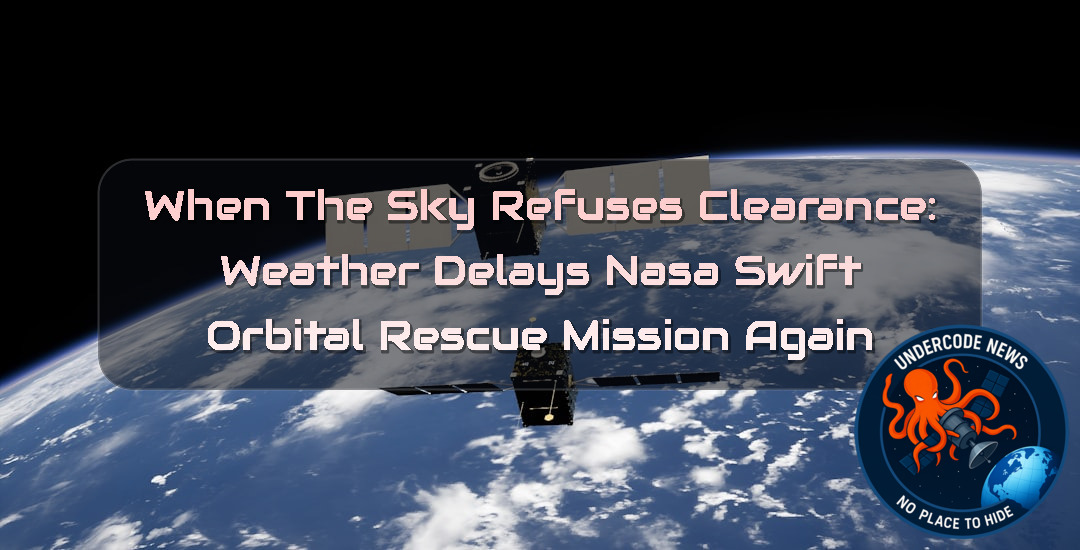
INTRODUCTION: A MISSION CAUGHT BETWEEN ENGINEERING AND THE ELEMENTS
Space missions often fail not because of technology, but because of something far more unpredictable: weather. In a striking reminder of how Earth still dictates the rules of spaceflight, the planned launch of Katalyst Space’s robotic servicing spacecraft LINK has once again been postponed. The mission, designed to extend and boost NASA’s Neil Gehrels Swift Observatory, now waits for a clearer sky. What was meant to be a precise orbital choreography has turned into a patient standoff with nature itself.
ORIGINAL EVENT SUMMARY: WHAT HAPPENED
The launch scheduled for Wednesday was called off due to unfavorable weather conditions at the launch site in the Marshall Islands. The mission team confirmed that the next attempt is now set for no earlier than Thursday, July 2 at 9:09 p.m. UTC+12 (5:09 a.m. EDT). The spacecraft LINK, built by Katalyst Space, will ride Northrop Grumman’s Pegasus XL rocket launched from Kwajalein Atoll. Its goal is ambitious yet delicate: to boost and extend the operational life of NASA’s Swift Observatory, a critical space telescope monitoring high-energy cosmic events.
WHY WEATHER STILL CONTROLS SPACEFLIGHT
Despite decades of aerospace advancement, launch windows remain tightly bound to atmospheric conditions. Winds at altitude, storm activity, and even upper-level turbulence can turn a nominal launch into a dangerous gamble. For air-launched rockets like Pegasus XL, weather plays an even more complex role because both the carrier aircraft and rocket ignition sequence depend on stable flight conditions.
THE LINK MISSION: SMALL CRAFT, BIG RESPONSIBILITY
LINK is not just another satellite; it is a robotic caretaker in orbit. Its task is to rendezvous with the aging Swift Observatory and provide orbital boost capability, effectively extending its scientific life. The Swift Observatory has been instrumental in detecting gamma-ray bursts and other cosmic phenomena that reveal the violent universe. Without servicing missions like LINK, many such observatories face premature decommissioning.
PEGASUS XL AND THE KWajalein LAUNCH COMPLEX
The Pegasus XL rocket is unique in modern launch systems because it is air-launched rather than ground-launched. Dropped from a carrier aircraft at high altitude, it ignites mid-air, giving it flexibility in reach and trajectory. Kwajalein Atoll provides an ideal remote oceanic launch corridor, minimizing risk and maximizing orbital efficiency. However, this isolation also means fewer weather alternates and tighter scheduling constraints.
WHY THIS DELAY MATTERS MORE THAN IT SEEMS
A delay of a single day may sound minor, but in orbital mechanics, timing is everything. Launch windows are calculated based on alignment, Earth rotation, and target orbital planes. Missing a window can cascade into days or even weeks of rescheduling. For missions extending aging spacecraft, time lost can also mean reduced operational overlap between servicing craft and target.
WHAT UNDERCODE SAY:
Space missions are increasingly dependent on Earth-bound uncertainties
Weather remains the most unpredictable launch variable despite technological progress
Robotic servicing is becoming essential for extending orbital infrastructure life
LINK represents a shift from disposable satellites to maintainable space assets
NASA’s Swift Observatory still holds high scientific value after years in orbit
Gamma-ray burst detection remains one of astrophysics’ most important fields
Pegasus XL shows the continued relevance of air-launch systems
Kwajalein Atoll remains strategically vital for equatorial launch efficiency
Orbital servicing reduces long-term mission costs significantly
Delays highlight the fragility of tightly timed orbital windows
Weather forecasting is still not precise enough for absolute launch certainty
Each delay increases operational coordination complexity
Space logistics now resemble airline scheduling under extreme conditions
Mission planning must account for both space and atmospheric unpredictability
Robotics is replacing human EVAs for many servicing tasks
Satellite lifespan extension is now a core aerospace strategy
Scientific observatories depend on maintenance as much as launch
International collaboration remains central to mission success
Remote launch sites introduce both advantages and risks
Air-launched rockets reduce ground infrastructure dependence
Climate variability is increasingly affecting launch reliability
Real-time decision-making is critical in launch operations
Space agencies must integrate meteorology and orbital physics deeply
Delays can impact downstream scientific observation schedules
Mission risk management now includes environmental volatility
Space infrastructure is evolving toward sustainability models
LINK is part of a growing orbital maintenance ecosystem
Swift Observatory continues to provide high-value astrophysical data
Small spacecraft are becoming increasingly powerful and specialized
Launch timing precision is measured in seconds, not minutes
Weather windows are narrowing operational flexibility
Space industry is shifting toward service-based orbital models
Robotics reduces human risk in space maintenance
Orbital boosting is cheaper than full satellite replacement
The future of astronomy depends on sustained orbital health
Weather remains the final “gatekeeper” of space access
Even advanced rockets cannot override atmospheric instability
Mission delays are now expected, not exceptional
Precision engineering meets unpredictable nature at launch pads
The future of space depends on mastering both technology and timing
✅ The LINK mission is designed for orbital servicing and boosting of NASA’s Swift Observatory
✅ Pegasus XL is an operational air-launched rocket used for specialized missions
❌ Exact timing of launches is always subject to weather and range conditions, making fixed scheduling provisional
Weather-related delays are a standard and recurring issue in aerospace operations, especially for air-launch systems
Kwajalein Atoll is a known and active launch location used for equatorial trajectories
PREDICTION RELATED TO ARTICLE:
(+1) The launch will proceed within the next confirmed window if weather stabilizes, likely within 24–72 hours 🌤️🚀
(+1) Interest in orbital servicing missions like LINK will increase as satellite lifespans become a major economic factor
(-1) Further delays remain possible due to persistent atmospheric instability in equatorial regions
DEEP ANALYSIS: SYSTEMS AND OPERATIONAL COMMAND INSIGHT
Check launch weather constraints (conceptual simulation)
curl -X GET "https://api.launchweather.nasa.gov/kwajalein"
Analyze orbital window alignment for Swift Observatory boost
python3 orbital_window_calc.py --target "Swift Observatory" --method boost
Simulate Pegasus XL flight profile under wind shear conditions
bash simulate_flight.sh --rocket "Pegasus XL" --wind-model high_altitude
Monitor real-time launch updates feed
watch -n 30 "curl https://status.katalystspace.com/launch-feed"
Compute delay impact on orbital rendezvous timing
python3 rendezvous_delay_model.py --delay 24h --target "LEO Swift"
Evaluate risk thresholds for air-launch abort decision
./risk_assessment --vehicle PegasusXL --weather unstable
Cross-check ISS-style orbital alignment (analytical model)
orbital_tool –sync –object Swift –mode maintenance
Generate launch probability forecast curve
python3 launch_probability.py --site Kwajalein --days 7
Analyze atmospheric turbulence layers
meteorology_scan –region equatorial –altitude 0-120km
Review historical Pegasus XL delay statistics
data_query –rocket PegasusXL –metric delay_frequency
▶️ Related Video (82% Match):
🕵️📝Let’s dive deep and fact‑check.
🎓 Live Courses & Certifications:
Join Undercode Academy for Verified Certifications
🚀 Request a Custom Project:
Secure, high-velocity infrastructure and disruptive technological engineering. Contact our engineering team for high-tier development and proprietary systems:
[email protected]
💎 Smart Architecture | 🛡️ Secure by Design | ⭐ Trusted by Thousands
References:
Reported By: science.nasa.gov
Extra Source Hub (Possible Sources for article):
https://www.instagram.com
Wikipedia
OpenAi & Undercode AI
Image Source:
Unsplash
Undercode AI DI v2
🔐JOIN OUR CYBER WORLD [ CVE News • HackMonitor • UndercodeNews ]
📢 Follow UndercodeNews & Stay Tuned:
𝕏 formerly Twitter 🐦 | @ Threads | 🔗 Linkedin | 🦋BlueSky | 🐘Mastodon | 📺Youtube


