
Listen to this Post
Introduction: The AI Promise vs. Reality
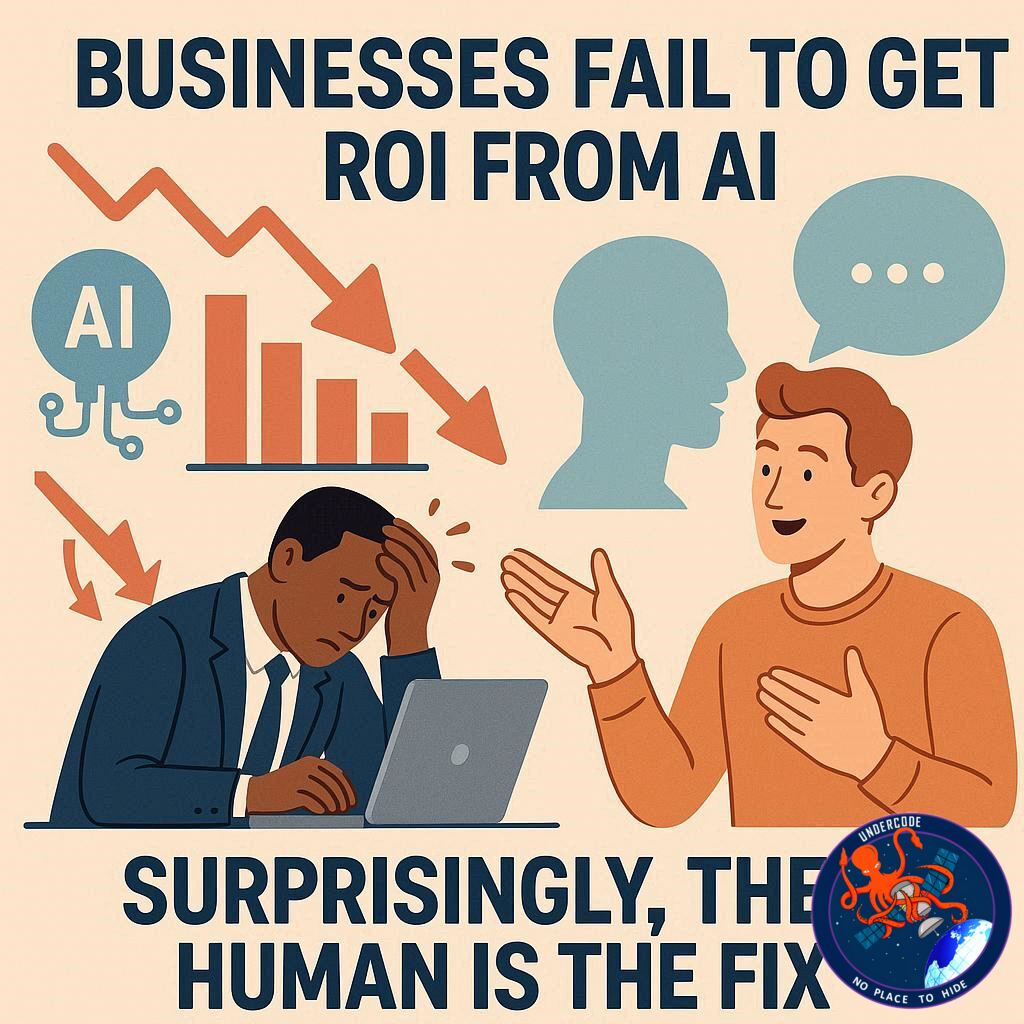
Artificial Intelligence was sold as the magic key to efficiency, automation, and smarter decision-making. Yet, despite the billions being invested, most businesses are finding that their AI strategies aren’t delivering the promised return on investment (ROI). Studies suggest that companies are adopting AI rapidly but with limited trust, weak governance, and poor infrastructure to support it. The irony is that the solution to this costly problem is less about technology itself and more about the human factor — building trust, skills, and a cultural framework that allows AI to thrive.
The Struggle for ROI in AI Projects
A new study by SAS and IDC highlights a painful truth: nearly 95% of enterprise AI projects yield little to no ROI. Businesses eagerly deploy AI tools but simultaneously distrust them. That paradox is stalling real results.
The SAS-IDC survey reveals that although 65% of businesses already use AI and another 32% plan to adopt it soon, most don’t have proper governance structures in place. Shockingly, while 78% of respondents claim to “completely trust AI,” only 40% have implemented actual guardrails to ensure their systems are reliable and explainable.
This disconnect explains why companies continue spending without reaping benefits. Instead of measured adoption with transparency, organizations are jumping in blindly. As Chris Marshall of IDC explains, “This misalignment leaves much of AI’s potential untapped.”
The Roadblocks Preventing ROI
The research identifies three critical barriers that explain the widespread failures in AI ROI:
- Weak Infrastructure – Businesses often lack strong cloud frameworks to support AI at scale.
- Poor Governance – Without explainability and accountability, trust in AI outcomes collapses.
- Skill Gaps – Many organizations don’t have workers trained to manage, interpret, or optimize AI tools.
Of these three, skills are the hardest to solve, but the most crucial. Technology can be purchased and governance frameworks outsourced, but human expertise takes time to build. This explains why training programs are now a higher priority than layoffs, and why professionals who add even one AI-related skill can significantly boost their career prospects.
Human Bias in Trusting AI
The study also highlights a strange psychological twist: people tend to trust generative AI tools like ChatGPT or Gemini more than traditional machine learning systems. Ironically, the latter are older, simpler, and more transparent, while the former are black-box systems prone to errors and hallucinations.
Why does this happen? Humans instinctively trust systems that feel more “human-like.” Generative AI communicates fluently, gives the illusion of understanding, and sometimes even evokes emotional connections. This perceived familiarity makes users treat AI as more reliable than it actually is.
But this misplaced trust can be dangerous. A chatbot that feels like a human conversation partner might inspire confidence, yet its predictions may lack the rigor of less glamorous but more explainable machine learning models. This trust gap could amplify mistakes, creating costly outcomes for businesses.
What Undercode Say:
The findings of this study strike at the heart of a paradox in modern technology adoption: businesses are racing to integrate AI, but without the human structures to make sense of it. Here’s how I interpret the situation:
ROI isn’t about technology alone — Companies wrongly assume that buying cutting-edge tools guarantees returns. The reality is that without governance, data discipline, and skilled operators, AI is just an expensive experiment.
The illusion of intelligence is blinding leaders — Because generative AI “sounds smart,” leaders assume it is smart. This leads to misplaced confidence, especially in areas where accuracy matters most, like finance, healthcare, or legal applications.
Governance is underrated but vital — Transparency and explainability aren’t optional; they’re the backbone of trust. If organizations don’t know how AI reaches its conclusions, they won’t fully commit to its insights.
The skill shortage is the silent killer — AI won’t replace jobs wholesale, but it will replace people who fail to adapt. Businesses that neglect workforce training will struggle to find value, while those who invest in reskilling will unlock competitive advantages.
Infrastructure determines scalability — AI pilots may show promise, but without strong cloud systems, deployment at enterprise scale is nearly impossible. Many companies underestimate this barrier and fail to prepare for growth.
Trust is psychological, not logical — Humans favor AI that “feels human,” even when it’s less accurate. This behavioral quirk must be acknowledged and mitigated with stronger oversight and cross-validation processes.
Cultural adoption is just as important as technical adoption — Employees need to feel comfortable using AI tools, not threatened by them. Fear of job loss reduces engagement, which in turn weakens ROI.
The future belongs to hybrid models — Businesses that combine human intuition with AI-driven insights will outperform those that lean too heavily on either side. The “AI plus human” approach creates balance and better decision-making.
The competitive advantage lies in trust — In the next few years, the companies that succeed won’t be the ones that use the flashiest AI, but the ones that manage to build trust in their systems — both internally and externally.
Ultimately, AI ROI isn’t about the code running in the background. It’s about the humans running the show. Organizations must realign their strategies to focus less on speed of adoption and more on the quality of integration.
Fact Checker Results
✅ The SAS-IDC study confirms that governance, skills, and infrastructure are the top barriers to AI ROI.
❌ Businesses show higher trust in AI than their actual governance practices justify.
✅ Evidence shows generative AI is trusted more than traditional models, despite being less reliable.
Prediction
Looking ahead, businesses that fail to address skill gaps and governance will continue to waste millions on AI projects with no ROI. Those that invest in human-centered adoption — training employees, building transparent systems, and aligning culture with technology — will dominate their industries. Within five years, AI will shift from being a “shiny experiment” to a trusted partner in decision-making, but only for the organizations that take trust as seriously as technology.
🕵️📝✔️Let’s dive deep and fact‑check.
References:
Reported By: www.zdnet.com
Extra Source Hub:
https://www.facebook.com
Wikipedia
OpenAi & Undercode AI
Image Source:
Unsplash
Undercode AI DI v2
🔐JOIN OUR CYBER WORLD [ CVE News • HackMonitor • UndercodeNews ]
📢 Follow UndercodeNews & Stay Tuned:
𝕏 formerly Twitter 🐦 | @ Threads | 🔗 Linkedin | 🦋BlueSky | 🐘Mastodon


