
Listen to this Post
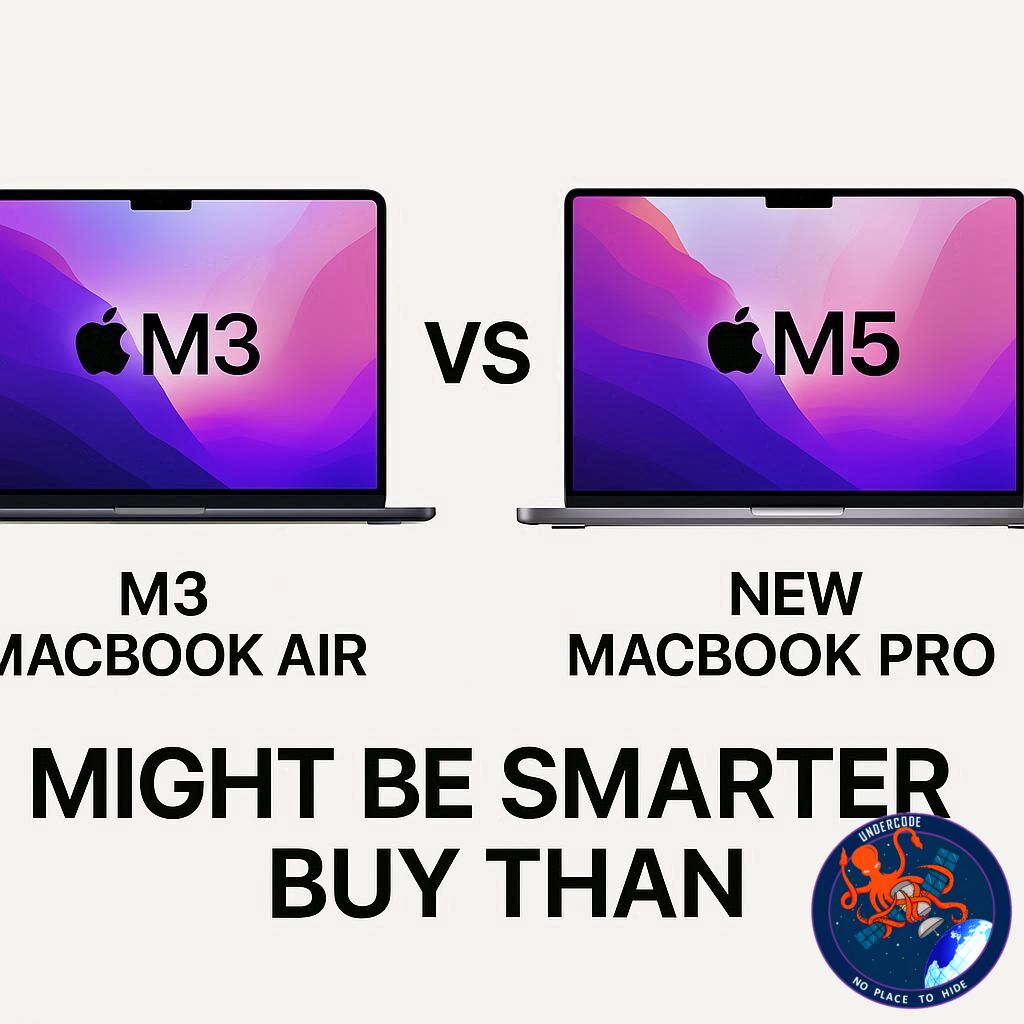 Apple has unveiled its newest flagship, the M5 MacBook Pro, promising unprecedented performance with its latest Apple silicon chip. The announcement has tech enthusiasts buzzing, but the real question remains: should you rush to buy the latest MacBook Pro, or could a previous-generation model serve you just as well at a fraction of the cost? While the M5 MacBook Pro is undoubtedly a powerhouse, for most users, older models like the M3 MacBook Air may offer better value without compromising on everyday performance.
The Allure of the M5 MacBook Pro
The M5 MacBook Pro is undeniably impressive. Apple claims the new M5 chip delivers 1.6 times the graphics performance of its predecessor, making it a tempting option for Mac gamers and creative professionals. The laptop also boasts extraordinary battery life, with Apple advertising up to 24 hours of use. Even compared to the M4 MacBook Pro, which already delivered over 18 hours in real-world tests, this is a remarkable improvement. In short, the M5 MacBook Pro is a top-tier machine, brimming with features and raw computing power.
Why You Might Want to Pause
Despite the hype, the M5 MacBook Pro may not be the most practical choice for everyone. Early reviews and hands-on experiences are still limited, and we don’t yet know the full performance story. For most users, the question is not “Can it run?” but “Do I actually need this much power?” For the majority of everyday tasks—web browsing, video streaming, office work, and even light photo or video editing—the previous generation M3 MacBook Air delivers more than enough performance.
The Case for the M3 MacBook Air
The M3 MacBook Air, released just 18 months ago, remains a high-performing, reliable laptop. Its lightweight design, long-lasting battery, and robust performance earned it full marks in expert reviews. While it doesn’t have the cutting-edge M5 chip, the M3’s capabilities are more than sufficient for most users. Apple’s entry-level silicon chips already outperform many competitors, making older MacBooks extremely capable and often the smarter financial choice.
Price Matters
A major factor tipping the scales in favor of older models is price. While the M5 MacBook Pro starts at $1,599, refurbished M3 MacBook Air units are available for as low as $649. Even upgraded versions with 16GB memory and 512GB storage come in around $859, still nearly half the price of the new Pro. For users who don’t need top-tier performance, this is an unbeatable bargain.
Performance vs. Practicality
Certain tasks like 3D rendering, AI video enhancements, and heavy creative workloads may benefit from the M5 chip, but these are niche requirements. Both the M3 Air and the M5 Pro use entry-level chips, meaning real-world performance differences for everyday use are minimal. If you’re not pushing the limits of creative software or gaming at maximum settings, the older MacBook will suffice—and save you a significant sum.
Future-Proofing vs. Immediate Needs
Many buyers fall into the trap of overestimating their future needs, opting for higher-end models “just in case.” For most people, this is unnecessary. Apple’s silicon chips are so advanced that even models from a few years ago remain fast, reliable, and capable of handling new software updates for years to come. Unless your work involves specialized, high-intensity tasks, buying for your current needs is both practical and financially savvy.
What Undercode Say:
The launch of the M5 MacBook Pro is impressive, but the broader context reveals a more nuanced picture. Apple continues to lead in chip efficiency and battery longevity, but this does not automatically make every new release the best choice for every user. The M3 MacBook Air is a perfect example of how incremental hardware improvements may not always justify a premium price tag.
Analyzing this from a user perspective, the majority of laptop buyers engage in activities that don’t require cutting-edge chips. Web browsing, productivity software, video conferencing, and streaming are all well within the capabilities of the M3 MacBook Air. Even basic creative work, such as photo editing or light video processing, can be handled efficiently by previous-generation models. Investing in the M5 MacBook Pro may make sense for professionals with heavy computational needs, but for most users, the return on investment is limited.
From an economic standpoint, the M3 MacBook Air’s value proposition is stronger. The ability to obtain a refurbished, upgraded unit for roughly half the price of the M5 Pro while retaining sufficient performance illustrates the practicality of buying previous-generation devices. This aligns with broader consumer tech trends: the latest hardware is rarely a necessity for the average user, especially when previous iterations are still highly capable.
Moreover, Apple’s roadmap suggests that higher-tier M5 chips (Pro and Max) are expected to arrive next year. This indicates that the current M5 MacBook Pro may represent only a modest step forward rather than a revolutionary leap. Strategic patience can allow users to skip intermediate releases and target models that genuinely match their performance requirements.
Additionally, the environmental impact and sustainability factor of purchasing older, refurbished laptops should not be overlooked. Opting for a previous-generation MacBook reduces electronic waste and maximizes the lifespan of existing technology. This approach aligns both with financial prudence and responsible consumption.
Even for tech enthusiasts who crave the latest hardware, the real takeaway is about alignment of needs with resources. The M5 MacBook Pro shines for power users and niche professional applications, but for the vast majority of buyers, the M3 MacBook Air delivers nearly identical satisfaction at a fraction of the cost. It’s a balance of performance, price, and practicality.
In conclusion, while the M5 MacBook Pro is a technological marvel with impressive specifications, the smarter choice for most consumers is the M3 MacBook Air. It offers excellent performance, long battery life, portability, and a price point that makes upgrading feasible without financial strain. Waiting for higher-tier M5 chips or choosing refurbished units can provide a superior cost-to-benefit ratio for the average user.
Fact Checker Results:
✅ Apple claims the M5 chip offers 1.6x graphics performance over M4 – consistent with announcements.
✅ The M3 MacBook Air has sufficient power for most users, as verified in multiple expert reviews.
❌ Buying the M5 MacBook Pro is not necessary for everyday tasks; previous models suffice.
Prediction:
📊 The next 12 months will likely see the release of M5 Pro and M5 Max MacBook Pros, driving high-end creative and gaming adoption. Meanwhile, prices for M3 MacBook Air units may drop further, making them the best value for everyday users. Consumers prioritizing cost-effectiveness and sustainability will increasingly favor refurbished or previous-generation Apple laptops.
🕵️📝✔️Let’s dive deep and fact‑check.
References:
Reported By: www.techradar.com
Extra Source Hub (Possible Sources for article):
https://www.reddit.com
Wikipedia
OpenAi & Undercode AI
Image Source:
Unsplash
Undercode AI DI v2
Bing
🔐JOIN OUR CYBER WORLD [ CVE News • HackMonitor • UndercodeNews ]
📢 Follow UndercodeNews & Stay Tuned:
𝕏 formerly Twitter 🐦 | @ Threads | 🔗 Linkedin | 🦋BlueSky | 🐘Mastodon


