
Listen to this Post
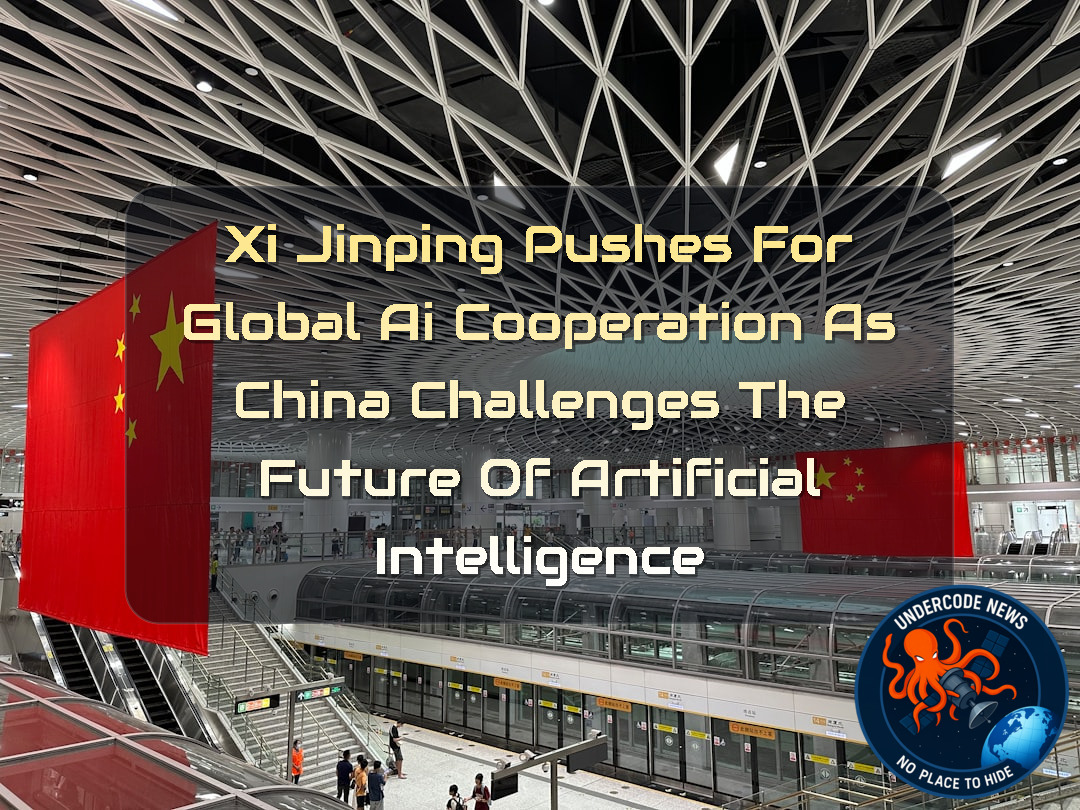 Introduction, AI Is No Longer Just a Technology Race
Artificial Intelligence has evolved from an emerging technology into one of the world’s most influential strategic assets. Governments are no longer discussing AI solely as a tool for innovation, but as a foundation for economic growth, national security, scientific leadership, and geopolitical influence. While competition between global powers continues to intensify, another debate has emerged: should AI become a shared global resource, or remain dominated by a handful of technological superpowers?
At the 2026 World Artificial Intelligence Conference (WAIC) in Shanghai, Chinese President Xi Jinping delivered one of his strongest messages yet on international AI governance. Speaking before thousands of officials, researchers, and technology executives, Xi argued that Artificial Intelligence should become the product of global collaboration rather than unilateral dominance, positioning China as a supporter of broader international AI cooperation while also advancing its own strategic ambitions.
Xi Jinping Makes His First Appearance at WAIC
Chinese President Xi Jinping attended the opening ceremony of the World Artificial Intelligence Conference for the first time, highlighting how significantly AI has risen on China’s national agenda.
His keynote speech centered on a single message: Artificial Intelligence should not become the exclusive advantage of one nation.
According to Xi, AI should develop through international cooperation rather than geopolitical rivalry. He described future AI development as “a symphony of international cooperation” instead of a performance led by a single country.
His remarks reflected
China Rejects AI Monopoly
One of the strongest points in
He warned that allowing only a few nations to control advanced AI technologies could create what he described as “new historical injustices.”
Instead, China called for wider access to AI infrastructure, computing resources, research partnerships, and technical education, particularly for developing economies.
Beijing argues that countries with fewer technological resources should not be excluded from the benefits of the AI revolution.
This position also strengthens
Supporting Developing Nations Through AI
Xi announced new initiatives designed to expand AI cooperation with countries throughout Asia, Africa, Latin America, and members of the BRICS alliance.
The objective is to help developing nations improve:
AI education
Computing infrastructure
Research collaboration
Digital transformation
Industrial modernization
China believes broader participation in AI development will create a more balanced global innovation ecosystem.
For many developing countries, affordable AI technologies could become an important driver of healthcare, education, manufacturing, and agriculture.
Birth of the World AI Cooperation Organization
One of the conference’s biggest announcements came before Xi’s speech.
Representatives from 29 countries officially signed an agreement creating the World AI Cooperation Organization, which will be headquartered in Shanghai.
Participating countries reportedly include:
Russia
Brazil
Cuba
Belarus
Serbia
Venezuela
Multiple Asian nations
Ten African countries
Chinese officials describe the organization as an international platform dedicated to improving AI cooperation, policy coordination, technical standards, and governance.
The initiative may become one of
Human Control Remains Essential
Although Xi promoted rapid AI development, he also emphasized responsible deployment.
He argued that governments must establish:
AI legislation
Regulatory oversight
Technology monitoring
Early warning systems
Emergency response frameworks
Most importantly, Xi insisted that Artificial Intelligence should always remain under human control.
This reflects growing international concerns surrounding autonomous decision-making, AI safety, and accountability.
Countries around the world continue to debate how much authority future AI systems should receive in critical sectors.
The Growing AI Competition Between China and the United States
Xi’s speech comes at an important geopolitical moment.
China and the United States are preparing for their first government-level AI discussions under President Donald Trump’s current administration.
Despite increasing political tensions, both governments recognize AI as one of the defining technologies of the century.
Chinese AI companies have recently attracted international attention by delivering competitive large language models at significantly lower operating costs than many American alternatives.
Meanwhile, American companies continue leading in frontier AI research, semiconductor design, and cloud computing infrastructure.
The competition now extends beyond technology into economics, diplomacy, defense, and global influence.
Technology Restrictions Continue
The AI race has become increasingly complicated by export controls.
The United States and the European Union have continued restricting certain advanced technology exports to China, particularly involving semiconductor manufacturing equipment and high-performance computing hardware.
Western governments argue these restrictions are necessary to protect national security.
China, however, views many of these measures as attempts to slow its technological development.
Xi indirectly addressed these disputes by criticizing what he called the excessive expansion of national security concerns within AI policy.
Security Risks Surrounding Artificial Intelligence
While AI promises enormous economic opportunities, governments are becoming increasingly aware of its risks.
Xi acknowledged concerns involving:
AI-enabled cyberattacks
Autonomous weapons
Criminal misuse
Terrorist exploitation
Ethical governance
He argued that international cooperation should focus not only on innovation but also on minimizing these emerging threats.
Global AI regulation remains fragmented, making multinational cooperation increasingly important.
World Artificial Intelligence Conference Showcases
The World Artificial Intelligence Conference runs for four days in Shanghai.
More than 1,000 exhibitors from Chinese technology companies are participating alongside universities, researchers, international organizations, and government officials.
Among the conference attendees are United Nations Secretary-General Antonio Guterres, Cambodian Prime Minister Hun Manet, and senior Thai official Anutin Charnvirakul.
Approximately 3,000 technology products are being demonstrated during the event.
One of the most talked-about innovations is a smartphone capable of autonomously operating applications using AI, providing another glimpse into how artificial intelligence may reshape everyday digital experiences.
Deep Analysis
China’s AI strategy extends far beyond research laboratories. It combines infrastructure investment, open-source development, diplomacy, semiconductor independence, and regulatory influence. For cybersecurity professionals and AI engineers, understanding secure AI deployment is becoming just as important as model development itself.
Example: Verify GPU availability on a Linux AI server
nvidia-smi
Check CUDA installation
nvcc --version
List installed Python AI frameworks
pip list | grep -E "torch|tensorflow|transformers"
Launch a local AI model using Ollama
ollama run llama3
Test GPU support with PyTorch
Run
import torch
print(torch.cuda.is_available())
print(torch.cuda.get_device_name(0))
Monitor GPU utilization
watch -n 1 nvidia-smi
Scan open network services on an AI server
nmap -sV 192.168.1.100
Check running Docker AI containers
docker ps
Monitor system resource usage
htop
These commands illustrate how AI infrastructure depends not only on powerful models but also on secure system administration, hardware optimization, and continuous operational monitoring.
What Undercode Say
China’s message at WAIC is about much more than international cooperation. It represents an effort to reshape the global AI narrative. For years, AI leadership has largely been associated with American technology giants, powerful semiconductor companies, and Western research institutions. Beijing now wants to demonstrate that another ecosystem can exist, one centered on broader international partnerships and lower-cost AI development.
However, global AI cooperation will not be determined by speeches alone. Trust remains one of the biggest challenges. Countries are increasingly worried about data sovereignty, intellectual property, supply-chain resilience, cybersecurity, and national security implications. These concerns make truly open AI collaboration difficult, even when governments publicly support it.
The creation of the World AI Cooperation Organization could become a significant geopolitical development if it evolves into a genuine standards-setting body. Similar organizations in telecommunications, aviation, and trade have historically influenced global regulations. If this new institution successfully develops technical standards or governance frameworks, it may increase China’s influence over how AI evolves internationally.
Another important factor is affordability. Chinese AI companies have become increasingly competitive by offering capable models at lower operational costs. For many emerging economies with limited computing resources, affordability may matter more than absolute benchmark leadership. This could accelerate AI adoption across regions that have historically faced technological barriers.
At the same time, AI governance cannot ignore security. Powerful models can assist researchers, businesses, educators, and healthcare providers, but they can also enable sophisticated phishing campaigns, automated vulnerability discovery, misinformation, and cybercrime. Strong governance must therefore balance innovation with accountability.
The semiconductor supply chain also remains central to this competition. AI leadership depends not only on algorithms but also on advanced chips, manufacturing capacity, memory technologies, cloud infrastructure, and energy availability. Export controls have shown that hardware access can shape the pace of AI progress as much as software innovation.
Diplomatically,
The United States, meanwhile, continues to lead in many frontier AI capabilities, venture capital investment, and cutting-edge semiconductor ecosystems. The coming years are therefore unlikely to produce a single dominant AI power. Instead, the world may see multiple AI ecosystems developing in parallel, each with different regulations, business models, and geopolitical alliances.
Ultimately, the future of Artificial Intelligence will depend on whether global competition can coexist with meaningful cooperation. Innovation moves fastest when knowledge is shared, but national interests often encourage technological protectionism. Finding the balance between those forces may become one of the defining political and technological challenges of the next decade.
Prediction
(+1) Global AI Alliances Will Expand Despite Strategic Competition 📈
Over the next several years, more countries are likely to join international AI partnerships as governments seek access to affordable AI infrastructure and expertise. China will continue expanding its influence through cooperative initiatives, while the United States and its allies strengthen their own technology alliances. Rather than one nation dominating AI entirely, the world is expected to develop multiple regional AI ecosystems that compete, collaborate, and establish separate governance models. The result will likely be faster global AI adoption alongside increasingly complex geopolitical competition.
✅ Fact: Xi Jinping called for greater international cooperation on Artificial Intelligence during the 2026 World Artificial Intelligence Conference in Shanghai and emphasized that AI should not be dominated by a single country.
✅ Fact: Representatives from 29 countries signed an agreement to establish the World AI Cooperation Organization, headquartered in Shanghai, as reported during the conference.
✅ Fact: The article accurately reflects growing international concerns surrounding AI governance, cybersecurity, autonomous weapons, and the ongoing strategic competition between China and the United States over AI leadership.
▶️ Related Video (78% Match):
🕵️📝Let’s dive deep and fact‑check.
🎓 Live Courses & Certifications:
Join Undercode Academy for Verified Certifications
🚀 Request a Custom Project:
Secure, high-velocity infrastructure and disruptive technological engineering. Contact our engineering team for high-tier development and proprietary systems:
[email protected]
💎 Smart Architecture | 🛡️ Secure by Design | ⭐ Trusted by Thousands
References:
Reported By: www.dw.com
Extra Source Hub (Possible Sources for article):
https://www.discord.com
Wikipedia
OpenAi & Undercode AI
Image Source:
Unsplash
Undercode AI DI v2
🔐JOIN OUR CYBER WORLD [ CVE News • HackMonitor • UndercodeNews ]
📢 Follow UndercodeNews & Stay Tuned:
𝕏 formerly Twitter 🐦 | @ Threads | 🔗 Linkedin | 🦋BlueSky | 🐘Mastodon | 📺Youtube


