
Listen to this Post
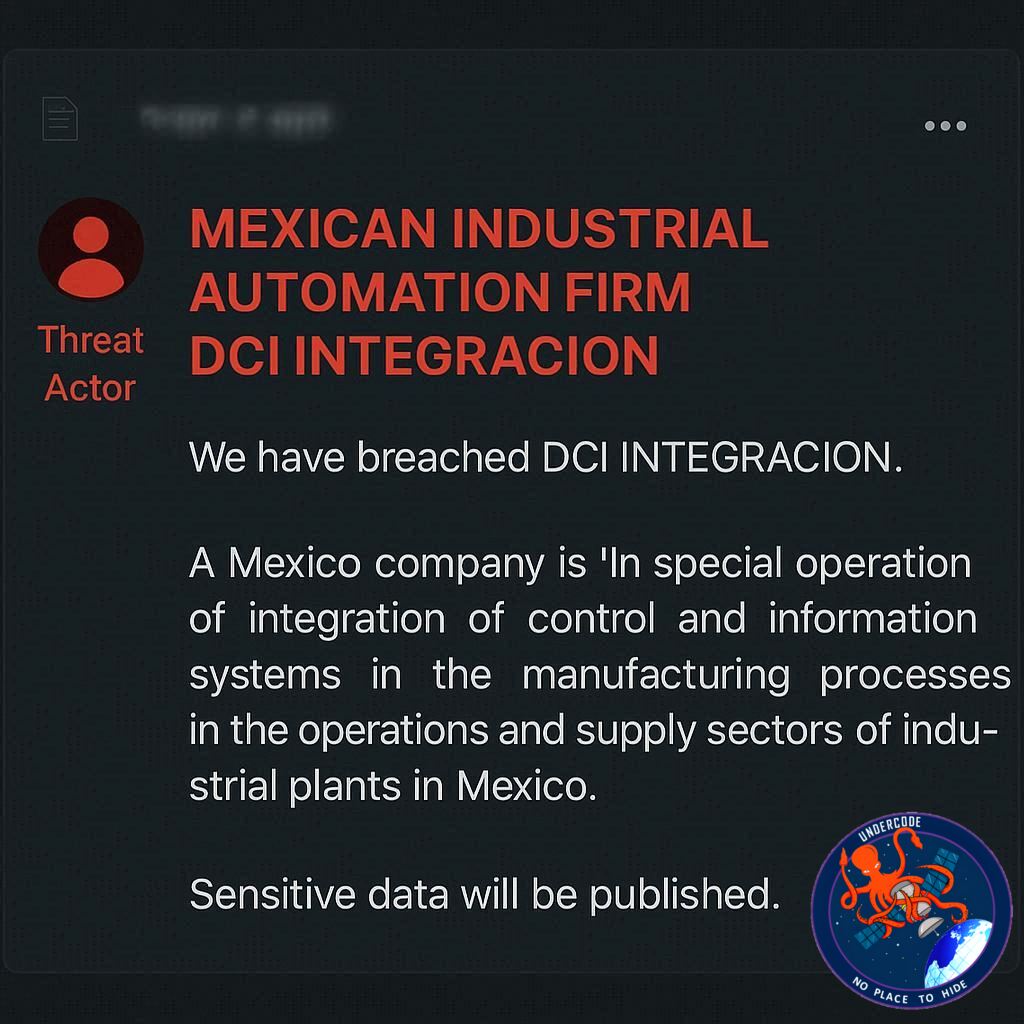
Industrial cybersecurity incidents are becoming one of the most dangerous trends in the modern threat landscape, and a newly surfaced dark web claim involving Mexican company DCI Integración is raising concerns across the OT and ICS security community. According to a post published by the threat monitoring account “Dark Web Intelligence,” a threat actor allegedly claims to have compromised systems connected to DCI Integración, a company reportedly involved in industrial automation, process control systems, and engineering integration services in Mexico.
Unlike ordinary corporate data leaks involving customer emails or financial records, attacks against industrial technology vendors can create ripple effects that spread into manufacturing environments, utilities, logistics chains, and even critical infrastructure sectors. Because industrial integrators often bridge operational technology with traditional IT networks, a compromise could potentially expose highly sensitive engineering environments.
The shared screenshot referenced “DCI Group Mexico” alongside industrial branding and process-control related terminology. While no independent verification has yet confirmed the authenticity or scale of the alleged breach, the nature of the targeted sector alone makes the claim noteworthy.
Security observers point out that companies operating in industrial automation frequently maintain remote administrative access into customer environments. This means attackers who gain footholds inside such organizations may potentially obtain access to sensitive documentation, industrial architecture diagrams, VPN credentials, SCADA configurations, PLC programming environments, and infrastructure mapping information.
The concern grows significantly when operational technology becomes part of the attack surface. OT and ICS ecosystems are often built on legacy infrastructure that was never originally designed to withstand modern cyber threats. Many industrial environments continue relying on outdated segmentation strategies, exposed remote management systems, and insecure authentication methods.
If the alleged compromise extends beyond corporate systems and into engineering environments, potential downstream risks may affect multiple sectors including manufacturing, utilities, energy operations, transportation logistics, and industrial production chains. Even partial exposure of industrial configuration data can assist threat actors in future reconnaissance campaigns.
Supply-chain risk is another major issue highlighted in the report. Industrial integration firms often maintain trusted relationships with multiple vendors and customers simultaneously. A successful intrusion into one integrator could potentially provide attackers with pathways into several connected organizations through credential reuse, VPN access, remote monitoring tools, or trusted network channels.
Researchers increasingly warn that attackers targeting industrial vendors are no longer focused solely on ransomware payouts. Many groups now seek intelligence collection opportunities involving infrastructure visibility, operational technology mapping, and long-term persistence inside critical industrial ecosystems.
The dark web claim surrounding DCI Integración remains unverified at the time of writing. No confirmed evidence currently demonstrates whether operational systems were accessed, whether customer infrastructure was impacted, or whether data theft actually occurred. Nevertheless, the incident reflects a wider trend affecting Latin American organizations tied to industrial operations and infrastructure management.
Cybercriminal groups continue expanding their attention toward regions where industrial cybersecurity maturity remains uneven. Organizations with weak remote access controls, insufficient IT/OT segmentation, legacy industrial infrastructure, and exposed engineering interfaces remain particularly vulnerable to targeted attacks.
Experts recommend that organizations connected to industrial ecosystems closely monitor for unusual VPN sessions, abnormal engineering workstation activity, unauthorized remote access behavior, credential abuse attempts, suspicious OT network scanning, and underground leaks involving configuration files or infrastructure diagrams.
Even if this particular claim ultimately proves exaggerated or false, the broader threat environment surrounding industrial automation vendors is very real and continues evolving rapidly across global infrastructure sectors.
What Undercode Says:
Industrial Integrators Are Becoming Prime Targets
The most dangerous aspect of this alleged DCI Integración breach is not the possibility of leaked employee data. The real concern is access inheritance. Industrial integration companies frequently act as trusted bridges between enterprise IT environments and operational technology networks.
That creates an attractive attack path.
If attackers compromise the integrator, they may inherit visibility into customer operations without directly attacking the customer first. This dramatically lowers the effort required for reconnaissance and lateral movement.
OT Security Still Lags Behind Traditional IT
Many industrial environments continue using aging technologies that prioritize uptime over cybersecurity. In real-world factories and industrial plants, systems sometimes run for years without significant security updates because operational interruptions can cost millions of dollars.
Threat actors know this.
Legacy PLC environments, SCADA servers, engineering workstations, and industrial HMIs often become soft targets once attackers obtain initial credentials.
Remote Access Remains the Weakest Link
One recurring pattern in industrial intrusions is abused remote access infrastructure. Vendors frequently deploy VPNs, remote management platforms, and engineering support portals to maintain customer systems remotely.
Those tools become extremely valuable once stolen.
A single compromised remote support account can sometimes expose multiple industrial customers simultaneously.
Latin America Is Facing Increased Industrial Targeting
Threat intelligence reports over the past two years show increasing cybercriminal activity targeting industrial organizations across Latin America. Several factors contribute to this trend:
Legacy infrastructure adoption
Limited OT security investment
Expanding digital transformation projects
Weak segmentation practices
Third-party vendor exposure
Attackers increasingly view the region as an opportunity-rich environment.
Engineering Documentation Can Be More Valuable Than Financial Data
Many organizations underestimate the value of industrial documentation. Attackers are not always searching for bank information or customer payment records.
Sometimes engineering diagrams are more useful.
Detailed architecture files can reveal:
Network segmentation layouts
Safety control systems
Backup operations
Physical infrastructure dependencies
Industrial process logic
Maintenance schedules
That intelligence becomes extremely useful for future campaigns.
Supply Chain Attacks Are Evolving Fast
The cybersecurity industry has spent years discussing supply-chain attacks after incidents like SolarWinds and MOVEit. However, industrial supply-chain compromise introduces additional risks because operational environments often contain physical consequences.
An attacker with OT visibility can potentially disrupt manufacturing lines, logistics operations, or utility management systems.
This changes the threat from a financial issue into an operational resilience issue.
Attackers Increasingly Focus on Persistence
Modern threat actors rarely smash systems and leave immediately. Many campaigns now involve stealth persistence inside infrastructure environments.
Attackers quietly collect:
Credentials
Network maps
Engineering files
Access tokens
Vendor trust relationships
The objective is often long-term operational access rather than immediate destruction.
Third-Party Risk Is Becoming Harder to Manage
Large enterprises may secure their own networks effectively but remain vulnerable through smaller contractors and engineering partners.
Industrial ecosystems are interconnected by design.
That means cybersecurity weaknesses inside one vendor can cascade into multiple organizations downstream.
OT Reconnaissance Is a Growing Underground Economy
Dark web forums increasingly feature discussions around:
SCADA access
ICS documentation
VPN credentials
Industrial remote management panels
Building automation systems
Manufacturing access brokers
This reflects growing criminal interest in industrial espionage and infrastructure compromise.
The Biggest Danger Is Invisible Exposure
The most concerning scenario is not ransomware headlines. It is silent exposure that remains undetected for months.
If engineering credentials or infrastructure diagrams were actually stolen, those assets could be reused in later attacks long after the original incident disappears from public discussion.
That is why even unverified dark web claims deserve careful monitoring.
Deep analysis :
Detect exposed remote access services
nmap -Pn -p 3389,5900,22,443,8443 TARGET_IP
Scan industrial protocols
nmap --script modbus-discover TARGET_IP
nmap --script s7-info TARGET_IP
Identify suspicious VPN sessions
grep "VPN" /var/log/auth.log
Monitor failed authentication attempts
cat /var/log/auth.log | grep "Failed password"
Detect abnormal network scanning
tcpdump -i eth0 port 502 or port 102
Search for leaked configuration archives
find / -name ".scada"
find / -name ".plc"
find / -name ".hmi"
Check exposed engineering workstations
netstat -antp
Hunt for persistence mechanisms
crontab -l
systemctl list-units --type=service
Review OT segmentation paths
traceroute TARGET_IP
Enumerate connected industrial assets
arp -a
🔍 Fact Checker Results
✅ No independent confirmation currently proves the alleged DCI Integración breach occurred.
✅ Industrial automation vendors are increasingly targeted because they maintain trusted OT and IT access paths.
❌ There is currently no public evidence confirming customer infrastructure or SCADA environments were compromised.
📊 Prediction
🔮 Threat actors will continue targeting industrial integrators because they provide indirect access into larger infrastructure ecosystems.
🔮 Latin American OT environments will likely experience increased reconnaissance campaigns focused on remote management systems and legacy industrial technologies.
🔮 Future industrial cyberattacks will increasingly prioritize stealth persistence and intelligence collection instead of immediate ransomware deployment.
▶️ Related Video (78% Match):
🕵️📝Let’s dive deep and fact‑check.
References:
Reported By: x.com
Extra Source Hub (Possible Sources for article):
https://www.reddit.com
Wikipedia
OpenAi & Undercode AI
Image Source:
Unsplash
Undercode AI DI v2
Bing
🔐JOIN OUR CYBER WORLD [ CVE News • HackMonitor • UndercodeNews ]
📢 Follow UndercodeNews & Stay Tuned:
𝕏 formerly Twitter 🐦 | @ Threads | 🔗 Linkedin | 🦋BlueSky | 🐘Mastodon | 📺Youtube


