
Listen to this Post
Introduction
India’s booming fintech ecosystem has transformed how millions access loans, credit scoring, and digital financial services. But the same rapid digital expansion that fuels financial inclusion is also creating massive cybersecurity risks. A newly surfaced dark web claim is now raising alarms across the Indian financial sector after a threat actor allegedly advertised a leaked database connected to CredRight, containing highly sensitive financial and identity-related records tied to Indian citizens.
According to screenshots shared by the threat intelligence account Dark Web Intelligence, the alleged dataset appears far more dangerous than an ordinary contact leak. The exposed information reportedly combines personal identification details, government-linked identifiers, financial repayment histories, and behavioral credit-risk analytics — a combination that could become a goldmine for cybercriminals if verified as authentic.
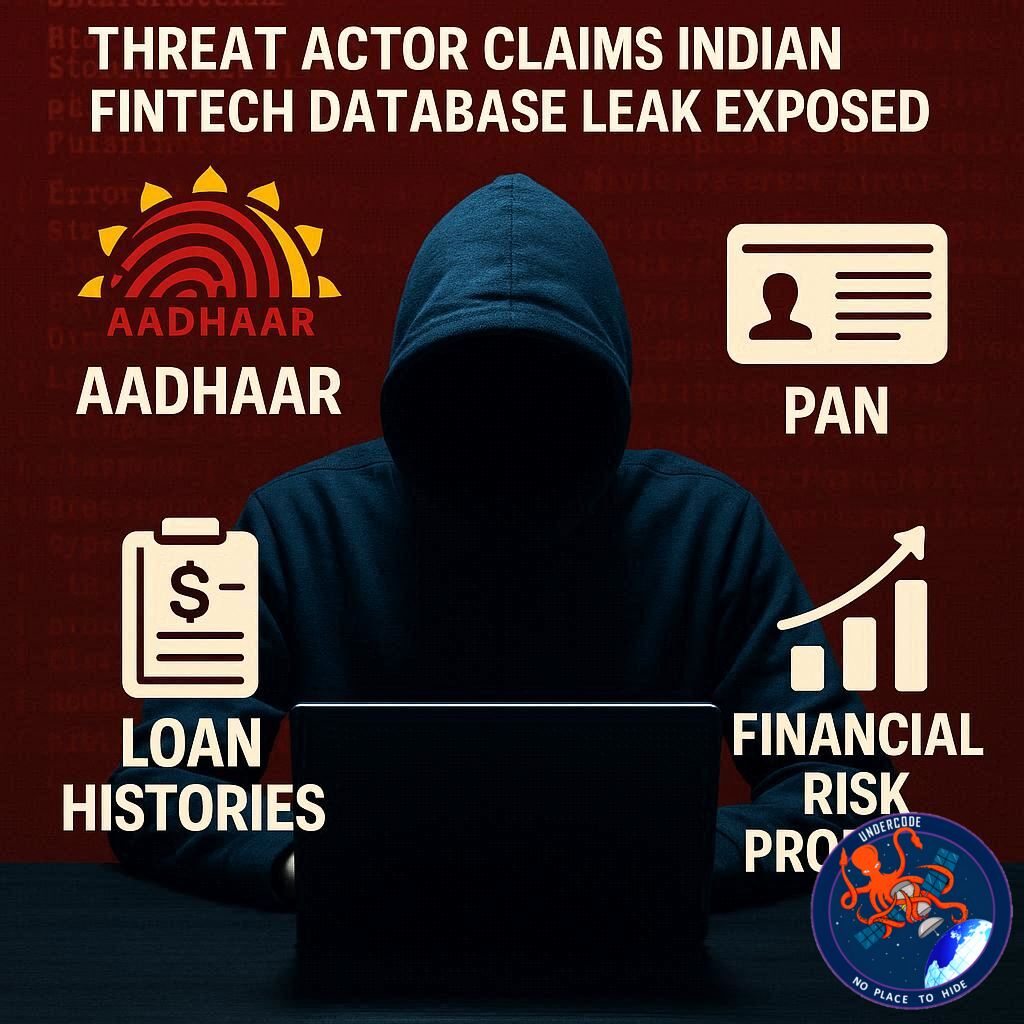
The leak allegedly contains Aadhaar-linked indicators, PAN card details, customer identities, addresses, salary information, loan account numbers, EMI repayment histories, branch metadata, delinquency indicators, and risk assessment information. Security analysts warn that datasets containing both financial behavior and identity data dramatically increase the potential for sophisticated fraud campaigns.
The alleged exposure also highlights a growing problem inside modern fintech ecosystems: the heavy reliance on interconnected APIs, third-party vendors, SaaS platforms, and external data processors. In many cases, sensitive financial information no longer resides only within traditional banking infrastructure. Instead, it is distributed across analytics providers, onboarding services, cloud environments, recovery platforms, and lending partners — significantly expanding the attack surface available to cybercriminals.
At the time of reporting, the authenticity of the leak has not been independently verified. However, the structure and detail of the sample shown online have already sparked serious concerns among cybersecurity researchers monitoring financial-sector threats in India.
The Alleged Leak Appears Larger Than a Typical Data Breach
Unlike ordinary breaches that expose emails or phone numbers, this alleged dataset reportedly contains layered financial intelligence tied directly to consumer behavior. That distinction makes the incident particularly concerning for cybersecurity professionals.
The screenshots indicate the exposed information may include complete borrower profiles, financial histories, repayment performance metrics, and lender-related metadata. Such information can enable criminals to build detailed behavioral profiles of victims instead of relying solely on stolen identities.
The presence of Aadhaar-linked references and PAN information significantly elevates the severity of the alleged exposure. In India, these identifiers are deeply integrated into banking, lending, KYC verification, and financial onboarding systems. Criminal access to such information can create long-term fraud risks for affected individuals.
Why Financial Behavioral Data Is Extremely Valuable to Criminals
Traditional identity theft focuses mainly on personal identifiers like names, addresses, or phone numbers. However, modern cybercriminal organizations increasingly seek “decision intelligence” datasets — information that reveals how consumers behave financially.
This alleged leak appears to include repayment behavior, delinquency indicators, EMI histories, and financial risk metrics. Such data allows criminals to identify vulnerable individuals, prioritize targets with debt exposure, and tailor scams with unusually high precision.
Fraud groups can exploit this information to create fake debt recovery operations, impersonate loan agents, or launch highly believable phishing campaigns referencing real loan amounts and repayment histories. Victims are far more likely to trust scams containing accurate financial details.
The inclusion of lender metadata and branch information may also enable attackers to conduct convincing social engineering attacks against customer support teams or financial institutions themselves.
The Growing Cybersecurity Crisis Inside India’s Fintech Industry
India’s digital lending sector has expanded aggressively over the past decade. Fintech firms now process enormous volumes of sensitive consumer information through interconnected digital ecosystems.
This rapid expansion has introduced several structural cybersecurity weaknesses:
Heavy API integrations between fintech platforms
Dependence on third-party onboarding vendors
Cloud-hosted financial processing systems
Distributed KYC verification environments
External analytics and scoring platforms
Large partner ecosystems with varying security maturity
Each additional integration creates another potential attack surface. Even if a core banking system remains secure, a compromise involving a third-party vendor or analytics provider can still expose massive quantities of sensitive data.
The alleged CredRight dataset appears, based on the screenshots, more consistent with a lending analytics or fintech-processing environment than a traditional banking database. That observation aligns with broader industry trends where auxiliary service providers increasingly become the weakest cybersecurity link.
Synthetic Identity Fraud Could Become a Major Risk
One of the most dangerous implications of this alleged leak is the possibility of synthetic identity creation.
Synthetic identity fraud involves combining real personal data with fabricated information to create entirely new financial identities. Criminals use these synthetic profiles to open fraudulent loan accounts, evade detection systems, and exploit financial institutions for extended periods before disappearing.
Because the alleged dataset reportedly combines identity information with financial histories and risk indicators, it could provide attackers with enough intelligence to engineer highly credible synthetic profiles.
This type of fraud is particularly difficult to detect because the identities often partially match legitimate government-linked records.
Phishing Campaigns Could Become Extremely Sophisticated
Most phishing attacks fail because they appear generic or suspicious. However, access to real financial data dramatically improves criminal success rates.
Attackers could potentially reference:
Actual loan amounts
Genuine EMI schedules
Real branch names
Correct customer IDs
Accurate repayment dates
Existing delinquency issues
This level of personalization makes scams appear authentic. Fraudulent calls or messages impersonating loan recovery agents, customer support representatives, or financial investigators become much harder for victims to identify.
Cybercriminals frequently weaponize financial stress during economic uncertainty. Individuals already dealing with debt obligations may become more vulnerable to manipulation tactics involving urgency, threats, or fake settlement offers.
Third-Party Vendors Are Becoming Prime Targets
Modern financial ecosystems increasingly depend on external providers for onboarding, verification, analytics, and servicing functions.
Threat actors understand this reality. Instead of attacking heavily protected banks directly, many cybercriminal groups now target smaller vendors with weaker defenses but access to equally valuable datasets.
If the alleged breach originated from a third-party fintech environment, it would reinforce a global cybersecurity pattern seen across multiple industries: attackers increasingly exploit supply-chain weaknesses rather than front-line institutions.
This strategy often provides broader access with significantly lower operational risk for attackers.
What Undercode Says:
The Alleged Leak Reflects a Dangerous Evolution in Cybercrime
The most alarming aspect of this incident is not simply the exposure of personal information. It is the convergence of identity data, financial intelligence, behavioral analytics, and repayment histories into a single accessible dataset.
Cybercrime has evolved far beyond traditional password theft. Modern threat actors increasingly seek data ecosystems capable of enabling long-term monetization strategies. Financial behavioral intelligence offers exactly that.
India’s Fintech Explosion Created a Massive Attack Surface
India’s digital finance revolution has connected millions of citizens to instant lending platforms, digital onboarding systems, and automated credit evaluations. While this expansion improved accessibility, it also produced an enormous concentration of sensitive data across fragmented infrastructures.
Fintech growth frequently prioritizes speed, scalability, and customer acquisition over deep security architecture. Smaller vendors often lack mature detection systems, incident response teams, or zero-trust segmentation models.
That imbalance creates ideal conditions for cybercriminal exploitation.
Behavioral Data Is More Dangerous Than Basic PII
Many organizations still underestimate the value of behavioral financial data. However, criminals increasingly view repayment histories and risk-scoring information as more useful than traditional personally identifiable information.
Behavioral datasets allow attackers to identify financially stressed individuals, predict responses to manipulation, and design scams with psychological precision.
This represents a major evolution in fraud operations.
Financial Intelligence Enables Multi-Stage Criminal Campaigns
A dataset like the one allegedly advertised could support multiple criminal operations simultaneously:
Identity theft
Loan fraud
Credential stuffing
SIM swap attacks
Social engineering
Blackmail attempts
Recovery-agent impersonation
Financial extortion campaigns
Threat actors no longer operate isolated fraud schemes. Many now run interconnected criminal ecosystems where leaked data feeds several monetization pipelines simultaneously.
The Presence of Aadhaar-Linked References Raises Serious Concerns
Government-linked identifiers dramatically increase the long-term damage potential associated with breaches.
Unlike passwords, individuals cannot easily replace identity systems connected to national infrastructure. Once exposed, such identifiers may remain exploitable for years.
This creates persistent fraud exposure rather than temporary compromise.
Third-Party Ecosystems Remain the Weakest Link
Many companies secure their primary infrastructure while overlooking vendor risk management. Yet modern fintech systems rely heavily on external processors, SaaS integrations, and cloud-based analytics environments.
Attackers understand that compromising a smaller partner can sometimes provide access to data from multiple organizations simultaneously.
This strategy reduces operational cost while maximizing breach scale.
Financial Fraud Operations Are Becoming Industrialized
Cybercrime today resembles organized industry rather than isolated hacking activity.
Threat groups increasingly specialize in:
Data acquisition
Fraud automation
Social engineering
Credential enrichment
Financial laundering
Synthetic identity generation
Leaked datasets become raw material feeding sophisticated underground economies.
AI Could Intensify the Threat Landscape
Artificial intelligence may significantly amplify the risks associated with datasets like this.
Attackers can already automate phishing personalization, fraud scripting, and behavioral targeting using AI-driven tools. Combining stolen financial intelligence with AI-generated impersonation campaigns could increase scam effectiveness dramatically.
Deepfake voice impersonation targeting borrowers and financial institutions may also become more common.
Detection and Monitoring Gaps Remain a Critical Problem
Many fintech ecosystems still rely heavily on reactive security rather than proactive threat hunting.
Attackers often remain inside cloud environments or partner infrastructures for extended periods before discovery. Weak logging, poor API monitoring, and insufficient segmentation continue to create blind spots.
Organizations handling financial intelligence must treat telemetry and anomaly detection as mission-critical functions rather than compliance exercises.
Consumers Face Growing Long-Term Risk Exposure
Even if organizations contain breaches quickly, exposed consumers may remain vulnerable for years.
Financial profiling data enables ongoing fraud campaigns because repayment histories, risk indicators, and financial behavior patterns often remain relevant long after initial compromise.
Victims may experience recurring phishing attempts, fraudulent loan applications, and targeted scams over extended periods.
Regulatory Pressure on Fintech Firms Will Likely Intensify
Incidents involving financial intelligence leaks typically attract significant regulatory scrutiny.
Governments worldwide are increasingly demanding:
Stronger vendor oversight
Better encryption practices
Improved breach disclosure timelines
Mandatory security audits
Tighter API governance
Data minimization strategies
India’s rapidly expanding digital finance sector will likely face stronger cybersecurity expectations as incidents like this continue to emerge.
Deep Analysis
The alleged breach demonstrates how modern fintech architectures can unintentionally centralize extremely sensitive intelligence into unified environments attractive to attackers.
Many financial platforms rely on interconnected microservices, APIs, and cloud-hosted data lakes. When improperly segmented, these environments can allow attackers to pivot across systems after initial compromise.
Common attack vectors in fintech ecosystems include:
Example reconnaissance activity attackers may use
nmap -sV fintech-api-domain.com
Searching for exposed cloud assets
aws s3 ls s3://target-bucket --no-sign-request
API enumeration testing
ffuf -u https://api.target.com/FUZZ -w wordlist.txt
Credential stuffing automation
hydra -L users.txt -P passwords.txt fintech-login.com
Threat actors also increasingly target unsecured API gateways and improperly configured cloud storage.
Security teams defending financial ecosystems typically deploy:
Zero Trust Architecture
Web Application Firewalls
Behavioral anomaly detection
API rate limiting
IAM segmentation
SIEM correlation systems
Endpoint Detection & Response platforms
However, rapid fintech scaling often leaves defensive maturity lagging behind operational growth.
🔍 Fact Checker Results
✅ The Leak Has Not Been Independently Verified
The threat actor’s claims remain unconfirmed at the time of publication, and no official public validation of the alleged CredRight database exposure currently exists.
✅ The Described Data Would Be Extremely Sensitive if Authentic
The combination of Aadhaar-linked indicators, PAN details, repayment histories, and risk analytics would represent a severe privacy and financial-security concern if proven legitimate.
✅ Fintech Ecosystems Globally Face Similar Cybersecurity Risks
Cybersecurity experts have repeatedly warned that third-party integrations, API-heavy infrastructures, and distributed SaaS environments increase attack surfaces across modern financial ecosystems.
📊 Prediction
Cybercriminals Will Increasingly Target Financial Intelligence Platforms
Future attacks will likely focus less on traditional banking systems and more on interconnected fintech ecosystems, analytics providers, and third-party processors that aggregate high-value financial intelligence.
AI-Driven Fraud Campaigns Could Surge
Threat actors are expected to combine leaked financial datasets with AI-powered phishing, voice cloning, and behavioral automation tools to create highly convincing scam operations.
Governments May Enforce Stricter Fintech Security Regulations
As financial ecosystems continue digitizing rapidly, regulators will likely impose stronger cybersecurity compliance requirements involving vendor audits, API governance, cloud-security standards, and mandatory breach reporting frameworks.
▶️ Related Video (72% Match):
🕵️📝Let’s dive deep and fact‑check.
References:
Reported By: x.com
Extra Source Hub (Possible Sources for article):
https://www.instagram.com
Wikipedia
OpenAi & Undercode AI
Image Source:
Unsplash
Undercode AI DI v2
Bing
🔐JOIN OUR CYBER WORLD [ CVE News • HackMonitor • UndercodeNews ]
📢 Follow UndercodeNews & Stay Tuned:
𝕏 formerly Twitter 🐦 | @ Threads | 🔗 Linkedin | 🦋BlueSky | 🐘Mastodon | 📺Youtube


