
Listen to this Post
Introduction: A Quiet Shift in Fast Food Automation
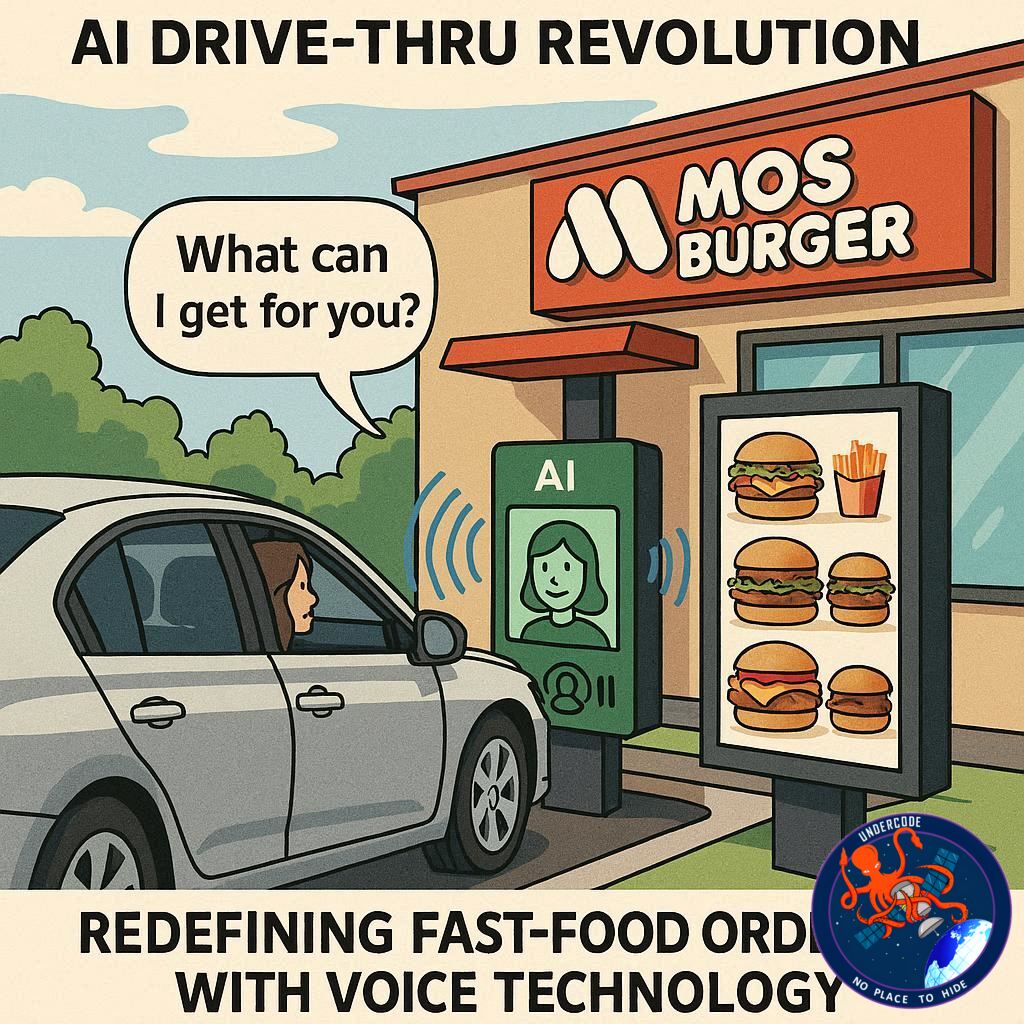
The fast food industry is undergoing a subtle but powerful transformation. While customers may only notice shorter wait times or smoother ordering experiences, behind the scenes, companies are rapidly integrating artificial intelligence into everyday operations. One of the most compelling examples comes from MOS Burger, which is experimenting with AI-powered voice ordering at drive-thru lanes. This initiative signals not just a technological upgrade, but a deeper shift in how restaurants manage labor, efficiency, and customer interaction.
Summary: MOS Burger’s AI Drive-Thru Experiment Explained
MOS Food Services has begun testing an innovative “AI Drive-Thru” system that uses artificial intelligence to recognize customer speech and process orders automatically. This experiment represents a significant step toward automating one of the most human-dependent aspects of fast food service: communication.
In December 2025, MOS Food Services formed a strategic partnership with New Innovations, a technology firm based in Tokyo specializing in advanced AI solutions. Together, they launched a pilot program at the MOS Burger Yoshikawa Minami location in Saitama Prefecture. The test ran for several days, during which the AI system was deployed to interact directly with customers at the drive-thru.
The core function of this AI system is to listen to customer orders, interpret them accurately, and input them into the restaurant’s ordering system without human intervention. Unlike traditional systems that rely heavily on staff to manually input orders, this approach reduces the need for real-time human involvement in the ordering process.
One of the key motivations behind this experiment is addressing labor shortages, a growing issue in Japan’s service industry. By allowing AI to handle initial customer interactions, MOS Burger aims to reduce the workload on staff, particularly during peak hours when drive-thru demand spikes.
Interestingly, the system does not aim to completely eliminate human workers. Instead, it redefines their roles. New or less experienced staff, who might traditionally struggle with fast-paced order-taking, can focus on other responsibilities such as food preparation, quality control, or customer service inside the store. This shift helps improve overall operational efficiency while maintaining service quality.
The trial also explored how accurately AI could handle real-world variables such as background noise, different speaking styles, and complex or customized orders. Early results suggest that while the technology is promising, there are still challenges to overcome before full-scale deployment.
Following the initial test, MOS Burger plans to refine the system based on collected data and expand trials to additional locations. The long-term vision is to integrate AI more deeply into restaurant operations, creating a hybrid model where humans and machines collaborate seamlessly.
What Undercode Say: The Strategic Impact of AI in Fast Food Operations
The move by MOS Burger is not just about convenience, it reflects a broader structural change in how fast food businesses operate under pressure from labor shortages, rising costs, and increasing customer expectations. What appears to be a simple drive-thru upgrade is actually a calculated step toward operational resilience.
AI voice ordering directly addresses one of the most fragile points in the fast food workflow: communication accuracy under time pressure. Human error, misheard orders, and language barriers have long been pain points in drive-thru systems. By introducing AI, MOS Burger is attempting to standardize this interaction, making it more predictable and scalable.
However, the real significance lies in workforce transformation. Rather than replacing employees outright, this system redistributes responsibilities. Entry-level workers, often overwhelmed by multitasking demands, can now operate in less stressful roles. This could lead to higher job satisfaction and reduced turnover, which is a major issue in the fast food sector globally.
There is also a financial angle. Labor costs continue to rise, especially in developed economies like Japan. AI systems, once implemented and optimized, offer a long-term cost advantage despite high initial investment. Over time, automation can stabilize operational expenses while improving consistency.
Yet, the technology is far from perfect. Speech recognition in a controlled environment is one thing, but drive-thru settings are unpredictable. Weather conditions, engine noise, accents, and rapid speech patterns all challenge AI systems. If accuracy drops, customer frustration could increase, potentially damaging brand perception.
Another layer to consider is customer acceptance. Not all consumers are comfortable interacting with machines, especially in cultures that value human service. The success of this initiative will depend not only on technical performance but also on how natural and intuitive the AI interaction feels.
From a competitive standpoint, MOS Burger is positioning itself ahead of many traditional fast food chains by embracing AI early. If successful, this could set a benchmark for the industry, pushing competitors to accelerate their own automation strategies.
In essence, this experiment is less about replacing humans and more about redefining efficiency. The companies that succeed in this transition will be those that balance automation with human touch, rather than choosing one over the other.
Fact Checker Results
✅ MOS Burger is actively testing AI-based voice ordering systems in drive-thrus
✅ The partnership with New Innovations was established in December 2025
❌ The AI system is not yet fully deployed or proven for large-scale use
Prediction
📊 AI-driven ordering systems will expand rapidly across fast food chains within the next 3–5 years
📊 Hybrid human-AI service models will become the industry standard rather than full automation
📊 Early adopters like MOS Burger could gain a competitive advantage in efficiency and cost control
🕵️📝✔️Let’s dive deep and fact‑check.
References:
Reported By: xtechnikkeicom_dcbd99b3169a3d56e4c2c657
Extra Source Hub (Possible Sources for article):
https://www.discord.com
Wikipedia
OpenAi & Undercode AI
Image Source:
Unsplash
Undercode AI DI v2
Bing
🔐JOIN OUR CYBER WORLD [ CVE News • HackMonitor • UndercodeNews ]
📢 Follow UndercodeNews & Stay Tuned:
𝕏 formerly Twitter 🐦 | @ Threads | 🔗 Linkedin | 🦋BlueSky | 🐘Mastodon


