
Listen to this Post
Introduction
For years, the tech industry promised that studying computer science was a ticket to a stable, lucrative career. But with the rise of artificial intelligence, the job landscape has shifted dramatically. While some see AI as a direct threat to employment in IT and coding roles, others view it as a once-in-a-generation opportunity. Beyond these two perspectives lies a third possibility — AI as the ultimate accelerator for startup success. This emerging view suggests that AI won’t just reshape the job market; it could redefine how new businesses are born, scaled, and sustained in the years ahead.
the Original
Artificial intelligence is rapidly taking over many roles once considered secure in technology, especially programming and software development. According to The New York Times, AI programming tools capable of producing thousands of lines of code in seconds, combined with mass layoffs at tech giants like Amazon, Intel, Meta, and Microsoft, are narrowing opportunities in a once-booming sector.
There are three main narratives about AI and jobs:
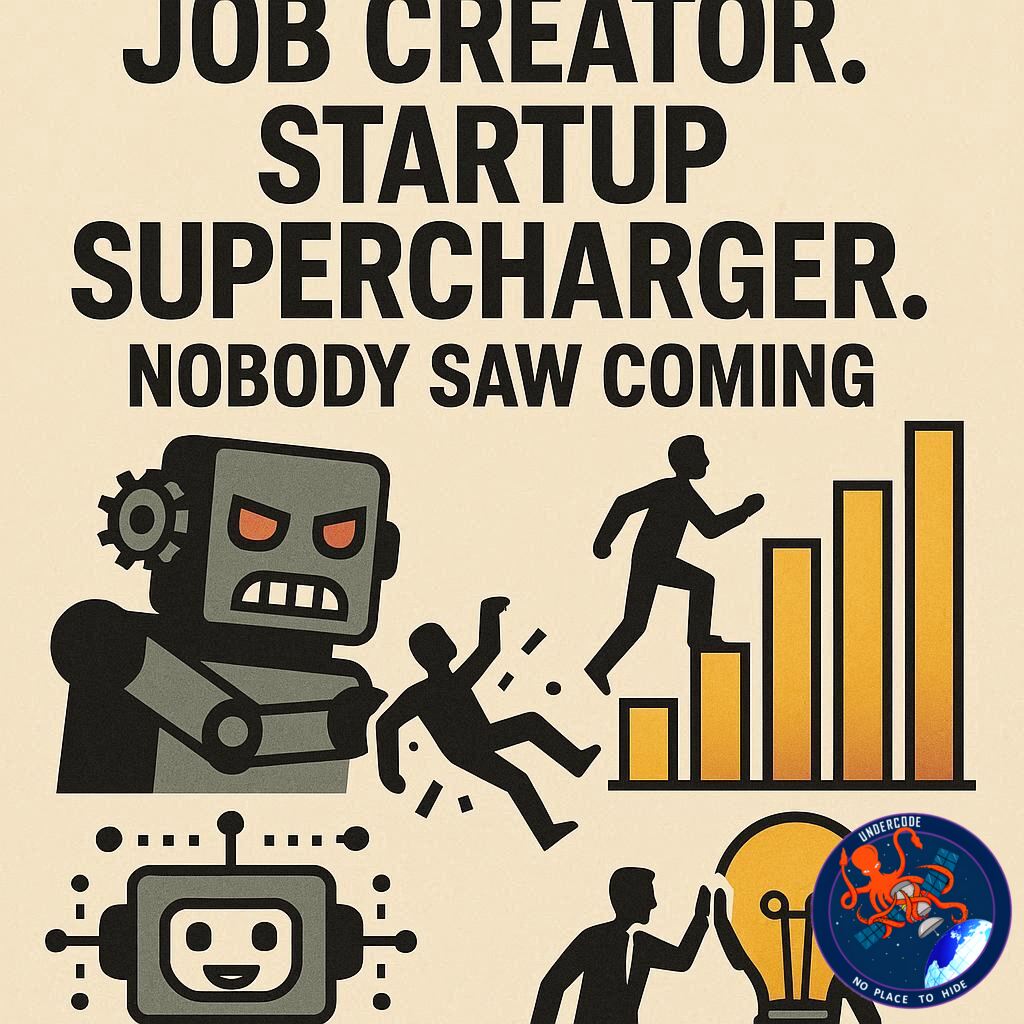
- AI as a job killer, replacing traditional tech roles.
- AI as a skill enabler, creating demand for AI development and oversight experts.
- AI as a startup rocket fuel, empowering professionals to launch businesses faster and cheaper than ever before.
Venture capitalist Spiros Margaris believes AI significantly lowers the barriers for entrepreneurs, allowing them to automate operations, test ideas quickly, reduce costs, and potentially reach profitability sooner. By removing some of the risk associated with launching a business, AI could encourage more professionals to leave traditional jobs and enter the startup world.
Still, starting a business remains risky — U.S. Bureau of Labor Statistics data shows nearly half of startups fail within five years, and up to 90% eventually fold due to competition, poor product-market fit, or high costs. AI’s greatest strength lies in speed, enabling prototypes and market tests in weeks instead of months or years. It levels the playing field, granting smaller teams access to capabilities once reserved for corporations with deep pockets.
AI is now central to nearly all startup sectors — from fraud detection and marketing to e-commerce and coding. But Margaris warns that AI is not a “free lunch.” It introduces complexity, cybersecurity challenges, and potential regulatory hurdles. Startups must prepare for evolving intellectual property issues, data privacy regulations, and AI-powered cyberattacks.
His advice to aspiring founders: build teams skilled in AI, data science, ethics, and governance. Stay alert to the shifting AI regulatory environment. Above all, remember that “tools don’t win; people do” — a strong team with the right mindset will outpace competitors, no matter how advanced the AI tools available.
What Undercode Say:
AI’s impact on the job market often dominates headlines, but this binary “job loss vs. job creation” framing misses a crucial middle ground. The startup economy is where AI’s influence could be most transformative in the short term.
- The Startup Barrier Is Falling — But Not for Everyone
AI democratizes access to advanced capabilities like natural language processing, image recognition, and predictive analytics, allowing two-person teams to compete with companies that once needed entire departments. However, access to the technology doesn’t equal success — the real differentiator will be the ability to integrate AI into meaningful, scalable products.
2. Capital Efficiency Is the New Growth Metric
In previous startup eras, “growth at all costs” dominated investor thinking. Now, AI enables leaner operations, making capital efficiency just as important as rapid scaling. Margaris is right — the ability to reach profitability faster could become a make-or-break factor in the AI-driven startup landscape.
- AI-First Is No Longer a Strategy — It’s a Survival Requirement
Startups that fail to embed AI into their core processes risk falling behind. Even if a company’s product isn’t inherently AI-based, integrating AI into marketing, logistics, and customer support could be essential for competitiveness.
4. The Complexity Tax
While AI reduces certain operational burdens, it introduces new ones: ethical governance, compliance with emerging regulations, and cybersecurity threats. AI tools can defend against cyberattacks, but they also arm malicious actors with unprecedented offensive capabilities.
5. Risk Distribution Will Change
By shortening development timelines and reducing costs, AI allows startups to run more experiments in parallel, potentially spreading risk across multiple product ideas. This could lead to a new model of “portfolio entrepreneurship,” where founders launch and test several concepts simultaneously.
6. Regulation as a Wild Card
Rapid regulatory changes — particularly around data usage, AI ethics, and intellectual property — could reshape the startup landscape overnight. Startups must be agile enough to pivot quickly when compliance rules evolve.
7. The Billion-Dollar Solo Founder Myth
While stories of one-person AI-powered unicorns are compelling, they are exceptions, not the rule. Even with AI’s capabilities, building a billion-dollar company still requires strategy, resilience, market insight, and luck. AI can be an amplifier, but it doesn’t replace execution.
In essence, AI won’t simply replace jobs or create them — it will redistribute opportunity, shifting the locus of innovation from entrenched corporations to agile, AI-savvy entrepreneurs. The ones who thrive will combine AI’s capabilities with human judgment, creativity, and business acumen.
🔍 Fact Checker Results
✅ AI programming tools are already capable of producing large volumes of code quickly, as reported by The New York Times.
✅ Startup failure rates align with U.S. Bureau of Labor Statistics data (approx. 50% fail within five years, up to 90% over time).
✅ AI adoption is widespread across fraud detection, marketing, e-commerce, and other startup-critical areas.
📊 Prediction
Within the next five years, the “AI-first startup” will become the default model for new businesses, much like “mobile-first” was in the 2010s. The founders who succeed will be those who master not only AI tools but also the regulatory, ethical, and cybersecurity challenges they bring. Expect a surge in micro-startups — lean teams leveraging AI to rapidly build, test, and scale products — with a small percentage breaking into billion-dollar valuations.
Do you want me to also create a highly shareable, click-optimized SEO headline for this so it can perform better in search rankings? That could make this even stronger.
🕵️📝✔️Let’s dive deep and fact‑check.
References:
Reported By: www.zdnet.com
Extra Source Hub:
https://www.quora.com/topic/Technology
Wikipedia
OpenAi & Undercode AI
Image Source:
Unsplash
Undercode AI DI v2
🔐JOIN OUR CYBER WORLD [ CVE News • HackMonitor • UndercodeNews ]
📢 Follow UndercodeNews & Stay Tuned:
𝕏 formerly Twitter 🐦 | @ Threads | 🔗 Linkedin | 🦋BlueSky | 🐘Mastodon


