
Listen to this Post
Introduction: When Passion Isn’t Enough to Pay the Bills
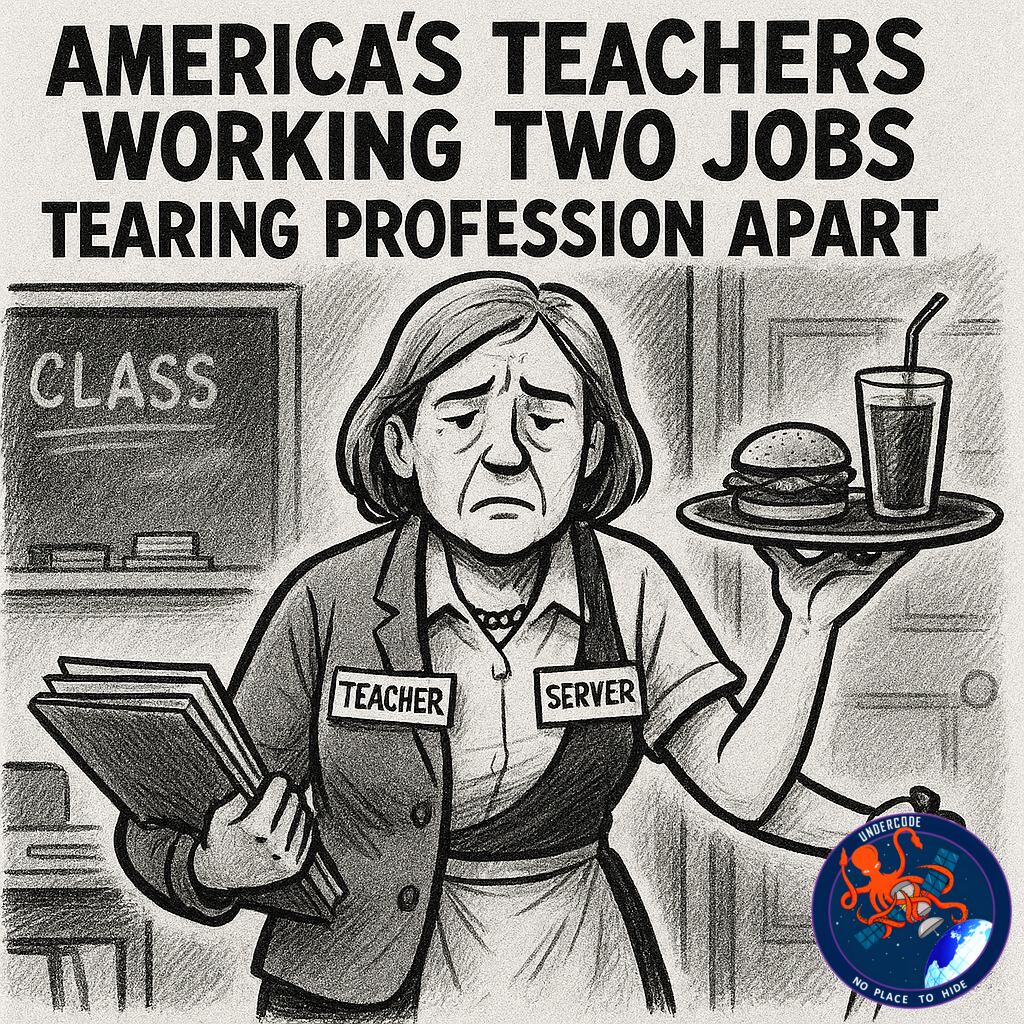
Across the United States, teaching is still described as a “calling.” But for many educators, passion alone no longer covers rent, groceries, or long-term security. Behind classroom doors, an uncomfortable reality is growing: a majority of public school teachers now rely on side hustles just to maintain a modest standard of living. What was once an exception has quietly become the norm, and the consequences are beginning to reshape the future of public education.
the Original Report
Ashley, a fifth-grade teacher in Washington state, genuinely loves her job teaching math, reading, and science. Yet love does not equal financial stability. During the school year, she works nights as a spray tanner, and during winter break she helps at her family’s Christmas tree farm. Her husband, Jake, also a public school teacher, supplements his income by working as a painter. Their combined effort is not about luxury—it is about survival and long-term security.
Ashley earns about $62,000 USD per year, but says that without extra income, she would feel trapped in a paycheck-to-paycheck cycle. The additional money is earmarked for travel and, more importantly, saving for a house—a goal that feels increasingly out of reach on two teacher salaries.
According to a recent survey by Gallup, conducted in partnership with the Bipartisan Policy Center and the Walton Family Foundation, 71% of public school teachers hold at least one side job. While teaching schedules include summers and breaks, 85% of teachers with side hustles work those extra jobs during the school year, not just during time off.
Nearly one-third of teachers take on work completely unrelated to education, including driving rideshare vehicles, delivering food, bartending, or waiting tables. The rising cost of living—groceries, insurance, utilities—has intensified a long-standing issue of teacher underpayment.
Only 28% of teachers say they are living comfortably. Meanwhile, 52% report they are “just getting by,” and 21% face serious financial challenges. Those struggling financially are twice as likely to hold non-education side jobs compared to their more financially stable peers.
Former U.S. Education Secretary Margaret Spellings described the findings as “shocking,” warning that financial strain is pushing teachers away from the profession. Despite perks like pensions, healthcare benefits, and tenure, years of budget cuts have weakened these advantages. Burnout is rising, teacher shortages are growing—especially in special education—and many educators, like Ashley, are questioning whether they can stay in the classroom long-term.
What Undercode Say:
The data points to something deeper than low pay—it reveals a systemic contradiction. Society claims teachers are essential, yet compensates them like they are replaceable. When 71% of educators need second jobs, the issue is no longer personal budgeting or lifestyle choices; it is structural failure.
Teacher salaries have not kept pace with inflation or with wages in other professions requiring similar education levels. The National Education Association reports an average teacher salary of roughly $72,000 USD, but that number hides wide disparities between states and districts. In real terms, many teachers are effectively earning less than they did a decade ago.
Even more alarming is the pay gap. Data from the Economic Policy Institute shows teachers earn about 27% less than similarly educated professionals—a record high gap dating back to the 1970s. For male teachers, that gap balloons to 36%. This makes teaching increasingly unattractive to younger workers already burdened with student debt and high housing costs.
Side hustles also carry hidden costs. Working nights and weekends drains energy, reduces lesson preparation time, and accelerates burnout. The Gallup survey’s finding that over half of financially struggling teachers feel burned out “very often or always” should be treated as a warning sign, not a footnote.
Perks like pensions and tenure are often cited to justify lower wages, but those benefits are slowly eroding. Pension systems face long-term funding concerns, healthcare costs are rising, and tenure protections are under political pressure. In exchange, teachers are asked to absorb emotional labor, administrative overload, and public scrutiny—while quietly driving Ubers after class.
The long-term risk is not just teacher dissatisfaction; it is educational decline. Chronic burnout leads to higher turnover, less experienced classrooms, and widening inequality between well-funded and under-funded districts. When experienced teachers leave, students lose stability, mentorship, and institutional knowledge.
Raising pay alone will not solve everything, but it is the foundation. Without competitive wages, no amount of “teacher appreciation” rhetoric will reverse the exodus. Career ladders, classroom-based advancement, and sustained public investment are not optional—they are the minimum required to stabilize the system.
Fact Checker Results
✅ Survey data confirming that 71% of teachers hold side jobs is accurately attributed to Gallup and its partners.
✅ Salary figures and pay-gap percentages align with data from national education and economic policy organizations.
❌ Claims that teacher perks fully offset low pay are misleading, as many benefits have been reduced over time.
Prediction
If teacher wages continue to lag behind inflation and comparable professions, side hustles will become a permanent feature of the job. Over the next decade, the U.S. is likely to face deeper teacher shortages, increased burnout, and declining classroom continuity—unless policymakers act decisively to make teaching financially sustainable again.
🕵️📝✔️Let’s dive deep and fact‑check.
References:
Reported By: edition.cnn.com
Extra Source Hub (Possible Sources for article):
https://www.pinterest.com
Wikipedia
OpenAi & Undercode AI
Image Source:
Unsplash
Undercode AI DI v2
Bing
🔐JOIN OUR CYBER WORLD [ CVE News • HackMonitor • UndercodeNews ]
📢 Follow UndercodeNews & Stay Tuned:
𝕏 formerly Twitter 🐦 | @ Threads | 🔗 Linkedin | 🦋BlueSky | 🐘Mastodon


