
Listen to this Post
 Introduction: A Small Feature That Changes the Entire iPhone Ecosystem
Apple is once again reshaping expectations in the smartphone industry with the release of the new Apple iPhone 17e. At first glance, the upgrade may appear modest—doubling storage and introducing MagSafe support. But beneath that simple change lies a significant shift that affects the entire iPhone lineup and accessory ecosystem.
For the first time since the launch of Apple iPhone 12 in 2020, every new iPhone model sold by Apple now fully supports MagSafe without requiring a case. That means even Apple’s more affordable phones are now part of the same magnetic accessory universe as its premium devices.
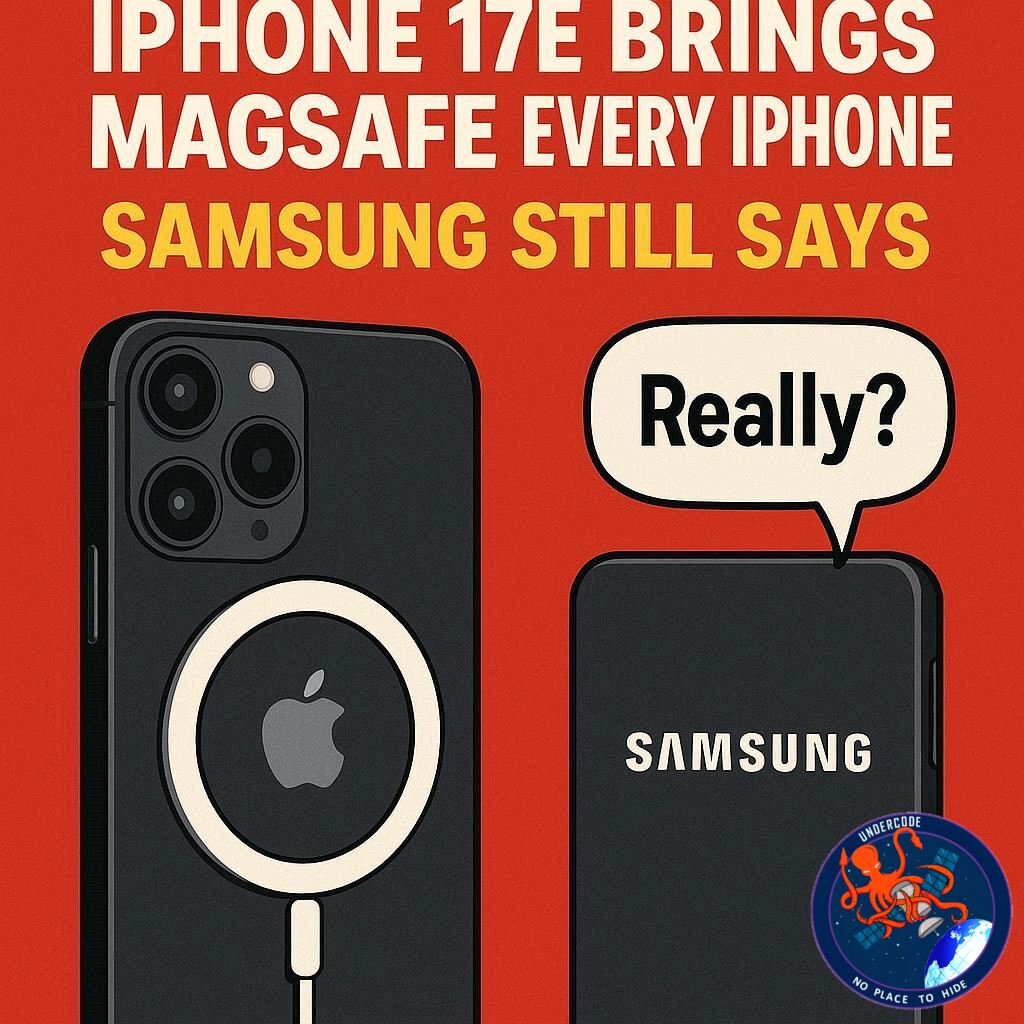
This move does more than improve charging convenience. It highlights a growing philosophical divide between Apple and its biggest Android competitor, Samsung, which continues to avoid embedding magnets directly inside its smartphones—even in flagship devices like the Samsung Galaxy S24 Ultra.
The result is a fascinating battle of design priorities: Apple pushing integrated hardware ecosystems, while Samsung argues that cases make built-in magnets unnecessary.
Apple’s Budget iPhone Gets a Meaningful Upgrade
The new Apple iPhone 17e replaces the previous Apple iPhone 16e, which itself succeeded the long-running Apple iPhone SE lineup.
While Apple’s budget devices historically lacked some premium features, this new model removes one of the biggest remaining gaps: MagSafe compatibility.
In practical terms, the upgrade means users can attach accessories directly to the back of the phone using a strong magnetic ring built into the device. This allows effortless use of wallets, charging pucks, battery packs, and stands without needing special cases.
The change may seem minor, but it represents a major shift in Apple’s hardware philosophy. Previously, MagSafe was reserved primarily for higher-end iPhones. Now, it has become a standard feature across the entire lineup.
Why MagSafe Matters More Than It Sounds
MagSafe is not just about magnets—it is about creating a standardized hardware platform for accessories.
With MagSafe integrated into the device, wireless chargers snap perfectly into alignment every time. This alignment improves charging efficiency and reduces energy loss that can occur when coils are slightly misaligned.
More importantly, the magnetic connection enables a wide ecosystem of accessories. Wallets attach instantly, portable battery packs lock into place, and stands can be mounted without clips or adhesives.
This level of consistency becomes possible only when the magnet system is built directly into the phone itself rather than relying on third-party cases.
Apple Completes the MagSafe Ecosystem
Since MagSafe debuted with the Apple iPhone 12, Apple has gradually expanded its accessory ecosystem.
Products such as Apple MagSafe Charger, magnetic wallets, and battery packs became popular additions to the iPhone experience. Even Apple’s tracking accessories, like the Apple AirTag, often pair naturally with MagSafe wallets and holders.
By bringing MagSafe to the entry-level iPhone, Apple ensures that every new iPhone user can participate in this ecosystem without restrictions.
For accessory manufacturers, the message is clear: the entire iPhone user base now supports magnetic accessories.
Samsung’s Different Philosophy
While Apple has embraced built-in magnets, Samsung continues to avoid integrating them into its phones.
According to Samsung executive Won‑Joon Choi, who oversees research and development for Samsung’s mobile division, the company believes magnets create design tradeoffs that are not worthwhile.
Samsung argues that most users already place their phones inside cases. Because of that, the company believes magnetic functionality can be added to cases rather than embedded inside the phone.
Choi has suggested that magnets add thickness to a phone’s design—space that Samsung would rather dedicate to larger batteries or slimmer devices.
The Case Argument: Samsung’s Key Justification
Samsung claims that roughly 80–90 percent of smartphone users place their devices inside protective cases.
If that is true, the company believes embedding magnets directly into the phone becomes redundant. Instead, accessory makers can integrate magnets into their cases.
From Samsung’s perspective, this approach offers flexibility while preserving valuable internal space.
But critics argue this method leads to inconsistent accessory performance because magnet placement and strength vary between case manufacturers.
The Problem With Third-Party Magnet Systems
Without a standardized magnetic system built directly into the device, the accessory experience becomes fragmented.
Some cases may position magnets incorrectly, weakening attachment strength. Others may use weaker magnets that fail to hold accessories securely.
This inconsistency creates unpredictable results when attaching wireless chargers or magnetic accessories.
By contrast, Apple’s approach ensures uniform magnet placement across every compatible device.
That means accessories designed for MagSafe work reliably across the entire iPhone lineup.
Apple’s Engineering Counterargument
Interestingly, Apple has demonstrated that integrating magnets does not necessarily compromise design.
The company even managed to incorporate MagSafe into ultra-thin devices like the Apple iPhone Air, showing that magnets can coexist with slim designs and solid battery performance.
This undercuts the argument that magnets inevitably require sacrificing battery capacity or device thickness.
Apple’s engineering solution suggests the tradeoffs may be smaller than critics claim.
What Undercode Says:
Apple Is Playing the Long Ecosystem Game
Apple rarely introduces hardware features without a long-term ecosystem strategy behind them. MagSafe is a perfect example of this philosophy.
At first, MagSafe looked like a convenience feature for wireless charging. But over time, it evolved into a platform—a hardware layer enabling an entire accessory economy.
By extending MagSafe to the Apple iPhone 17e, Apple effectively guarantees that every future iPhone user becomes part of that ecosystem.
That translates into enormous economic opportunity for accessory makers and further strengthens Apple’s control over the user experience.
The Hidden Revenue Engine Behind Accessories
MagSafe also opens the door to recurring accessory purchases.
Users frequently buy magnetic wallets, charging docks, car mounts, and battery packs that rely on Apple’s standardized magnet system. Each accessory reinforces the value of staying within the Apple ecosystem.
In other words, MagSafe is not just a hardware feature—it is a long-term monetization strategy.
Accessory ecosystems often generate billions of dollars in annual revenue for smartphone platforms.
Samsung’s Strategy Reflects Different Priorities
Samsung’s hesitation may reflect its broader Android strategy, which prioritizes hardware flexibility and rapid experimentation.
Instead of enforcing a single ecosystem standard, Samsung allows third-party manufacturers to innovate independently.
While this creates variety, it also sacrifices the tight integration Apple is known for.
This philosophical difference mirrors the larger contrast between iOS and Android: control versus openness.
Consumer Experience vs Engineering Efficiency
Samsung’s argument about saving internal space for batteries or slimmer phones is technically valid.
But from a consumer perspective, convenience often outweighs small hardware gains.
A magnetically attached charger or wallet may offer more daily value than an extra millimeter of thinness.
Apple clearly believes users prefer practical convenience over microscopic design optimizations.
MagSafe’s Real Advantage Is Simplicity
Technology succeeds when it removes friction.
MagSafe does exactly that. Instead of fiddling with cables or aligning wireless chargers manually, users simply snap accessories into place.
That simplicity creates a smoother user experience—and smoother experiences tend to win long-term consumer loyalty.
Samsung may eventually adopt a similar system once the accessory ecosystem grows large enough to demand it.
The Accessory Market Could Force Samsung’s Hand
If MagSafe accessories become dominant in the mobile accessory market, Samsung may eventually face pressure to introduce a compatible system.
Consumers increasingly expect convenience features that simplify everyday use.
And when enough users start asking why Android phones lack magnetic accessories that iPhones have, market pressure can shift corporate decisions quickly.
In technology history, ecosystem advantages often outweigh small hardware tradeoffs.
🔍 Fact Checker Results
MagSafe Introduction Timeline
✅ MagSafe was introduced with the Apple iPhone 12 in October 2020 and has expanded across Apple’s lineup since then.
Samsung’s Official Position on Magnets
✅ Samsung executives have publicly stated that magnets may add thickness and that many users rely on cases with built-in magnets instead.
Accessory Ecosystem Reality
❌ The claim that magnets significantly reduce battery capacity is debated; Apple has demonstrated thin designs with MagSafe intact.
📊 Prediction
Apple’s decision to make MagSafe universal across its iPhone lineup will likely accelerate the growth of magnetic accessories over the next five years.
Accessory makers will increasingly prioritize MagSafe-compatible designs because every new iPhone user can now support them.
If the accessory market continues expanding, Android manufacturers—including Samsung—may eventually introduce their own standardized magnetic systems.
The smartphone industry has repeatedly shown that once a convenience feature becomes widely adopted, competitors eventually follow. MagSafe may soon become not just an Apple feature—but an industry standard.
🕵️📝✔️Let’s dive deep and fact‑check.
References:
Reported By: 9to5mac.com
Extra Source Hub (Possible Sources for article):
https://www.instagram.com
Wikipedia
OpenAi & Undercode AI
Image Source:
Unsplash
Undercode AI DI v2
Bing
🔐JOIN OUR CYBER WORLD [ CVE News • HackMonitor • UndercodeNews ]
📢 Follow UndercodeNews & Stay Tuned:
𝕏 formerly Twitter 🐦 | @ Threads | 🔗 Linkedin | 🦋BlueSky | 🐘Mastodon


