
Listen to this Post
 Introduction: When Data Becomes the Backbone of the Farm Economy
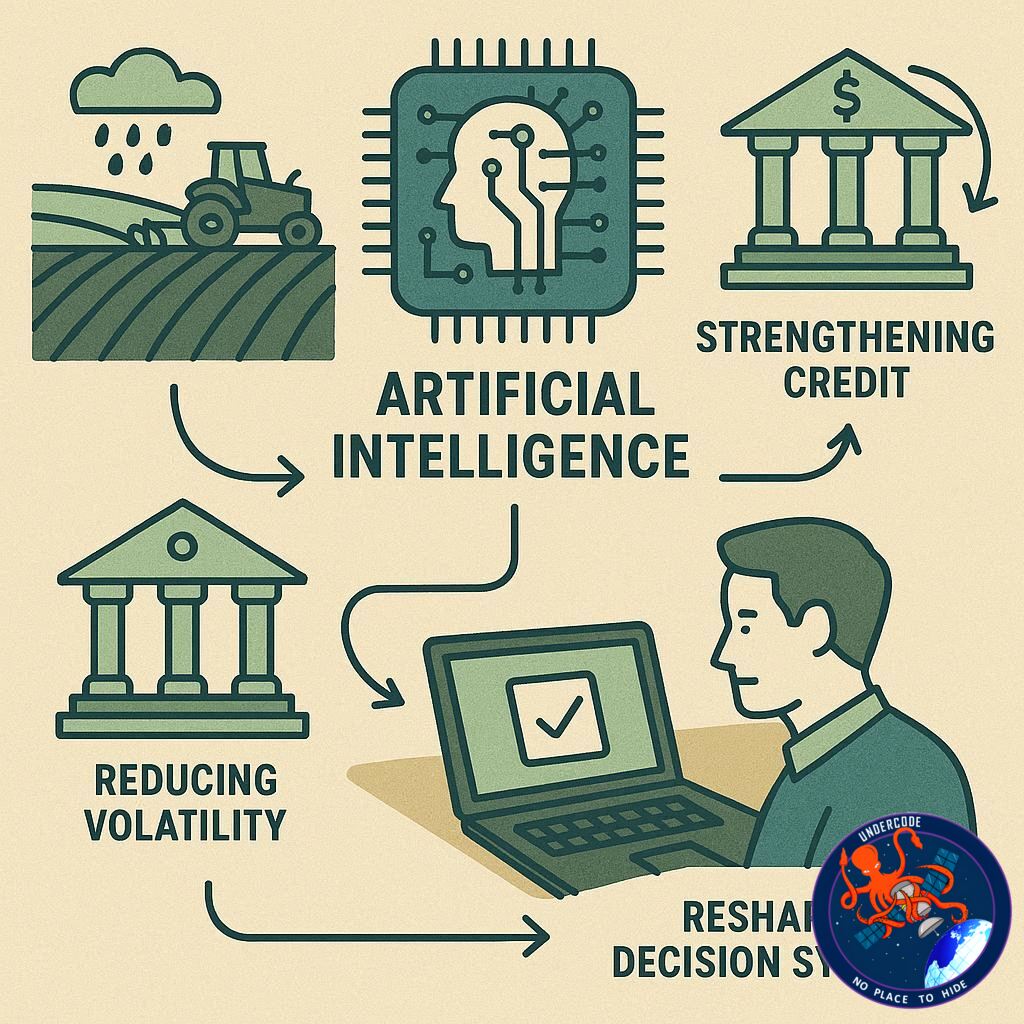
For decades, agriculture has struggled with one persistent enemy: uncertainty. Prices fluctuate without warning. Storage conditions deteriorate quietly. Credit decisions lag behind reality. Farmers and traders often operate with fragmented information, reacting instead of planning. Now, artificial intelligence is stepping beyond experimentation and positioning itself as the invisible operating layer of agricultural systems. Over the next two to five years, AI is expected to move from pilot projects and dashboards into the core infrastructure that powers decision-making across storage networks, lending institutions, and commodity markets.
This shift is not about replacing farmers or financial institutions. It is about embedding intelligence directly into the system so that price signals, quality data, repayment patterns, and regional demand movements are analyzed continuously rather than occasionally. The ambition is straightforward but transformative: reduce uncertainty, stabilize incomes, and create a more resilient agricultural value chain.
AI Transitioning from Initiative to Infrastructure
Artificial intelligence in agriculture is no longer framed as a separate innovation project. It is evolving into a foundational layer beneath everyday operations. Instead of launching new tools that sit outside workflows, AI is expected to integrate directly into processes that already exist, quietly improving their efficiency and reliability.
Agriculture often suffers from timing gaps between storage, financing, and market access. When information flows slowly or incompletely, decisions about selling crops, extending credit, or holding inventory become speculative rather than strategic. AI addresses this by continuously processing data across these interconnected segments. By analyzing storage costs, repayment behaviors, commodity price trends, and local demand shifts in real time, it enables better judgment calls.
The ultimate goal is to smooth volatility and create income predictability across the agricultural ecosystem. When decision-making becomes data-driven and dynamic, risk is distributed more intelligently.
Strengthening Storage and Quality Control Systems
Distributed storage networks play a crucial role in agricultural trade, yet they often operate with inconsistent monitoring standards. Structured quality checks and collateral assessments are essential, but maintaining consistency across geographies can be operationally demanding.
AI can standardize these processes. By monitoring storage points simultaneously and identifying deviations in temperature, moisture, or handling conditions, it creates early-warning mechanisms. Instead of discovering quality deterioration after financial losses occur, systems can flag risks before they escalate.
Equally important is the generation of digital audit trails. Transparent records of quality inspections and collateral evaluations strengthen trust between farmers, lenders, and buyers. In a sector where documentation has traditionally been fragmented, consistent digital tracking reduces disputes and increases credibility.
Dynamic Credit Underwriting and Risk Calibration
Agricultural lending has historically relied on static documentation and manual verification. This approach struggles to adapt to commodity price volatility and changing repayment behaviors. As more first-time borrowers enter formal credit systems, the need for dynamic risk assessment becomes critical.
AI-driven underwriting models can incorporate commodity cycles, historical repayment data, and storage patterns into real-time risk calculations. Instead of assessing creditworthiness based solely on paperwork, lenders can calibrate risk dynamically. If market conditions shift or repayment trends change, models adjust accordingly.
This flexibility allows high volumes of small-ticket, commodity-backed loans to be processed without slowing decision cycles. For rural borrowers, faster approvals mean quicker access to working capital. For lenders, it means scalable growth without proportional increases in operational strain.
Managing Scale Through Pattern Recognition
Scale introduces complexity. Monitoring thousands of storage facilities, analyzing district-level price data, and matching supply with buyer specifications require immense coordination. Human systems alone struggle to process this volume of information efficiently.
AI excels in pattern recognition across large datasets. It can determine whether holding stock remains economically rational after factoring in carrying costs. It can match supply based on grade, quantity, and location to precise buyer requirements. It can detect anomalies that indicate storage quality risks before losses accumulate.
These are not abstract efficiencies. They directly impact profitability. When supply meets demand more precisely and inventory decisions are data-informed, margins improve and waste declines.
The Cost Question: Who Pays for Intelligence?
Despite the operational benefits, a central concern remains: access and affordability. AI systems rely on data infrastructure, analytics platforms, and continuous model training. The costs associated with building and maintaining such systems must be allocated somewhere.
Will farmers absorb these costs? Will governments subsidize adoption? Or will platform providers integrate expenses into service fees? Adoption will ultimately depend on measurable return on investment. If farmers see income stability improve and risk decline, AI becomes justified. If costs outweigh perceived gains, uptake may stall.
Clarity on economic responsibility is essential. Without a sustainable pricing model, even the most advanced systems risk underutilization.
Grounding AI in Agricultural Realities
Agriculture is not uniform. Harvest windows differ across regions. Market volumes shift with seasonal cycles. Rural liquidity tightens and loosens based on crop timing. AI models must incorporate these regional variables to remain relevant.
Data alone is insufficient without contextual understanding. Systems must communicate recommendations transparently. When a credit decision is flagged or a risk alert is generated, stakeholders need to understand why. Trust depends on explainability.
If AI recommendations appear opaque or disconnected from lived agricultural realities, adoption will falter. But if systems reduce risk at the farmgate, improve capital efficiency, and encourage broader participation in formal financial systems without adding operational complexity, they will fundamentally reshape the ecosystem.
What Undercode Say:
The transformation described here is less about technology and more about structural correction. Agriculture has always been an information-asymmetry industry. Farmers often lack timely price visibility. Lenders lack granular crop-cycle insights. Storage operators lack predictive monitoring systems. AI does not invent new markets, it reduces blindness within existing ones.
What stands out is the shift from reactive correction to predictive prevention. Historically, quality loss in storage was discovered after deterioration. Loan defaults were managed after delinquency occurred. Price collapses were addressed only once inventories had already piled up. AI introduces early detection logic. That fundamentally changes risk distribution.
However, the power dynamic embedded in this transition deserves scrutiny. When AI becomes the operating layer, control over data becomes control over leverage. Whoever owns the analytics platform gains visibility across the value chain. That visibility translates into influence over credit pricing, inventory timing, and trade matching. Governance frameworks will need to evolve alongside technological adoption.
Another dimension is data integrity. Agricultural environments often operate in low-connectivity regions. Data inputs may be inconsistent or manually entered. If raw data lacks reliability, AI models amplify noise rather than clarity. Investment in foundational data collection infrastructure is as critical as algorithm development itself.
There is also a psychological shift required. Farmers and small traders are accustomed to experiential decision-making rooted in generational knowledge. AI recommendations may challenge instinct. Adoption will not depend solely on accuracy metrics. It will depend on whether systems communicate in language aligned with agricultural intuition.
Financial inclusion is perhaps the most promising outcome. First-time borrowers entering formal credit systems represent a structural expansion of rural capital markets. Dynamic underwriting models can lower entry barriers without compromising risk discipline. That combination could gradually reshape rural liquidity patterns.
Yet scalability must be balanced with fairness. If algorithmic risk scoring becomes overly conservative in volatile regions, access to credit may shrink rather than expand. Transparent calibration is essential to prevent digital exclusion.
From an economic standpoint, AI in agriculture functions as a volatility dampener. Markets with smoother information flows tend to experience fewer extreme shocks. Stabilized income patterns contribute to broader macroeconomic resilience, particularly in agrarian economies where agriculture remains a substantial GDP component.
The next two to five years will likely determine whether AI becomes infrastructure or remains enhancement. Integration beneath workflows signals permanence. Once embedded in underwriting, storage audits, and price analytics, reversal becomes unlikely.
The real breakthrough will not be in model complexity but in systemic alignment. When incentives across farmers, lenders, storage operators, and technology providers align around shared risk reduction, AI ceases to be a tool and becomes an ecosystem stabilizer.
Fact Checker Results
✅ AI is increasingly integrated into agricultural storage monitoring and credit underwriting systems globally.
✅ Dynamic risk modeling based on commodity behavior improves lending precision compared to static documentation.
❌ AI adoption alone does not automatically guarantee income stability without proper governance and affordability structures.
Prediction
📊 AI will become embedded in most structured agricultural lending platforms within five years, especially in emerging markets.
📊 Farmers who adopt AI-supported storage and pricing systems early are likely to experience reduced income volatility.
📊 Regulatory frameworks will expand to address data ownership and algorithm transparency in rural finance ecosystems.
▶️ Related Video (76% Match):
🕵️📝✔️Let’s dive deep and fact‑check.
References:
Reported By: timesofindia.indiatimes.com
Extra Source Hub (Possible Sources for article):
https://www.quora.com/topic/Technology
Wikipedia
OpenAi & Undercode AI
Image Source:
Unsplash
Undercode AI DI v2
Bing
🔐JOIN OUR CYBER WORLD [ CVE News • HackMonitor • UndercodeNews ]
📢 Follow UndercodeNews & Stay Tuned:
𝕏 formerly Twitter 🐦 | @ Threads | 🔗 Linkedin | 🦋BlueSky | 🐘Mastodon


