
Listen to this Post
A Season Painted in Color
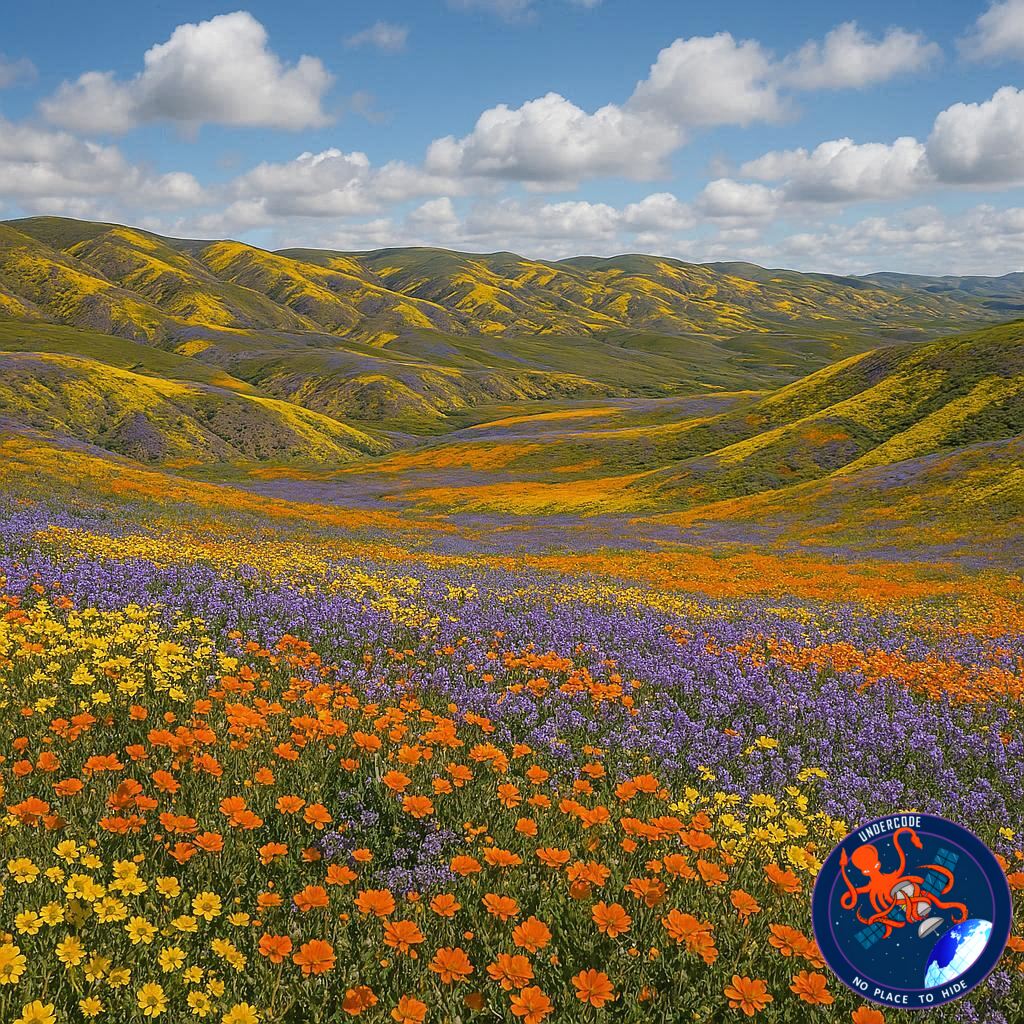
Every spring brings anticipation to California’s landscapes, but 2026 delivered something truly exceptional. Across the sweeping grasslands of Carrizo Plain National Monument, nature erupted into a vibrant display of wildflowers that many observers are calling a superbloom. While the term itself can be subjective, the sheer intensity and scale of color stretching across valleys and hills left little room for doubt: this was a rare and breathtaking moment in the natural cycle.
A Bloom That Began from Space
The transformation did not go unnoticed. Satellite imagery from NASA’s Landsat program first detected early signs of blooming as early as February. By March, areas surrounding Soda Lake were glowing in bright yellow hues, expanding rapidly across the terrain. The blooms followed the natural contours of the land, filling stream networks and spreading into surrounding hills, creating a living mosaic visible both from the ground and from orbit.
Rain, Timing, and the Perfect Formula
The remarkable bloom can be traced back to a near-perfect sequence of weather conditions. During late 2025, California experienced unusually heavy rainfall, with totals reaching nearly double the seasonal average. These soaking rains penetrated the soil, setting the stage for dormant seeds to awaken.
Many wildflower species require at least half an inch of rain to break their protective coating and begin germination. Once triggered, the following pattern of warm, dry intervals combined with occasional rainfall created ideal growing conditions. Instead of drowning in constant moisture, the plants thrived in this balanced rhythm, allowing them to establish and flourish.
Hillsides Come Alive
By early March, specific regions began to stand out. The Temblor Range’s west-facing slopes were among the first to burst into life, showcasing hillside daisies, California goldfields, and fiddlenecks. Meanwhile, the Caliente Range benefited from reduced grass cover following a wildfire in 2025, allowing wildflowers to dominate the landscape more vividly.
Near Soda Lake, the most striking yellow carpets were largely attributed to common goldfields. Though each plant is tiny, they grow densely and bloom in unison, creating vast fields of color that appear almost surreal from a distance.
A Valley of Endless Color
Botanists on the ground described the scene as overwhelming. Vast stretches of synchronized blooms covered both the valley floor and surrounding hills. What is typically a patchwork of seasonal flowers became an uninterrupted sea of color, far exceeding expectations even for seasoned experts.
This synchrony is what elevates a typical bloom into something extraordinary. When timing, moisture, and temperature align across an entire ecosystem, the result is a visual phenomenon that feels almost orchestrated.
Science Meets Spectacle
Beyond its beauty, the 2026 bloom offered a valuable opportunity for scientific research. Teams from NASA Goddard Space Flight Center conducted fieldwork during peak bloom, collecting spectral data from flowers while satellites captured imagery from above.
Their goal is ambitious: to build a global monitoring system capable of tracking flowering patterns using both ground observations and space-based sensors. Instruments like Landsat’s OLI and EMIT aboard the International Space Station are central to this effort.
Such systems could have far-reaching implications, helping farmers, beekeepers, and land managers better understand flowering cycles that impact crops like fruits, nuts, cotton, and honey production.
A Rare Alignment of Nature
Scientists involved in the study emphasized how unusual the conditions were. The previous year’s drought followed by a wet winter created a unique window where massive numbers of seeds germinated simultaneously. This rare alignment amplified the bloom’s scale and intensity, making it one of the most memorable displays in recent years.
What Undercode Say: The Hidden Power Behind a Superbloom
The 2026 Carrizo Plain bloom is more than a beautiful event; it is a living demonstration of ecological timing and resilience. Wildflowers are not simply passive elements of the landscape. They are highly responsive biological systems that react to subtle environmental triggers with remarkable precision.
What stands out most is the role of extremes. A dry year followed by heavy rainfall creates a biological reset. Seeds that have been dormant for years suddenly receive the signal to activate all at once. This synchronization is what transforms scattered blooms into a full-scale spectacle.
Another critical factor is disturbance. Events like wildfire, often viewed only as destructive, can actually prepare the land for future growth. By clearing dense vegetation, fire reduces competition and allows sunlight and nutrients to reach wildflower seeds. The result is often a more intense and visually dominant bloom in the following seasons.
From a technological perspective, this event highlights how far environmental monitoring has advanced. Satellite-based observation is no longer limited to tracking large-scale changes like deforestation or climate shifts. It is now precise enough to monitor seasonal biological events such as flowering cycles. This opens the door to predictive ecology, where blooms could be forecasted with increasing accuracy.
The implications extend into agriculture and economics. Pollinator activity, crop yields, and even tourism can be influenced by the timing and scale of flowering events. A reliable monitoring system could help industries prepare for fluctuations, optimizing production and resource allocation.
However, there is also a warning embedded in this beauty. Superbloom events depend on very specific conditions, many of which are being altered by climate change. As weather patterns become less predictable, the frequency and intensity of such blooms may shift. Some regions may experience more frequent blooms, while others could see them disappear entirely.
Ultimately, the Carrizo Plain bloom is a reminder of nature’s complexity. It is not just a seasonal attraction but a signal of deeper environmental processes at work. Understanding these processes is essential, not only for appreciating their beauty but for protecting the ecosystems that make them possible.
Fact Checker Results
✅ Heavy rainfall in late 2025 significantly increased soil moisture and supported germination
Streaming interrupted. Waiting for the complete message…
🕵️📝✔️Let’s dive deep and fact‑check.
References:
Reported By: science.nasa.gov
Extra Source Hub (Possible Sources for article):
https://www.quora.com
Wikipedia
OpenAi & Undercode AI
Image Source:
Unsplash
Undercode AI DI v2
Bing
🔐JOIN OUR CYBER WORLD [ CVE News • HackMonitor • UndercodeNews ]
📢 Follow UndercodeNews & Stay Tuned:
𝕏 formerly Twitter 🐦 | @ Threads | 🔗 Linkedin | 🦋BlueSky | 🐘Mastodon


