
Listen to this Post
Introduction: A Rare Bridge Between Rival Worlds
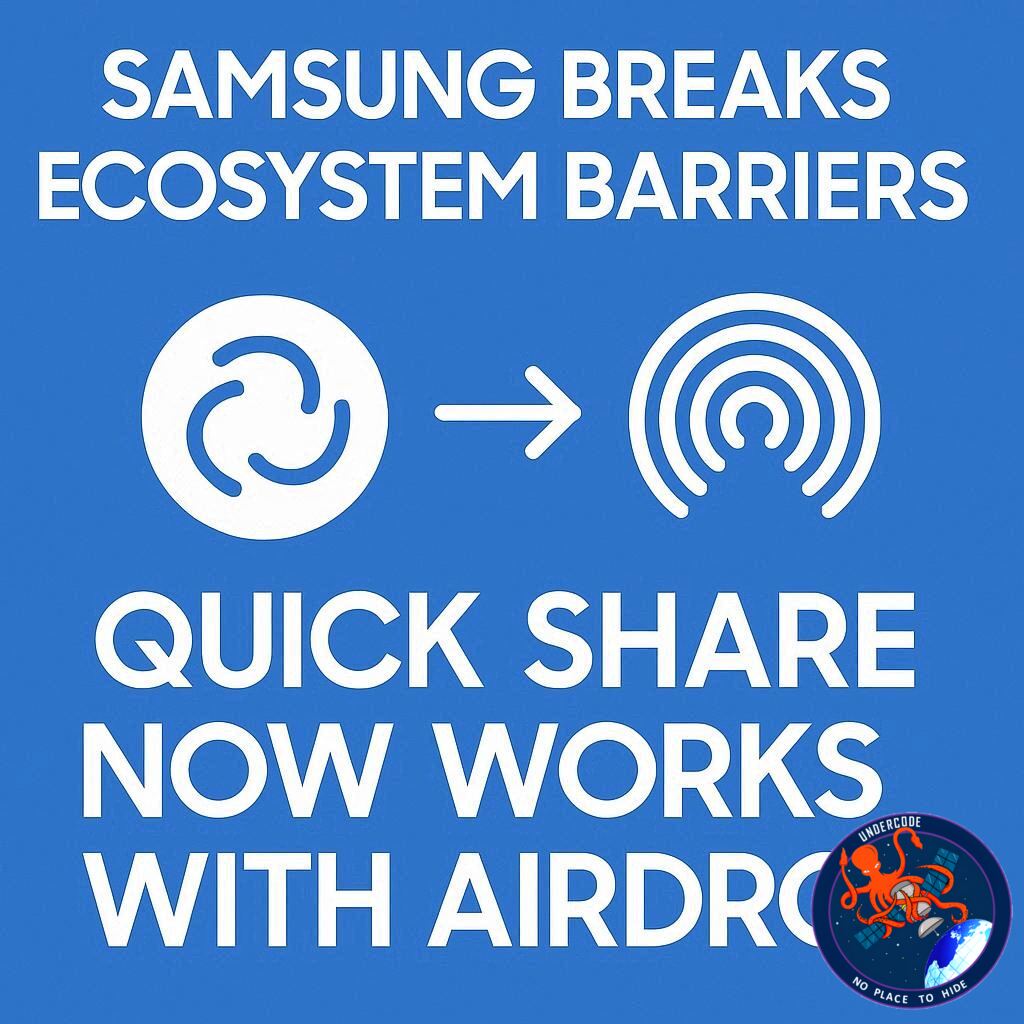
For years, the divide between Android and Apple users has been more than just preference, it has been a daily inconvenience. Sharing files across these ecosystems often meant relying on third-party apps, cloud uploads, or messaging workarounds. Now, Samsung Electronics is taking a bold step to close that gap by enabling compatibility between its Quick Share feature and AirDrop. This move signals a shift toward greater cross-platform usability, something users have long demanded but rarely received.
Summary: A Major Step Toward Cross-Platform File Sharing
Samsung has officially announced that its Quick Share feature will now support interoperability with Apple’s AirDrop, starting with the Galaxy S26 series. This means users of Samsung’s latest flagship smartphones will be able to exchange photos, videos, and other files directly with iPhones running iOS, something that was previously impossible without external tools. Both Quick Share and AirDrop rely on Bluetooth to detect nearby devices and facilitate secure file transfers, but until now, they operated within closed ecosystems that prevented cross-platform communication.
The update is rolling out first to Galaxy S26 users, with plans to expand support to additional Samsung devices in the future. Initially available in select markets, including the United States and Europe, the feature aims to simplify how users share content across different operating systems. Samsung emphasized that this integration is designed to maximize user convenience and eliminate friction between device users.
Alongside this announcement, Samsung also revealed a new Car-to-Home service developed in collaboration with Hyundai Motor Group. This feature allows drivers to control home appliances directly from their vehicles using the SmartThings platform. Users can activate air conditioners, lights, air purifiers, and even robot vacuum cleaners through in-car infotainment systems.
The service introduces practical modes such as “home mode,” which prepares the house as the user approaches, and “away mode,” which powers down unused devices while initiating cleaning tasks. This integration is currently available in Hyundai and Kia vehicles produced after November 2022 that support connected car systems, with broader expansion expected through future software updates.
Overall, Samsung’s announcements highlight a dual strategy: improving interoperability between competing ecosystems while deepening its own smart home and connected vehicle integrations. These developments suggest a future where device compatibility becomes less of a barrier and more of a seamless experience for users.
What Undercode Say: A Strategic Shift That Could Redefine Tech Rivalry
Samsung’s decision to make Quick Share compatible with AirDrop is not just a technical update, it is a strategic signal to the entire tech industry. For years, companies like Apple Inc. have relied on tightly controlled ecosystems to retain users, creating what many call “walled gardens.” By opening a bridge into Apple’s ecosystem, Samsung is challenging that model without directly confronting it.
This move reflects a growing realization in the tech world: user experience is becoming more important than ecosystem lock-in. Consumers today own multiple devices across brands, and forcing them into rigid ecosystems creates friction that ultimately harms brand loyalty. Samsung appears to be betting that convenience will win over exclusivity.
From a technical standpoint, enabling interoperability between Quick Share and AirDrop is not trivial. Both systems use proprietary protocols layered over Bluetooth and Wi-Fi. Achieving compatibility likely required reverse engineering, collaboration, or the adoption of shared standards that were previously avoided. This raises an important question: is Apple quietly allowing this integration, or is Samsung finding ways to work around it? Either scenario is significant.
The timing is also critical. As smartphone innovation slows in hardware, software features and ecosystem integration are becoming the primary differentiators. By enabling cross-platform sharing, Samsung is positioning itself as the more flexible and user-friendly option. This could attract users who are frustrated with Apple’s limitations but still need to interact with iPhone users daily.
Meanwhile, the Car-to-Home integration with Hyundai and Kia reveals Samsung’s broader ambition: to become the central hub of a connected lifestyle. By linking smartphones, vehicles, and home appliances through SmartThings, Samsung is building an ecosystem that extends beyond traditional devices. Unlike Apple, which focuses heavily on its own hardware lineup, Samsung is leveraging partnerships to expand its reach into areas like automotive technology.
However, there are risks. If Apple chooses to restrict or counter this interoperability, the feature could face limitations or inconsistencies. Additionally, expanding compatibility across devices requires maintaining security and privacy standards, something both companies are highly sensitive about. Any vulnerability introduced through cross-platform sharing could quickly undermine user trust.
Still, the long-term implications are hard to ignore. If this experiment succeeds, it could pressure other tech giants to follow suit, leading to a more open and interconnected digital environment. That would mark a significant departure from the closed ecosystems that have defined the smartphone era for over a decade.
In essence, Samsung is not just adding a feature, it is testing a new philosophy: one where collaboration, even indirect, becomes a competitive advantage.
Fact Checker Results
✅ Samsung confirmed Quick Share compatibility with AirDrop for Galaxy S26 devices.
✅ The feature rollout is initially limited, with expansion planned to other devices and regions.
❌ Full technical details on how interoperability is achieved have not been publicly disclosed.
Prediction
🔮 Cross-platform sharing will become a standard expectation rather than a premium feature.
🔮 Apple may respond with tighter controls or its own limited interoperability features.
🔮 Samsung’s SmartThings ecosystem will expand further into automotive and smart home dominance.
🕵️📝✔️Let’s dive deep and fact‑check.
References:
Reported By: zeenews.india.com
Extra Source Hub (Possible Sources for article):
https://www.stackexchange.com
Wikipedia
OpenAi & Undercode AI
Image Source:
Unsplash
Undercode AI DI v2
Bing
🔐JOIN OUR CYBER WORLD [ CVE News • HackMonitor • UndercodeNews ]
📢 Follow UndercodeNews & Stay Tuned:
𝕏 formerly Twitter 🐦 | @ Threads | 🔗 Linkedin | 🦋BlueSky | 🐘Mastodon


