
Listen to this Post
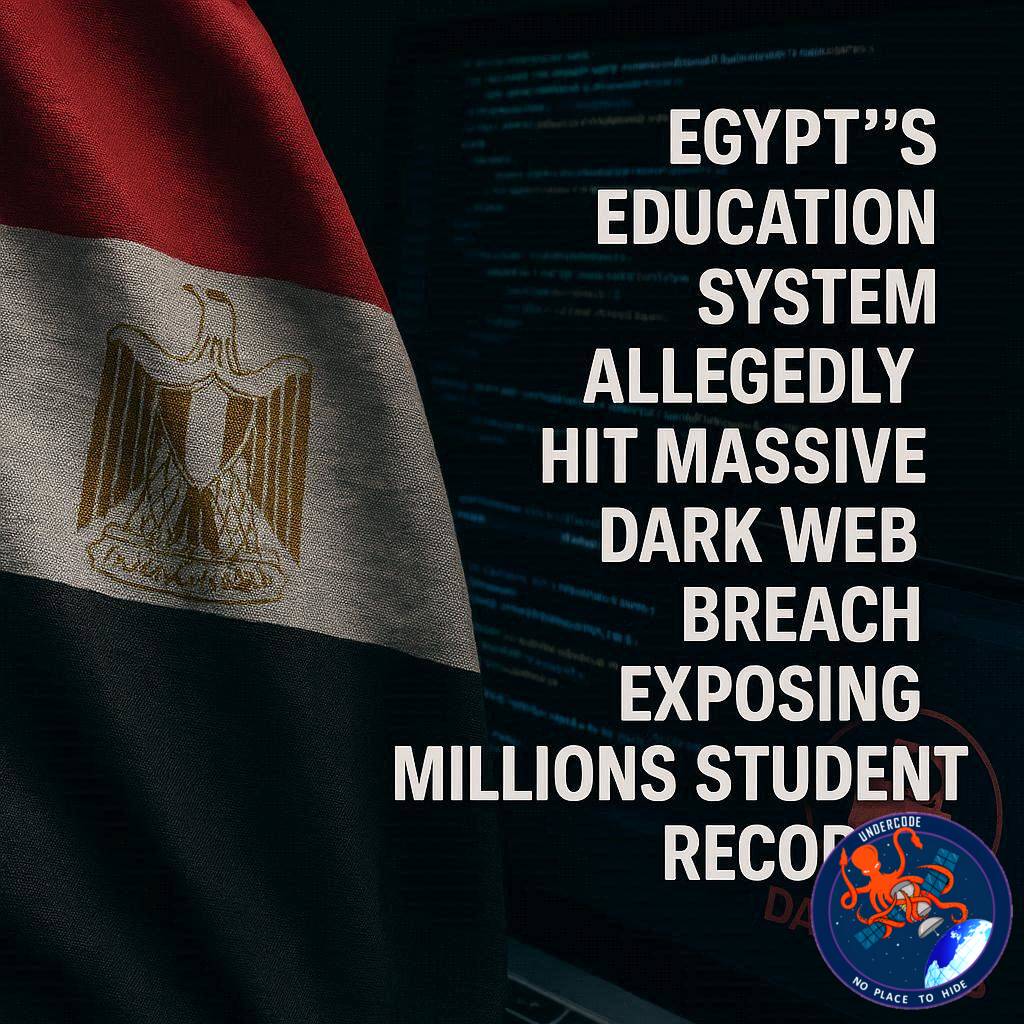
A Growing Cybersecurity Storm Around Egypt’s Ministry of Education
A new cyber threat allegation is sending shockwaves through the cybersecurity community after a dark web actor claimed to have gained extensive access to systems connected to Egypt’s Ministry of Education. The claims, first circulated by the cyber intelligence account “Dark Web Intelligence,” suggest that one of the largest educational data exposures in the region may have occurred — though officials have not yet verified the authenticity of the breach.
According to the underground post, the attacker allegedly accessed a huge collection of student and administrative information tied to the Egyptian education sector. The claims include access to records involving students from Grades 1 through 12, databases containing teacher and administrator details, examination infrastructure, and even high-level administrative privileges capable of controlling key educational platforms.
The alleged dataset reportedly contains nearly 26.8 million student-related entries and approximately 3.8 million records tied to teachers and administrators. The actor also claimed the overall data archive size reached around 22.6 GB, suggesting a potentially enormous centralized repository of sensitive educational information.
Even more alarming are the alleged capabilities described by the threat actor. According to the post, the intruder could supposedly manage teacher and student accounts, reset passwords, modify administrative data, alter personnel information, and control school-wide platform functionality. If proven authentic, the incident could represent a severe compromise of digital infrastructure tied to Egypt’s educational ecosystem.
At the moment, none of these claims have been independently confirmed. There has also been no official statement validating the alleged breach or confirming unauthorized access to Ministry systems. Cybersecurity researchers remain cautious because dark web actors frequently exaggerate claims to attract attention, buyers, or reputation within underground communities.
Still, experts warn that even unverified claims deserve serious attention when critical infrastructure and children’s data are involved. Education systems have become increasingly attractive targets for cybercriminals due to the massive amount of centralized personal information they store. Student databases often include names, addresses, phone numbers, academic records, national identifiers, parent details, and login credentials — all highly valuable for identity theft and phishing operations.
Teachers and school administrators are also prime targets because they often possess elevated access privileges across multiple platforms. If attackers gain access to those accounts, they may move laterally through connected systems, manipulate records, or disrupt operations across entire institutions.
One particularly worrying aspect of the alleged breach involves examination-related systems. Educational examination infrastructure has become a major cyber target globally because manipulating test data, leaking exams, or disrupting grading systems can create both financial and political chaos. Threat actors sometimes use such access for extortion, while others exploit it for fraud or credential abuse.
The education sector has long struggled with cybersecurity weaknesses. Many institutions continue operating with outdated infrastructure, weak network segmentation, inconsistent identity management systems, and underfunded security programs. Unlike major financial institutions that invest heavily in digital defense, educational organizations often lack the resources necessary to withstand sophisticated attacks.
Another major concern is the long-term risk involving minors. Data tied to children can remain useful for cybercriminals for years because young individuals are less likely to monitor financial activity or identity misuse. Stolen educational records may later be used for social engineering campaigns, phishing attacks, or even future identity fraud.
Cybersecurity analysts say organizations potentially affected by incidents like this should immediately review privileged account activity, rotate credentials, enforce multi-factor authentication across administrative systems, and audit account reset workflows. Monitoring for suspicious exports, unusual database activity, and unauthorized administrative behavior also becomes essential following alleged breaches of this scale.
Security teams investigating similar compromises typically search for exposed APIs, insecure cloud storage buckets, privilege escalation attempts, compromised SSO configurations, and signs of lateral movement inside internal systems. These attack patterns have become increasingly common in education-related cyber incidents worldwide.
The alleged Egypt incident also reflects a broader international trend where cybercriminals are aggressively targeting public-sector digital infrastructure. Government-linked educational systems are especially attractive because they combine enormous user populations with historically weak cybersecurity maturity.
Over the past few years, ransomware groups, data brokers, and financially motivated threat actors have increasingly focused on schools, universities, and ministries of education across multiple countries. These organizations often rely on interconnected platforms that manage admissions, examinations, payroll, communication systems, and cloud-based educational services — creating a large attack surface for exploitation.
The dark web ecosystem has further accelerated this trend. Underground forums now function like criminal marketplaces where stolen databases, access credentials, and compromised systems are traded regularly. Threat actors often use public breach claims as advertisements to attract buyers or establish credibility inside cybercriminal communities.
Whether this specific claim proves genuine or exaggerated, the incident highlights the fragile state of cybersecurity within educational infrastructure globally. Even the possibility of such extensive access demonstrates how critical it has become for governments and institutions to modernize defenses before attackers exploit systemic weaknesses at scale.
What Undercode Says:
The Education Sector Has Quietly Become a Cybersecurity Disaster Zone
One of the biggest misconceptions in cybersecurity is that banks or defense systems are the primary targets. In reality, education systems are rapidly becoming one of the most vulnerable sectors in the world. They contain massive amounts of centralized citizen data but rarely receive cybersecurity budgets capable of defending that information properly.
The alleged Egypt Ministry of Education breach perfectly reflects this dangerous imbalance.
Educational institutions are now giant digital ecosystems. They no longer store only grades or attendance records. Modern education platforms often contain biometric identifiers, national IDs, examination systems, cloud collaboration tools, parent communications, payment systems, and even behavioral analytics. A successful intrusion into such infrastructure can expose an entire generation’s digital identity footprint.
The reported number — nearly 26.8 million student entries — is staggering. Even if partially inflated, the scale alone suggests the possibility of deeply centralized architecture. Centralization increases efficiency for governments, but it also creates an attractive “single-point jackpot” for cybercriminals.
Another alarming aspect is the claimed administrative-level access. Data theft alone is already severe, but administrative control changes the threat entirely. Administrative access can allow attackers to manipulate records, alter identities, reset passwords, create persistence mechanisms, or even sabotage operational systems from within.
This transforms a potential breach from a passive data leak into an active infrastructure compromise.
The inclusion of examination-related systems is especially critical. Examination systems carry social, economic, and political significance in many countries. Manipulation of examination content or student results could trigger public outrage, legal disputes, and institutional distrust on a national scale.
Cybercriminal groups increasingly understand the psychological leverage attached to educational infrastructure. Unlike financial breaches, attacks on schools affect students, families, teachers, and public confidence simultaneously. That emotional impact gives attackers additional power during extortion attempts.
There is also a darker long-term issue many people ignore: children’s data ages extremely well for cybercrime purposes.
Unlike adults who may quickly detect suspicious financial activity, minors often remain outside traditional monitoring systems for years. Attackers can hold stolen identities for long periods before exploiting them later in adulthood. Educational databases effectively become future identity theft reservoirs.
Another important angle is geopolitical cyber exposure.
Regional government platforms frequently operate with legacy infrastructure that was never designed to withstand modern attack techniques. Rapid digital transformation often outpaces security modernization. Governments prioritize functionality and accessibility first, while security architecture becomes secondary.
This creates environments where:
legacy applications remain exposed online
privileged accounts accumulate excessive permissions
segmentation between services becomes weak
monitoring systems fail to detect lateral movement
outdated authentication systems persist for years
Threat actors actively search for exactly these weaknesses.
The dark web itself has also evolved significantly. Years ago, attackers mainly sold stolen credit cards or personal credentials. Today, access brokerage has become a booming underground economy. Criminals now sell direct access into organizations, cloud dashboards, government systems, and enterprise management panels.
That means breaches are no longer isolated events. One compromise often becomes the entry point for multiple criminal groups.
If the Egypt claims prove authentic, downstream risks could include:
phishing campaigns against parents and teachers
credential stuffing attacks
impersonation scams
educational certificate fraud
ransomware deployment
black-market identity trading
examination manipulation attempts
The biggest issue, however, is trust erosion.
When citizens lose confidence in educational systems, the consequences extend beyond cybersecurity. Public institutions depend heavily on perceived reliability. A major breach involving millions of minors could seriously damage trust in digital education initiatives for years.
This is why education cybersecurity can no longer remain treated as a secondary technical issue. It has become a national security concern.
Governments across the Middle East, Africa, Europe, and Asia are rapidly digitizing public education infrastructure, but many still underestimate how aggressively cybercriminals target these systems. Attackers understand that schools are often easier to penetrate than banks while still providing massive datasets with long-term value.
The modern cyber battlefield is no longer limited to military or financial targets. Schools, universities, and educational ministries are now frontline targets in the global data economy.
🔍 Fact Checker Results
✅ Verified Information
The dark web post claiming access to Egypt’s Ministry of Education systems was publicly shared online and referenced specific datasets, administrative privileges, and alleged platform capabilities.
❌ Unverified Claims
There is currently no independent forensic verification confirming that the alleged 26.8 million student records or administrative access claims are authentic.
✅ Realistic Cybersecurity Concerns
Experts widely agree that education systems globally remain attractive targets due to large centralized databases, legacy infrastructure, and historically underfunded cybersecurity programs.
📊 Prediction
Cyberattacks Against Schools Will Intensify Globally
Education-sector cyberattacks are expected to rise sharply over the next few years as governments continue digitizing student services and examination infrastructure. Threat actors increasingly view educational systems as high-value targets because they combine enormous data volumes with weaker defenses compared to financial institutions.
If incidents like the alleged Egypt breach continue appearing across the region, governments may be forced to accelerate cybersecurity modernization programs, implement mandatory multi-factor authentication across public-sector education systems, and strengthen national cyber incident response frameworks.
The larger trend is already visible: schools are no longer low-priority targets. They are becoming one of the most aggressively targeted sectors in the global cyber threat landscape.
🕵️📝Let’s dive deep and fact‑check.
References:
Reported By: x.com
Extra Source Hub (Possible Sources for article):
https://www.github.com
Wikipedia
OpenAi & Undercode AI
Image Source:
Unsplash
Undercode AI DI v2
Bing
🔐JOIN OUR CYBER WORLD [ CVE News • HackMonitor • UndercodeNews ]
📢 Follow UndercodeNews & Stay Tuned:
𝕏 formerly Twitter 🐦 | @ Threads | 🔗 Linkedin | 🦋BlueSky | 🐘Mastodon


