
Listen to this Post
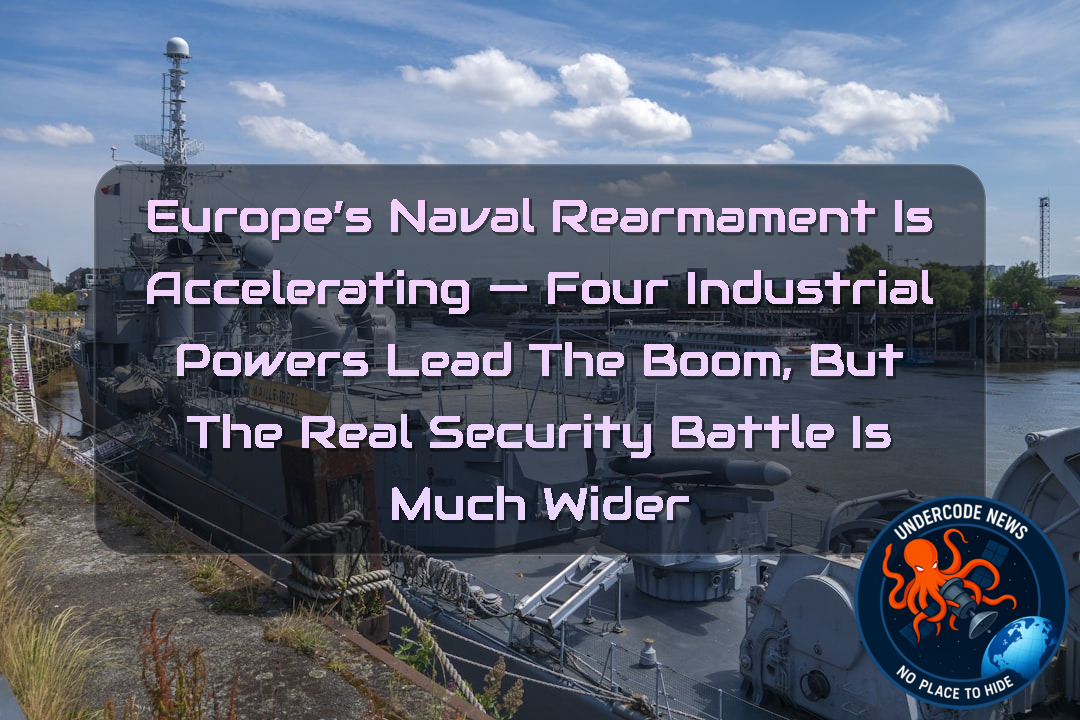 A New Maritime Arms Race Is Taking Shape
Europe is quietly undergoing one of the most significant naval buildups in decades. Across the continent, governments are increasing defence budgets, shipyards are expanding production, submarines are returning to the centre of military planning, and maritime surveillance is becoming just as important as the warships themselves.
The numbers reveal the scale of the transformation. Defence spending by the European Union’s 27 member states reached €418 billion in 2025, a 20% increase from 2024, and the European Defence Agency expects the figure to rise to approximately €454 billion in 2026, equivalent to 2.4% of EU GDP.
But Europe’s maritime transformation cannot be measured simply by counting ships or comparing national defence budgets. The countries building the largest numbers of naval systems are not necessarily the countries carrying the greatest strategic risk.
That distinction is becoming increasingly important as Europe confronts a security environment dominated by Russia’s war against Ukraine, threats to undersea infrastructure, vulnerable trade routes, sanctions evasion networks, hybrid warfare and the possibility that a future conflict could extend far beyond Europe’s land borders.
The Four Countries Building Europe’s Naval Future
France, Germany, Italy and Spain dominate the EU’s maritime defence industrial landscape. Together, they account for the overwhelming majority of Europe’s naval production and represent the industrial backbone upon which much of the continent’s future maritime capability will depend.
France is particularly important. Its shipbuilding sector supports a broad range of capabilities, including frigates, submarines, amphibious vessels and other advanced naval platforms. The country’s industrial base is also supported by a long-standing strategic culture that treats naval power as an essential instrument of national influence.
Germany brings a different strength. Its reputation in conventional submarine construction, naval engineering and sophisticated industrial manufacturing gives it an important role in European maritime security.
Italy has become another major naval power within the European industrial system. Its shipyards produce a wide range of surface combatants, support ships and patrol vessels, while its geographic position in the Mediterranean gives the country a direct strategic interest in maritime security.
Spain completes the group as another major European shipbuilding centre, combining industrial capacity with a strategic position linking the Atlantic and Mediterranean theatres.
The European Commission’s Blue Economy Observatory estimates that EU maritime defence production reached €13.7 billion in 2025. Ships represented approximately 65% of the output value, while submarines accounted for another 27%, demonstrating how heavily European naval investment is concentrated in high-value platforms.
Submarines Are Becoming a Central European Priority
One of the clearest signs of Europe’s changing strategic environment is the renewed importance of submarines.
Submarines are among the most difficult and expensive military systems to develop, but they provide capabilities that surface fleets cannot easily reproduce. They can monitor large maritime areas, operate covertly, threaten hostile naval forces and protect strategic approaches.
The European maritime defence industry produced an especially significant volume of submarine-related capability in 2025, with submarines accounting for 27% of total maritime defence output value.
This matters because Europe’s submarine requirements are no longer limited to traditional naval warfare. Underwater platforms can also contribute to surveillance, intelligence gathering and the protection of critical infrastructure.
The Map Can Be Misleading
A map showing France, Germany, Italy and Spain as Europe’s maritime defence leaders is technically accurate but strategically incomplete.
Industrial production tells us where Europe builds military equipment. It does not necessarily tell us where Europe faces the greatest maritime danger.
Greece is an obvious example.
Its navy operates in one of the most strategically complicated maritime environments in Europe, spanning the Aegean and Eastern Mediterranean and extending into areas affected by wider Middle Eastern instability.
Sweden presents another important case.
Its navy is smaller than those of France or Italy, but its geographical position makes maritime defence in the Baltic Sea a national priority. Sweden has also developed a sophisticated domestic defence industry capable of supporting specialised capabilities designed for northern European conditions.
The lesson is straightforward: industrial capacity and strategic exposure are two different measurements.
Poland Changes the Defence Map
The same problem appears when defence spending is measured as a percentage of GDP rather than in absolute euros.
Poland has emerged as one of Europe’s most aggressive defence spenders, with defence expenditure reaching 4.48% of GDP according to the figures presented in the source article.
Lithuania, Latvia and Estonia are also allocating exceptionally large shares of national economic output to defence.
Their common characteristic is geography.
These countries are located on Europe’s eastern flank, directly exposed to Russia or its strategic orbit and, in the case of Lithuania, Latvia and Estonia, situated close to Belarus.
For these states, defence spending is not simply about modernising armed forces. It is about maintaining deterrence.
Germany’s Transformation Is Particularly Important
Germany represents perhaps the most consequential shift among Europe’s major economies.
Its defence spending as a percentage of GDP has increased dramatically compared with the levels seen before Russia’s full-scale invasion of Ukraine.
The German transformation matters because Berlin possesses something few European countries can match: enormous economic and industrial capacity.
If Germany can translate financial resources into sustained military procurement, industrial expansion and operational readiness, the effect will extend far beyond the German military itself.
It could reshape Europe’s entire defence-industrial ecosystem.
Europe Does Not Need Twenty-Seven Navies of Equal Size
The central strategic question is not whether every EU country should build a large navy.
That would be financially inefficient and, in many cases, geographically unnecessary.
Instead, Europe needs a system in which different countries specialise while remaining interoperable.
One country may provide frigates.
Another may specialise in submarines.
Another may focus on maritime patrol aircraft.
Another may provide mine warfare capabilities.
Another may concentrate on unmanned underwater systems, coastal defence or surveillance.
The strength would come from connecting these capabilities into one operational picture.
Interoperability Could Matter More Than Fleet Size
A technologically advanced ship becomes less useful if it cannot communicate effectively with allied systems.
This is why interoperability is increasingly becoming one of Europe’s most important maritime defence requirements.
A distributed European fleet could potentially cover more territory and provide greater resilience than a smaller number of extremely powerful national fleets operating independently.
The objective should therefore not be to make every European navy look the same.
The objective should be to make different European navies work together as if they were parts of a larger security architecture.
The United Kingdom and Norway Cannot Be Ignored
Another limitation of an EU-only maritime map is that Europe’s security environment does not stop at the EU’s external borders.
The United Kingdom remains one of Europe’s most capable naval powers.
Norway occupies an exceptionally important strategic position in the North Atlantic and Arctic region.
Both countries are therefore essential to any serious discussion about European maritime security, even though neither is an EU member.
A European maritime strategy that excludes these partners would leave significant gaps in the North Atlantic, Arctic and northern European security picture.
Russia Has Changed the Maritime Threat
The driving force behind Europe’s naval spending is not simply a desire to acquire more advanced ships.
It is the changing nature of the threat.
Russia’s war against Ukraine has demonstrated that modern conflict can combine conventional military operations with cyberattacks, sabotage, intelligence operations, economic pressure and attacks against critical infrastructure.
The sea is increasingly becoming the environment where these activities overlap.
The Shadow Fleet Problem
One of Europe’s growing concerns is the so-called shadow fleet: vessels used to transport sanctioned commodities through opaque ownership structures, flags and insurance arrangements.
The strategic concern goes beyond sanctions enforcement.
A large and poorly understood maritime ecosystem creates opportunities for intelligence gathering, suspicious activity around critical infrastructure and other forms of hybrid pressure.
That means European maritime security increasingly requires authorities to understand not only military vessels but also commercial shipping patterns.
Undersea Cables Have Become Strategic Targets
Few developments illustrate the changing nature of maritime security better than Europe’s growing concern over submarine cables.
Modern economies depend heavily on undersea infrastructure.
The European Commission states that submarine data cables carry 99% of intercontinental internet traffic.
These cables also carry electricity between countries and support the functioning of increasingly interconnected European energy markets.
A cable cut may therefore appear to be a small physical incident while creating consequences far beyond the seabed.
Baltic Infrastructure Has Become a Warning
Repeated incidents involving undersea infrastructure in and around the Baltic Sea have forced European governments to reconsider how they protect critical maritime assets.
The response has included stronger surveillance, greater cooperation and the development of dedicated European policies for cable protection.
The EU adopted its Action Plan on Cable Security in February 2025, focusing on prevention, detection, response, recovery and deterrence.
This is an important evolution because it treats infrastructure protection as a security issue rather than merely an engineering problem.
NATO’s Maritime Role Is Growing Too
The European response is also closely connected to NATO.
Baltic maritime patrol and surveillance initiatives demonstrate that European maritime defence increasingly depends on cooperation between national navies and wider alliance structures.
The Baltic Sea is particularly important because it combines dense commercial traffic, critical infrastructure, NATO territory and proximity to Russia.
That makes it a testing ground for Europe’s new approach to maritime security.
Europe Is Funding Cable Protection
Brussels has begun putting money behind the new strategy.
In February 2026, the European Commission announced €347 million for strategic submarine cable projects, including funding to improve Europe’s ability to repair damaged cables.
That may sound substantial, but it is tiny compared with Europe’s overall defence spending.
This reveals an important problem: the cost of protecting critical infrastructure is relatively small compared with the economic consequences of losing it, yet funding remains fragmented across defence, digital infrastructure, energy and transport programmes.
Maritime Security Is Becoming an Economic Security Issue
The old definition of naval power was largely military.
Today, the definition is much broader.
Ports, energy pipelines, offshore wind farms, data cables, shipping lanes, fishing grounds and telecommunications networks are all part of the maritime security environment.
Protecting them requires navies, coast guards, intelligence agencies, commercial shipping companies, telecommunications providers and governments to share information.
The result is a maritime security model that looks increasingly like a network rather than a fleet.
Europe’s €150 Billion SAFE Instrument
The EU is also attempting to solve the procurement problem through large-scale financing.
The Security Action for Europe, or SAFE, provides up to €150 billion in EU-backed loans designed to support rapid defence investment and common procurement.
The significance of SAFE is not simply its size.
Its larger purpose is to encourage European countries to buy together, expand production capacity and reduce capability gaps.
If applied effectively to naval systems, this could help European countries avoid buying incompatible equipment from multiple suppliers.
The Industrial Maritime Strategy
In March 2026, the European Commission adopted an Industrial Maritime Strategy aimed at strengthening Europe’s maritime manufacturing and shipping sectors.
The strategy recognises that shipbuilding is not simply a commercial activity.
It has direct implications for strategic autonomy, defence capabilities, trade and economic security.
That is an important policy shift.
Europe is beginning to recognise that a country cannot maintain maritime military power indefinitely if its industrial ecosystem cannot build, repair and sustain the ships required by its armed forces.
PESCO Could Help Build Common Ships
European cooperation is also visible through Permanent Structured Cooperation, or PESCO.
The European Patrol Corvette project is one of the clearest examples.
The programme seeks to develop a common naval platform that participating countries can adapt to their individual requirements while maintaining a shared baseline.
This approach could reduce costs, simplify logistics and create larger production runs.
More importantly, it could help European navies become structurally compatible.
The Biggest Challenge Is Not Money Alone
Europe now has considerably more money available for defence than it did several years ago.
The harder question is whether European governments can spend it efficiently.
Defence procurement has historically been fragmented across national borders.
Different countries have developed different specifications, supply chains and procurement schedules.
This can create duplication and make maintenance more expensive.
A European naval buildup that simply multiplies national programmes could therefore produce a larger fleet without creating a substantially stronger European maritime force.
Shipbuilding Capacity Is a Strategic Asset
The ability to build a warship is only one part of maritime power.
Europe also needs the ability to maintain vessels, produce spare parts, repair damaged ships and replenish weapons and sensors during a prolonged crisis.
This is where industrial resilience becomes crucial.
A navy can have an impressive fleet on paper but still struggle if its shipyards cannot sustain operational tempo.
The Hidden Importance of Repair Infrastructure
Repair facilities are often less glamorous than new warships, but they may become more important during a prolonged conflict.
A fleet operating continuously requires maintenance.
Ships experience mechanical failures.
Sensors require servicing.
Weapons systems need replenishment.
Hull damage must be repaired.
Fuel and ammunition infrastructure must remain available.
A credible European maritime strategy therefore needs to invest in the industrial ecosystem behind the fleet, not just the fleet itself.
Europe’s Maritime Spending Is Also About Deterrence
The ultimate objective of rearmament is not necessarily to fight a war.
It is to make potential aggression less attractive.
A capable naval force can protect sea lanes, reinforce threatened territories, monitor suspicious activity and demonstrate that attacks on European infrastructure will not go unanswered.
Deterrence depends on credibility.
That credibility comes from a combination of platforms, personnel, logistics, intelligence, industrial capacity and political willingness.
The Mediterranean Requires a Different Strategy
Europe’s maritime geography is exceptionally diverse.
The Baltic Sea is different from the Mediterranean.
The Mediterranean is different from the Atlantic.
The North Sea presents different challenges from the Arctic approaches.
This makes a single standardised European naval doctrine difficult.
The answer may instead be a common strategic framework combined with regionally specialised forces.
The Baltic Is Becoming Europe’s Maritime Laboratory
The Baltic region is particularly important because it combines a relatively confined maritime environment with high infrastructure density.
That makes it ideal for testing new surveillance technologies, unmanned systems, seabed monitoring and rapid-response capabilities.
The region could become one of the most heavily monitored maritime spaces in Europe.
Unmanned Systems Will Change the Equation
The future European maritime force is unlikely to consist entirely of large crewed ships.
Unmanned surface vessels, autonomous underwater vehicles and aerial drones can extend surveillance coverage at a fraction of the cost of operating major warships continuously.
This could allow smaller European navies to contribute significantly to collective maritime security.
The strategic advantage may increasingly come from combining expensive platforms with large numbers of cheaper autonomous systems.
The Underwater Domain Is Becoming the Next Battlefield
The seabed is emerging as one of
Cables, pipelines and other infrastructure cross enormous distances beneath European waters.
Monitoring them continuously is difficult.
Protecting them is even harder.
This creates demand for underwater drones, acoustic sensors, specialised patrol vessels and improved intelligence-sharing.
Europe’s Naval Boom Is Therefore Bigger Than Warships
The phrase “naval rearmament” can create the impression that Europe is simply ordering more frigates and submarines.
The reality is much broader.
Europe is building a maritime security architecture involving ships, aircraft, satellites, drones, sensors, cyber capabilities, intelligence networks, ports, repair facilities and industrial supply chains.
The warship is only one component.
The October Test Will Matter
The next major test will not simply be how much Europe spends.
It will be whether European institutions can demonstrate that the money is translating into measurable capability.
A progress report expected later in 2026 could provide a clearer indication of whether Europe’s maritime strategy is becoming operational rather than remaining a collection of national and EU initiatives.
That distinction will determine whether
Deep Analysis
Follow the Money, Not the Map
The first command is simple: follow the money.
France, Germany, Italy and Spain dominate maritime defence production because they possess decades of accumulated industrial expertise.
That does not automatically mean they face the greatest maritime danger.
Separate Production From Exposure
The second command is: separate industrial capacity from strategic exposure.
A country can spend relatively little in absolute terms while facing an extremely serious security challenge.
This is why eastern European defence spending deserves attention even when those countries do not dominate shipbuilding statistics.
Measure Capability, Not Announcements
The third command is: measure delivered capability rather than announced budgets.
A €10 billion procurement programme means little if ships arrive years late, crews are unavailable or ammunition stocks remain insufficient.
Europe’s real maritime strength will be determined by what can actually be deployed.
Watch the Submarine Numbers
The fourth command is: watch submarine procurement closely.
Submarines are expensive, technically demanding and strategically powerful.
Growing submarine production indicates that European governments are preparing for a more contested maritime environment rather than merely expanding routine patrol capacity.
Track Repair Capacity
The fifth command is: track shipyard repair capacity.
A fleet’s wartime endurance depends heavily on how quickly damaged or ageing ships can return to service.
Europe needs not only more hulls but more industrial capacity to sustain those hulls.
Monitor the Baltic
The sixth command is: watch the Baltic Sea.
The Baltic combines military tension, commercial traffic and critical infrastructure in a relatively compact area.
What Europe learns there could influence maritime defence policy across the continent.
Treat Cables as Strategic Infrastructure
The seventh command is: treat cables like strategic assets.
A damaged cable can disrupt communications and economic activity without a conventional military attack.
That makes seabed security one of the most important emerging dimensions of European defence.
Watch the Shadow Fleet
The eighth command is: track suspicious commercial maritime activity.
The shadow-fleet issue demonstrates how the line between commercial shipping, sanctions enforcement and national security is becoming increasingly blurred.
Build Common Standards
The ninth command is: build common technical standards.
European navies will gain more from interoperable systems than from simply accumulating different national platforms.
Avoid Industrial Fragmentation
The tenth command is: avoid creating 27 separate procurement ecosystems.
If every country buys unique systems, Europe could spend more while achieving less.
Use PESCO Strategically
The eleventh command is: turn PESCO from cooperation into production.
Joint projects become strategically meaningful when they result in actual equipment entering service in meaningful numbers.
Use SAFE Carefully
The twelfth command is: use SAFE to create European capacity rather than merely finance purchases.
The €150 billion instrument can become a catalyst for industrial expansion if procurement is coordinated effectively.
Protect the Supply Chain
The thirteenth command is: map the supply chain behind every major naval programme.
A European shipyard can still depend on foreign components.
Strategic autonomy therefore requires visibility deep into the industrial chain.
Expand Maritime Intelligence
The fourteenth command is: build a shared maritime picture.
Europe cannot defend what it cannot see.
Ships, aircraft, satellites, drones and commercial data should increasingly feed into integrated surveillance networks.
Combine Crewed and Uncrewed Systems
The fifteenth command is: combine expensive warships with cheaper autonomous platforms.
This could give smaller European countries a way to contribute to surveillance without purchasing fleets of major surface combatants.
Strengthen the North Atlantic
The sixteenth command is: do not focus exclusively on the Baltic and Mediterranean.
The North Atlantic remains critical for European reinforcement, energy flows and transatlantic connectivity.
Bring the UK Into the Equation
The seventeenth command is: think beyond the EU institutional boundary.
The United Kingdom’s naval capabilities make it an indispensable part of Europe’s wider maritime security environment.
Keep Norway Central
The eighteenth command is: treat Norway as a strategic maritime partner.
Its geographic position gives it an outsized role in northern European and Arctic security.
Protect Ports
The nineteenth command is: protect ports as seriously as ships.
Ports are essential for military logistics, commercial trade and reinforcement.
Protect Energy Infrastructure
The twentieth command is: secure offshore energy and electricity links.
Europe’s transition toward interconnected energy systems makes subsea infrastructure increasingly important.
Think Beyond Warships
The twenty-first command is: stop defining naval power only by fleet size.
Sensors, logistics, intelligence and industrial resilience may prove just as decisive.
Test Readiness
The twenty-second command is: test forces under realistic conditions.
Exercises should determine whether European forces can actually coordinate during a crisis rather than simply demonstrate individual national capabilities.
Reduce Procurement Delays
The twenty-third command is: compress procurement timelines.
A threat environment can change faster than a conventional procurement cycle.
Preserve Industrial Skills
The twenty-fourth command is: protect the human expertise behind European shipbuilding.
Highly specialised naval engineering skills cannot be recreated overnight.
Expand Training
The twenty-fifth command is: increase training alongside procurement.
Buying advanced platforms without sufficient crews creates an illusion of capability.
Increase Ammunition Reserves
The twenty-sixth command is: build sufficient stocks to sustain operations.
A technologically advanced navy still requires missiles, torpedoes, ammunition, spare parts and fuel.
Improve Seabed Surveillance
The twenty-seventh command is: make underwater monitoring a permanent capability.
The seabed is becoming too strategically important to remain largely invisible.
Coordinate Civilian and Military Systems
The twenty-eighth command is: connect civilian maritime infrastructure with military planning.
Commercial shipping, telecommunications and energy operators increasingly form part of the security equation.
Measure Resilience
The twenty-ninth command is: measure how quickly Europe can recover from disruption.
Security is not only about preventing attacks.
It is also about restoring services after an attack.
Avoid Political Fragmentation
The thirtieth command is: keep national interests aligned with collective security.
Europe’s maritime challenge is continental, even when procurement remains national.
Build a Long-Term Strategy
The thirty-first command is: plan beyond the current crisis.
Defence industries require years to expand.
Warships take years to design and build.
Strategic decisions made today will determine European naval power well into the 2030s.
Judge Results by 2030
The thirty-second command is: use 2030 as a hard deadline rather than a slogan.
The
Focus on Integration
The thirty-third command is: make integration the centre of European naval planning.
A collection of national fleets is less powerful than a coordinated maritime force capable of sharing information and operating together.
Build Redundancy
The thirty-fourth command is: assume that some systems will fail.
Redundant communications, repair capacity and alternative routes can prevent a single incident from becoming a strategic crisis.
Protect the Industrial Base
The thirty-fifth command is: treat shipbuilding as part of national security.
Europe cannot outsource the industrial foundation of its maritime defence and still claim complete strategic autonomy.
Think Globally
The thirty-sixth command is: look beyond European waters.
Europe’s economy depends on global shipping routes and strategic chokepoints.
Defend Trade Routes
The thirty-seventh command is: protect the maritime routes that keep European economies functioning.
Energy, raw materials and manufactured goods depend on reliable sea transport.
Expect Hybrid Conflict
The thirty-eighth command is: prepare for attacks that remain below the threshold of conventional war.
Sabotage, cyberattacks, surveillance and economic coercion may become increasingly common.
Make Spending Count
The thirty-ninth command is: turn
The European Defence Agency says spending could reach as much as €547 billion annually by 2029 if current trends continue.
Remember the Real Objective
The fortieth and final command is: build a maritime system that makes Europe harder to intimidate, harder to isolate and harder to disrupt.
That is the real meaning of
What Undercode Say:
Europe Is Finally Treating the Sea as a Strategic Battlefield
Europe’s defence debate has traditionally focused heavily on land forces, especially because of the continent’s long history of land warfare.
That is changing rapidly.
The sea is becoming a frontline for military competition, economic security, intelligence operations and hybrid warfare.
The Industrial Concentration Is Both Strength and Weakness
France, Germany, Italy and Spain give Europe an impressive industrial foundation.
But concentrating so much production in four countries also creates dependencies.
If one major industrial programme suffers delays, labour shortages or supply-chain problems, the consequences can spread across the wider European defence ecosystem.
The Eastern States Deserve More Attention
The strongest argument against judging European maritime security solely by industrial output is the position of Europe’s eastern states.
Poland and the Baltic countries may not dominate naval production, but their security requirements are among the most urgent on the continent.
Their defence spending demonstrates how threat perception changes national priorities.
Europe Needs a Division of Maritime Labour
Europe should not try to make every navy equally large.
That would waste resources.
Instead, countries should develop specialised capabilities and connect them through common standards, communications and command structures.
The UK Changes the Strategic Equation
Any European maritime strategy that ignores Britain is incomplete.
The UK’s naval and intelligence capabilities significantly affect Europe’s ability to operate across the Atlantic and northern waters.
Undersea Infrastructure Is the New Strategic Frontier
The biggest transformation may happen below the surface.
Europe’s dependence on submarine cables, electricity connections and offshore infrastructure creates a vast new security environment.
Protecting that environment will require technologies and doctrines that many European militaries are only beginning to develop.
More Ships Will Not Automatically Mean More Security
This is perhaps the most important warning.
Europe could spend hundreds of billions of euros and still fail to achieve strategic security if procurement remains fragmented and forces cannot operate together.
Quantity without integration can produce an impressive-looking but inefficient defence system.
Europe Must Build for Endurance
The real question is not whether Europe can launch more ships.
It is whether Europe can keep those ships operating during a prolonged crisis.
That requires ammunition, spare parts, trained crews, maintenance facilities, intelligence and industrial capacity.
SAFE Could Become a Turning Point
The €150 billion SAFE instrument has the potential to transform European defence procurement if governments use it for genuine cooperation rather than simply accessing new money.
Common procurement could increase production volumes and reduce duplication.
The Maritime Strategy Needs a Security Dimension
The
The next step is ensuring that economic policy, industrial policy and military strategy reinforce each other.
The Real European Fleet May Be a Network
The future European navy may not be a single fleet based in one command structure.
It may instead be a network of national ships, submarines, aircraft, drones, satellites, sensors and civilian infrastructure connected through common systems.
That model could be more resilient than simply trying to create a massive centralised fleet.
The Biggest Risk Is Fragmentation
Europe has the money.
It has the industrial expertise.
It has advanced technology.
It has experienced navies.
The danger is that these advantages remain divided between national systems that do not work together efficiently.
The Next Few Years Will Be Decisive
Europe is entering a period in which defence budgets are rising faster than at almost any point in the post-Cold War era.
If those resources are converted into interoperable forces and resilient industries, Europe’s maritime position could change dramatically.
If not, the continent could end up with expensive platforms without the strategic architecture required to use them effectively.
Europe’s Maritime Power Is Becoming an Economic Shield
The most important change is conceptual.
Navies are no longer protecting only national territory.
They are protecting digital connectivity, energy infrastructure, trade routes, ports, economic supply chains and the broader European way of life.
That makes maritime defence an economic-security issue as much as a military one.
✅ Confirmed: EU member-state defence expenditure reached €418 billion in 2025 and is projected at €454 billion for 2026, with 2026 spending estimated at 2.4% of GDP.
✅ Confirmed: EU maritime defence production was valued at approximately €13.7 billion in 2025, with ships accounting for 65% and submarines 27% of output value.
❌ Needs clarification: The article’s maritime-production figures should not be interpreted as equivalent to national naval spending or military commitment. Industrial output measures where equipment is produced, while defence spending and strategic exposure measure different aspects of security.
Prediction
(+1) European Naval Investment Will Continue Rising
Europe is likely to maintain elevated maritime defence spending through the remainder of the decade as governments respond to Russia, infrastructure threats and growing uncertainty around global trade routes.
(+1) Submarines and Underwater Systems Will Gain Importance
Submarine fleets, autonomous underwater vehicles and seabed surveillance technologies are likely to receive increasing attention because Europe’s critical infrastructure is increasingly concentrated beneath the sea.
(+1) Joint Procurement Will Expand
EU financing mechanisms such as SAFE and projects under PESCO should encourage more multinational procurement, particularly where countries can share common platforms and reduce production costs.
(+1) Maritime Infrastructure Protection Will Become Permanent
Cable protection is unlikely to remain a temporary response to recent incidents. It is increasingly becoming a permanent component of European security planning, supported by dedicated EU funding and new monitoring capabilities.
(-1) Fragmented Procurement Could Limit the Results
If European governments continue prioritising national industrial interests over interoperability, the continent could spend enormous amounts without achieving the level of collective maritime power those budgets appear to promise.
(+1) Europe’s Naval Map Will Become More Distributed
The future European maritime balance is unlikely to be dominated exclusively by France, Germany, Italy and Spain. Poland, Greece, Sweden and other strategically exposed countries are likely to become increasingly important contributors to Europe’s wider maritime security network.
(+1) The Real Naval Competition Will Move Beneath the Surface
The next major phase of Europe’s maritime transformation may be less visible than a traditional shipbuilding boom. Underwater surveillance, cable protection, autonomous systems and submarine warfare are likely to become some of the defining security priorities of the 2030s.
▶️ Related Video (68% Match):
🕵️📝Let’s dive deep and fact‑check.
🎓 Live Courses & Certifications:
Join Undercode Academy for Verified Certifications
🚀 Request a Custom Project:
Secure, high-velocity infrastructure and disruptive technological engineering. Contact our engineering team for high-tier development and proprietary systems:
[email protected]
💎 Smart Architecture | 🛡️ Secure by Design | ⭐ Trusted by Thousands
References:
Reported By: www.euronews.com
Extra Source Hub (Possible Sources for article):
https://www.facebook.com
Wikipedia
OpenAi & Undercode AI
Image Source:
Unsplash
Undercode AI DI v2
🔐JOIN OUR CYBER WORLD [ CVE News • HackMonitor • UndercodeNews ]
📢 Follow UndercodeNews & Stay Tuned:
𝕏 formerly Twitter 🐦 | @ Threads | 🔗 Linkedin | 🦋BlueSky | 🐘Mastodon | 📺Youtube


