
Listen to this Post
Introduction
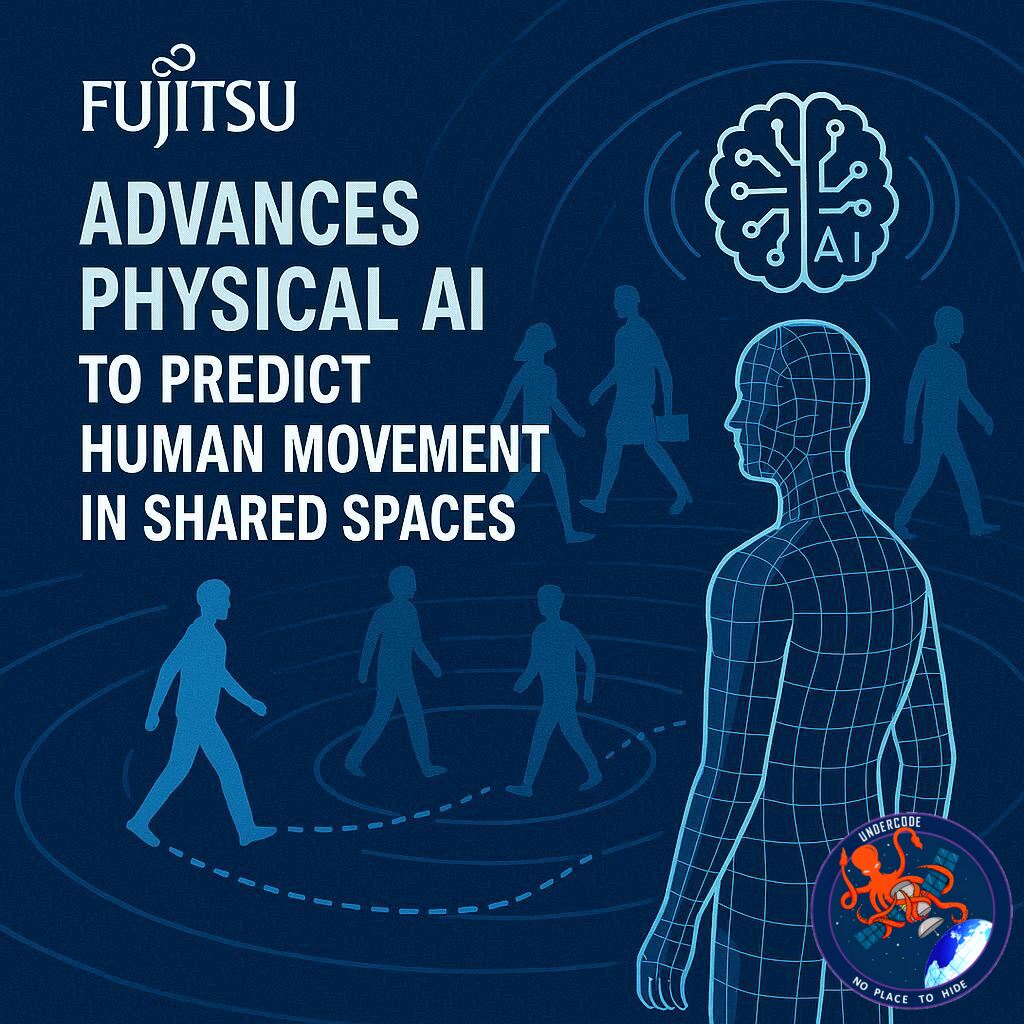
As workplaces, hospitals, and care facilities become more crowded and technologically complex, one challenge grows harder to ignore: how humans, robots, and automated systems can safely coexist in the same physical space. Fujitsu is positioning itself at the center of this challenge. Through the development of what it calls “Physical AI,” the company aims to predict complex human movement patterns before they happen, transforming how shared environments are designed, monitored, and optimized. This technology signals a shift from reactive safety systems toward anticipatory intelligence, where machines understand not just where people are, but where they are likely to go next.
Summary
Fujitsu has developed a new AI-based technology capable of predicting and analyzing complex movements of people and robots within shared environments. The core idea is to allow humans and machines to operate safely and cooperatively in the same physical space, even when movement patterns are dense, irregular, or unpredictable. This technology is designed for environments such as offices, construction sites, retail stores, hospitals, and elderly care facilities, where people constantly cross paths and safety risks are high.
The company refers to this approach as Physical AI, emphasizing its ability to understand real-world spatial dynamics rather than abstract digital behavior. By analyzing data from sensors and spatial models, the system forecasts near-future movements within a space, enabling proactive responses instead of delayed reactions. This marks a significant improvement over conventional systems that only respond after a risky situation has already emerged.
Fujitsu showcased a demonstration of this technology during a technical briefing held at its headquarters in Kawasaki City on December 2, 2025. During the demonstration, the system visualized how movement flows in a given space evolve over time, highlighting potential congestion points and collision risks before they occur. The focus was not only on human movement but also on how robots can adjust their paths dynamically when sharing space with people.
The company plans to begin real-world technical trials at its Kawasaki headquarters within fiscal year 2026. These experiments are intended to validate the system’s effectiveness in real operational settings, where unpredictable human behavior presents challenges that simulations alone cannot fully capture. Fujitsu envisions future applications where robots in care facilities or workplaces can move naturally among people, improving efficiency while maintaining safety.
Ultimately, the technology reflects Fujitsu’s broader ambition to integrate AI more deeply into physical environments. By enabling machines to anticipate human actions, the company aims to reduce accidents, improve workflow design, and create spaces where automation feels less intrusive and more supportive of human activity.
What Undercode Say:
Fujitsu’s Physical AI initiative represents a meaningful evolution in applied artificial intelligence, shifting the focus from perception to prediction. Most existing AI systems in physical environments are reactive by design. They detect obstacles, recognize people, and respond after a condition is met. What Fujitsu is proposing is fundamentally different: an AI that understands intent through motion patterns.
This distinction matters. In environments like elderly care facilities or hospitals, safety is not just about avoiding collisions. It is about anticipating hesitation, sudden stops, or irregular walking patterns that reflect real human behavior. Predictive movement modeling allows systems to slow down, reroute, or signal well before a risky interaction occurs. This creates a calmer and more natural coexistence between humans and machines.
Another key strength lies in scalability. Offices, retail stores, and construction sites all have different movement dynamics, yet they share one common trait: complexity. If Fujitsu’s Physical AI can generalize across these environments, it could become a foundational layer for smart infrastructure. Instead of designing rigid safety zones, organizations could rely on adaptive spatial intelligence that evolves with how people actually use a space.
There is also a strategic angle. Japan faces a rapidly aging population and labor shortages, particularly in care and maintenance roles. Technologies that allow robots to safely assist humans without requiring strict segregation are not just convenient, they are economically necessary. Fujitsu appears to be aligning this innovation with long-term demographic realities rather than short-term automation trends.
However, the success of such systems will depend heavily on data quality, sensor integration, and ethical deployment. Predicting movement means continuously observing people, which raises questions around privacy, consent, and transparency. Fujitsu’s challenge will be to balance predictive accuracy with responsible data governance.
If executed well, Physical AI could redefine how we think about safety in shared spaces. Instead of warning signs and barriers, intelligence itself becomes the safeguard. This is not about replacing human judgment, but about augmenting it with foresight that humans alone cannot maintain at scale.
Fact Checker Results
✅ Fujitsu is developing AI technology focused on predicting human and robot movement in shared spaces.
✅ The technology targets environments such as offices, care facilities, and construction sites.
❌ No public performance metrics or commercial rollout timeline have been disclosed yet.
Prediction
📊 Fujitsu’s Physical AI is likely to become a core component of smart building and care facility infrastructure by the late 2020s.
📊 Early adoption will focus on controlled environments, with broader deployment following successful trials.
📊 Predictive movement AI may soon become a standard expectation for human-robot coexistence systems rather than a premium feature.
🕵️📝✔️Let’s dive deep and fact‑check.
References:
Reported By: xtechnikkeicom_45cdd2735e086ad57d4e4fae
Extra Source Hub (Possible Sources for article):
https://www.facebook.com
Wikipedia
OpenAi & Undercode AI
Image Source:
Unsplash
Undercode AI DI v2
Bing
🔐JOIN OUR CYBER WORLD [ CVE News • HackMonitor • UndercodeNews ]
📢 Follow UndercodeNews & Stay Tuned:
𝕏 formerly Twitter 🐦 | @ Threads | 🔗 Linkedin | 🦋BlueSky | 🐘Mastodon


