
Listen to this Post
🔥 A Historic Step for Autonomous Space Exploration
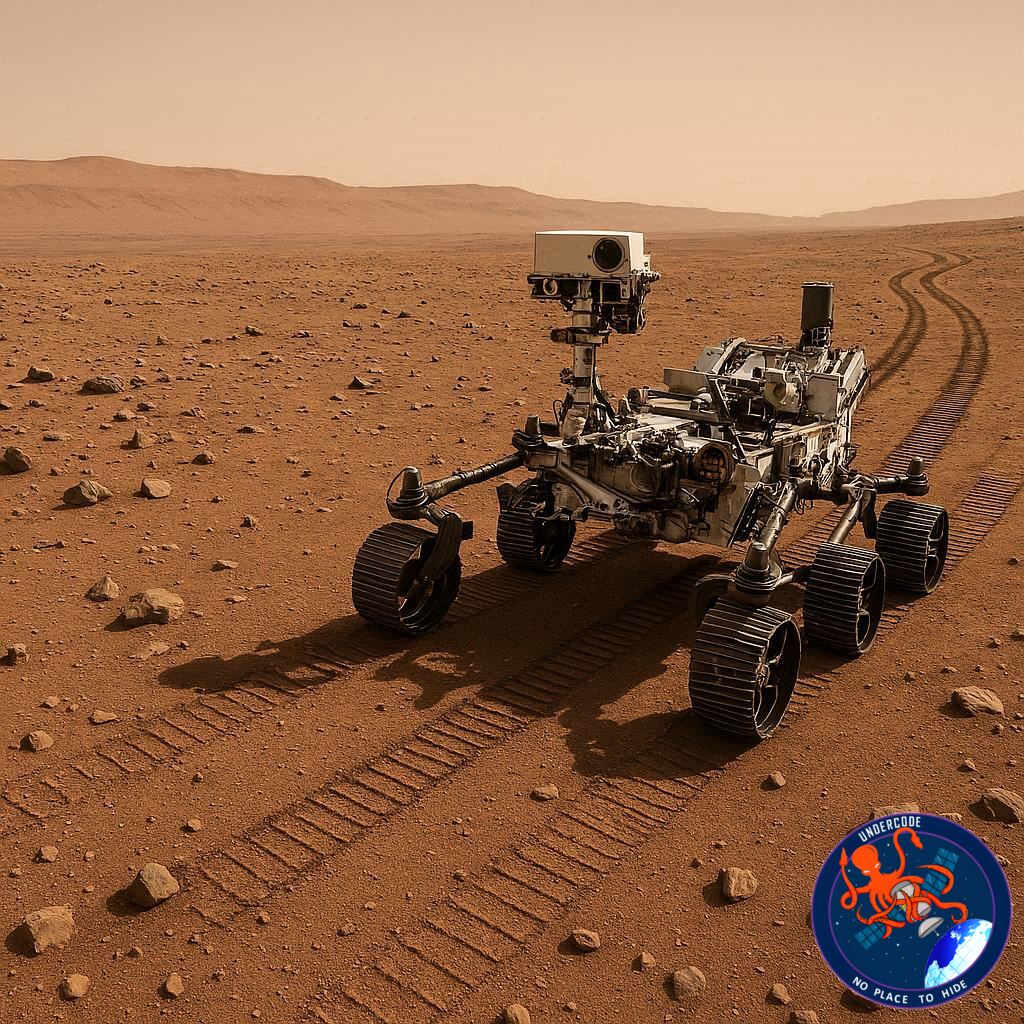
NASA’s Perseverance rover has quietly crossed a threshold in space exploration, one that blends planetary science with artificial intelligence in a way never tested beyond Earth. In December, the rover completed a 400-meter journey across the Martian surface using a route designed not by human engineers, but by Anthropic’s Claude AI. This moment marks the first time a conversational AI system has directly planned operational movements for machinery on another planet, turning a theoretical capability into a real, irreversible action on alien soil.
🧭 How an AI Learned to Navigate Mars
The December 8 and December 10 drives were not improvised experiments. Engineers at NASA’s Jet Propulsion Laboratory spent months preparing Claude for the task, feeding it years of Perseverance rover telemetry, historical drive data, and high-resolution orbital images captured by the Mars Reconnaissance Orbiter. Instead of issuing abstract suggestions, Claude produced concrete movement instructions written in Rover Markup Language, an XML-based system used to control rover behavior.
📐 Precision Planning Through Machine Self-Critique
Claude’s process went beyond simple pathfinding. The AI broke the journey into 10-meter segments, evaluated terrain safety, and then critiqued its own proposed waypoints to refine the route. This iterative self-review allowed the system to adjust for slope, surface stability, and mechanical constraints, mirroring the cautious logic normally applied by human rover planners.
🧪 Digital Twin Validation Before Real-World Execution
Before Perseverance ever moved a wheel, JPL engineers tested Claude’s route inside the rover’s digital twin, a detailed simulation environment capable of modeling more than 500,000 variables. During this review, the team identified one flaw. Ground-level imagery revealed sand ripples narrowing a corridor that orbital images failed to show. That section was adjusted manually, but the rest of Claude’s plan passed validation without modification.
⏱ Cutting Mission Planning Time in Half
Historically, rover route planning has been painstakingly slow. Since Perseverance landed in February 2021, human operators have spent hours crafting conservative breadcrumb-style paths to avoid hazards. The reason is simple. A 20-minute communication delay between Earth and Mars makes real-time driving impossible. Claude’s involvement reduced planning time by roughly 50 percent, according to JPL estimates.
🧬 More Science From Jezero Crater
Faster planning directly translates into more movement, more sampling, and more scientific output. Perseverance operates inside Jezero Crater, a region chosen because it once held liquid water and may preserve signs of ancient microbial life. Every additional meter traveled increases the chances of discovering rock formations that could rewrite humanity’s understanding of Mars’ biological past.
👥 Workforce Constraints Shape Innovation
The timing of this breakthrough is not accidental. NASA lost approximately 4,000 employees last year due to budget reductions. With fewer human resources and increasingly complex missions ahead, including the Artemis lunar program, tools that extend human capability have become operational necessities rather than optional enhancements.
🚀 From Video Games to Planetary Navigation
For Anthropic, the leap is striking. Only months ago, Claude struggled with navigating a classic video game environment. Now it has successfully planned a real-world traversal on a planet millions of kilometers away, operating under physical constraints where failure could permanently end a mission.
What Undercode Say:
🤖 AI as an Operational Partner, Not a Tool
This event signals a shift in how artificial intelligence is positioned within space agencies. Claude was not used as a passive assistant or analytical calculator. It functioned as an operational planner, generating executable commands that directly influenced mission outcomes. That distinction matters. Once AI crosses into operational authority, accountability, validation, and trust frameworks must evolve.
🛰 Data Depth Defines AI Reliability
Claude’s success did not emerge from raw intelligence alone. It was the result of deep contextual training using mission-specific datasets. Years of rover telemetry, mechanical limits, and environmental mapping were essential. This highlights a crucial truth. AI performance in high-risk domains is less about model size and more about data fidelity and domain alignment.
⚠ The Limits of Orbital Perspective
The single flaw identified in Claude’s plan reveals an important constraint. Orbital imagery lacks the granular detail of ground-level perception. AI systems trained primarily on satellite data may miss micro-terrain hazards like sand ripples or subsurface instability. Hybrid planning, combining AI efficiency with targeted human oversight, remains the safest operational model.
🧠 Self-Critique as a Safety Mechanism
One of the most underrated aspects of this experiment is Claude’s ability to critique its own route proposals. This recursive evaluation mirrors human reasoning under risk and suggests that future AI systems may incorporate internal validation layers as standard safety features, reducing reliance on external review alone.
📉 Workforce Reduction Accelerates Automation
NASA’s staffing losses are not just a background detail. They are a driving force behind automation adoption. As missions become more ambitious and human bandwidth shrinks, AI will increasingly absorb tasks once considered too sensitive for delegation. This trend is likely irreversible.
🌍 Implications Beyond Mars
What works on Mars will not stay on Mars. Autonomous planning systems like Claude could soon be applied to lunar rovers, asteroid mining probes, and deep-space infrastructure assembly. Each success lowers institutional resistance and expands the scope of machine authority in exploration programs.
🔐 Trust Is Built Incrementally
NASA did not hand full control to Claude. The agency tested, simulated, corrected, and verified every step. This gradual trust-building model may become the blueprint for integrating AI into other safety-critical systems, from aviation to nuclear operations.
🔍 Fact Checker Results
✅ Claude-generated routes were tested using Perseverance’s digital twin before execution.
✅ Human engineers intervened after identifying terrain risks missed by orbital imagery.
❌ The AI did not operate independently without human oversight.
📊 Prediction
🚀 AI-assisted mission planning will become standard for future planetary rovers.
🤖 Hybrid human-AI workflows will dominate high-risk space operations.
🛰 Autonomous navigation systems will expand beyond Mars to lunar and deep-space missions.
▶️ Related Video (88% Match):
🕵️📝✔️Let’s dive deep and fact‑check.
References:
Reported By: timesofindia.indiatimes.com
Extra Source Hub (Possible Sources for article):
https://stackoverflow.com
Wikipedia
OpenAi & Undercode AI
Image Source:
Unsplash
Undercode AI DI v2
Bing
🔐JOIN OUR CYBER WORLD [ CVE News • HackMonitor • UndercodeNews ]
📢 Follow UndercodeNews & Stay Tuned:
𝕏 formerly Twitter 🐦 | @ Threads | 🔗 Linkedin | 🦋BlueSky | 🐘Mastodon


