
Listen to this Post
Introduction: A Worldwide Signal Against Cyber Disruption
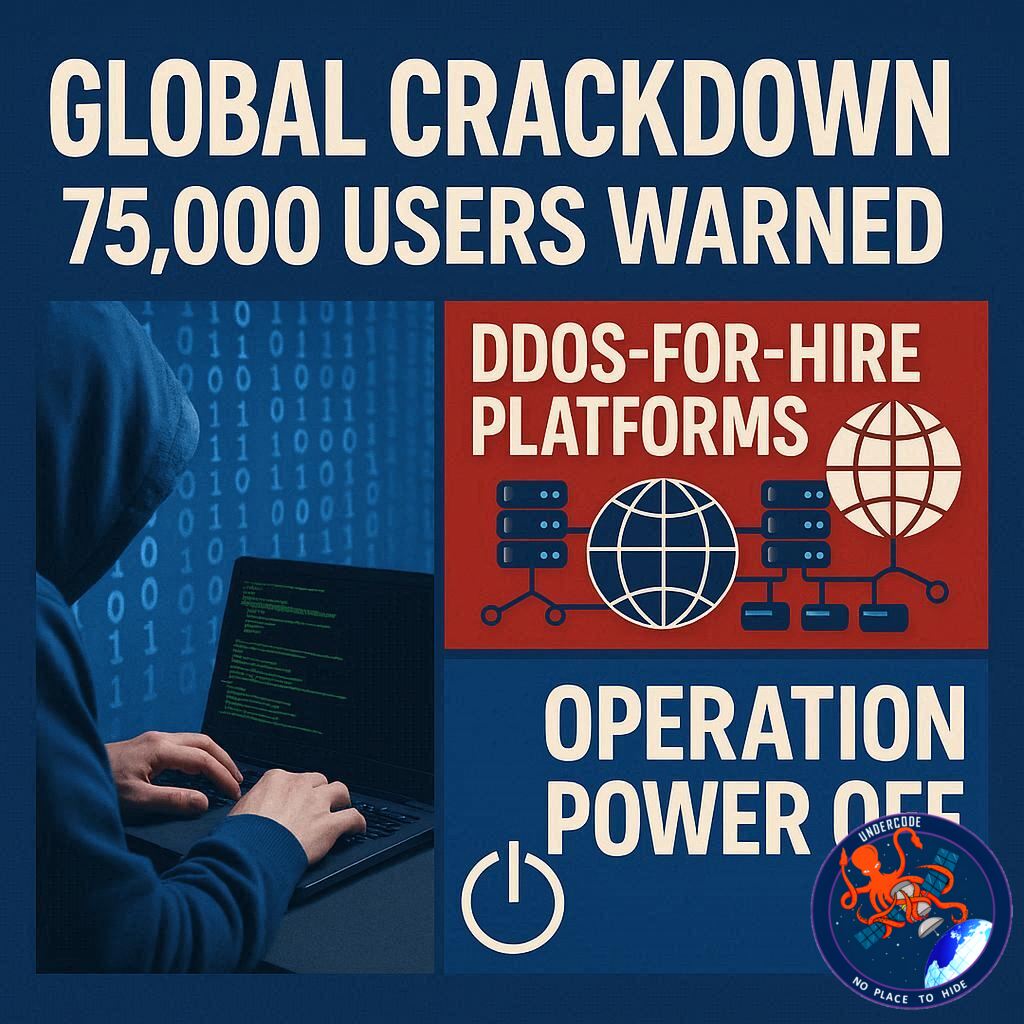
In a sweeping international effort to curb cybercrime, authorities have intensified their fight against distributed denial-of-service (DDoS) attacks by targeting not only the operators of illegal platforms but also their users. The latest phase of Operation PowerOFF marks a significant shift, focusing on awareness, deterrence, and accountability at a global scale. With tens of thousands of individuals now directly warned, the message is unmistakable: participating in cyberattacks, even indirectly, carries real consequences.
Summary: A Coordinated Strike on DDoS Ecosystems
More than 75,000 individuals linked to DDoS-for-hire services have received official warnings via emails and letters as part of the newest phase of Operation PowerOFF. This international law enforcement initiative, supported by Europol, involves authorities from 21 countries working together to dismantle cybercriminal infrastructure and disrupt malicious activity.
During this phase, coordinated actions led to the arrest of four suspects, the shutdown of 53 domains associated with illegal services, and the execution of 25 search warrants. These efforts were not isolated incidents but the result of extensive operational “sprints,” where experts from participating nations collaborated to identify high-value targets and execute strategic takedowns.
Authorities specifically focused on so-called “booter services,” platforms that allow users to pay for launching DDoS attacks. These services typically rely on networks of compromised devices, such as routers and Internet of Things (IoT) systems, to overwhelm targeted servers with traffic. While some operators attempt to disguise these platforms as legitimate stress-testing tools, they often lack proper verification mechanisms, making them a frequent tool for illegal cyberattacks.
Operation PowerOFF builds on earlier phases that successfully dismantled critical infrastructure and seized databases containing over 3 million criminal user accounts. The initiative has now entered a prevention-focused stage, aiming to reduce future participation in cybercrime.
This prevention phase includes awareness campaigns targeting younger audiences who may be tempted to experiment with DDoS tools. Authorities have also taken steps to remove over 100 URLs promoting illegal services from search engine results and introduced warning messages tied to blockchain transactions used for illicit payments.
The operation spans multiple regions, including European Union member states, as well as countries such as the United States, the United Kingdom, Australia, Japan, Thailand, and Brazil. This broad participation underscores the global nature of cybercrime and the necessity of international cooperation to combat it effectively.
What Undercode Say: The Real Impact Behind the Headlines
The Shift From Takedown to Prevention
The most notable evolution in Operation PowerOFF is its transition from reactive enforcement to proactive prevention. Instead of focusing solely on dismantling infrastructure, authorities are now targeting the demand side of the cybercrime economy. Warning 75,000 users is not just symbolic; it is a calculated move to disrupt the pipeline of future attackers before they escalate their activities.
Psychological Deterrence as a Strategy
Sending direct warnings introduces a psychological layer to cybersecurity enforcement. Many users of booter services operate under the assumption of anonymity. Receiving a letter or email from law enforcement shatters that illusion, potentially deterring repeat behavior and discouraging newcomers from engaging in similar activities.
Youth Engagement and Early Intervention
The emphasis on targeting young users through search engine interventions is particularly strategic. Many individuals who experiment with DDoS tools are often inexperienced and unaware of the legal consequences. By intercepting their intent at the search level, authorities are effectively inserting a barrier at the earliest stage of the attack lifecycle.
The Economics of DDoS-for-Hire Services
Booter platforms thrive because they lower the barrier to entry. Users do not need technical expertise; they simply pay for a service. By dismantling infrastructure and disrupting payment channels, Operation PowerOFF is attacking the economic foundation of these services. If profitability declines, operators will find it harder to sustain their operations.
Global Cooperation as a Necessity
Cybercrime does not respect borders, and this operation demonstrates how critical international collaboration has become. With participation from countries across multiple continents, Operation PowerOFF highlights a unified stance against digital threats. This level of coordination is essential for tackling distributed networks that operate across jurisdictions.
The Role of Infrastructure Seizure
Taking down 53 domains may seem modest compared to the scale of the problem, but each domain represents a node in a larger ecosystem. Removing these nodes disrupts user access, damages trust in the service, and forces operators to rebuild, increasing their operational costs and exposure to law enforcement.
Data Seizures and Long-Term Impact
The earlier seizure of databases containing over 3 million accounts is arguably one of the most impactful elements of the operation. Such data provides invaluable intelligence, enabling authorities to map networks, identify repeat offenders, and build stronger cases against both operators and users.
Blockchain Warnings and Financial Tracking
Introducing on-chain warning messages tied to illicit payments is an innovative approach. It signals that even transactions conducted via cryptocurrencies are not beyond scrutiny. This could significantly deter users who rely on perceived financial anonymity.
The Role of Awareness Campaigns
Awareness campaigns are often underestimated in cybersecurity strategies. However, educating potential offenders can be more effective than punishment alone. By clearly communicating the risks and consequences, authorities can reduce participation rates over time.
The Future of DDoS Mitigation
While operations like PowerOFF are impactful, the DDoS landscape continues to evolve. Attackers are constantly adapting, leveraging new technologies and vulnerabilities. This means that law enforcement efforts must be continuous, adaptive, and supported by technological innovation.
Fact Checker Results
✅ The operation involved over 75,000 individuals receiving warnings, confirming a large-scale enforcement effort.
✅ Authorities from 21 countries participated, highlighting strong international collaboration.
❌ Claims of complete disruption of DDoS ecosystems are overstated, as such services continue to re-emerge.
Prediction
🔮 Increased use of AI-driven detection systems will help identify DDoS activity earlier and more accurately.
🔮 Law enforcement will expand financial tracking methods, especially targeting cryptocurrency transactions linked to cybercrime.
🔮 Younger demographics will become a primary focus for prevention campaigns, aiming to reduce future cybercriminal recruitment.
🕵️📝✔️Let’s dive deep and fact‑check.
References:
Reported By: www.bleepingcomputer.com
Extra Source Hub (Possible Sources for article):
https://stackoverflow.com
Wikipedia
OpenAi & Undercode AI
Image Source:
Unsplash
Undercode AI DI v2
Bing
🔐JOIN OUR CYBER WORLD [ CVE News • HackMonitor • UndercodeNews ]
📢 Follow UndercodeNews & Stay Tuned:
𝕏 formerly Twitter 🐦 | @ Threads | 🔗 Linkedin | 🦋BlueSky | 🐘Mastodon


