
Listen to this Post
Introduction
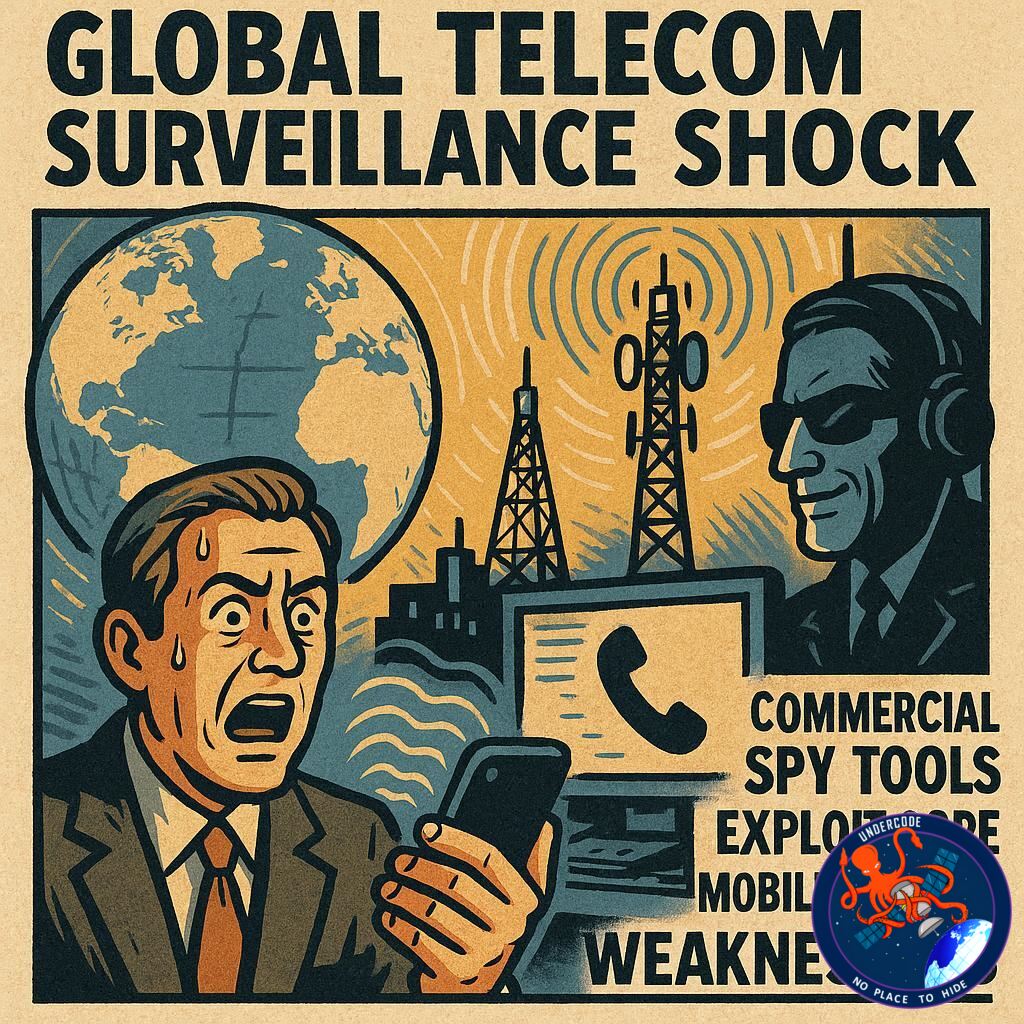
A new cybersecurity investigation has revealed a deeply concerning reality inside global telecommunications infrastructure. Commercial surveillance vendors are allegedly exploiting long-known vulnerabilities in mobile signaling systems to track targets across international networks. The findings suggest that real-world attack traffic has been directly linked to mobile operator signaling infrastructure for the first time, exposing how fragile and interconnected global mobile communications truly are.
Summary of the Original Investigation
Researchers from the University of Toronto’s Citizen Lab uncovered surveillance campaigns that leveraged weaknesses in telecom signaling protocols used by mobile operators worldwide. These campaigns involved unknown actors who deployed commercial surveillance tools to impersonate legitimate mobile network operators. By mimicking operator identities, they were able to manipulate signaling traffic and reroute communications through hidden pathways designed to avoid detection. The investigation claims this is the first documented case linking live attack traffic directly to mobile operator signaling infrastructure. The attackers exploited long-standing vulnerabilities in SS7 and Diameter protocols, which underpin global roaming and mobile connectivity. SS7 is widely used in older 2G and 3G networks, while Diameter supports 4G and parts of 5G infrastructure. Although Diameter was designed as a more secure replacement, both protocols remain vulnerable to exploitation. The surveillance activity was observed across infrastructure linked to multiple countries, including Cambodia, China, the UK, Italy, Sweden, Switzerland, Israel, Morocco, Rwanda, Thailand, and several others. Researchers found that attackers shifted between signaling protocols depending on the target environment, increasing their ability to remain undetected. Despite repeated warnings from security experts, such abuses of telecom signaling systems continue to occur without meaningful consequences. The researchers highlighted that the global telecom system is built on a trust-based architecture, which is increasingly being weaponized for covert surveillance. Citizen Lab researchers emphasized that these attacks are extremely difficult to attribute due to the complexity and opacity of telecom signaling networks. Even when suspicious traffic is detected, identifying the responsible vendor or operator is often impossible. The report also noted that surveillance vendors operate in a gray zone where malicious activity blends into billions of legitimate network transactions. Several telecom operators mentioned in the report denied direct involvement or awareness of malicious signaling activity. Some stated that observed infrastructure identifiers did not match their internal systems or could be attributed to third-party access arrangements. Others insisted they do not knowingly allow their signaling access to be used for tracking individuals. Researchers acknowledged that access to signaling systems may be obtained through intermediaries or commercial leasing arrangements, making attribution even harder. Overall, the investigation highlights a growing global cybersecurity blind spot within mobile telecommunications.
What Undercode Say:
The core issue exposed in this investigation is not just technical vulnerability, but structural insecurity embedded in global telecom design. Mobile networks were originally built for trust, not for adversarial environments, and that assumption is now being heavily exploited. SS7 and Diameter protocols were never designed with modern surveillance threats in mind, making them highly attractive targets for intelligence actors and commercial spyware vendors. The ability of attackers to impersonate mobile operators demonstrates how easily identity within telecom signaling can be forged when verification mechanisms are weak or outdated. This is not a new vulnerability, but a long-known weakness that has remained insufficiently addressed despite repeated warnings from cybersecurity researchers and regulators.
One of the most alarming aspects is the scale of global exposure. The investigation shows that compromised signaling traffic spans multiple continents and telecom ecosystems, indicating that this is not an isolated regional issue but a systemic global problem. The involvement of commercial surveillance vendors adds another layer of complexity, as it blurs the line between state-sponsored intelligence operations and private-sector espionage tools. These vendors operate in secrecy, often without clear accountability or transparent oversight, making enforcement extremely difficult.
Another critical factor is the architecture of telecom trust systems. Mobile operators rely on interconnectivity agreements that assume mutual trust between networks. However, this trust model becomes a weakness when exploited by actors who can gain indirect access through intermediaries or leased infrastructure. This creates what researchers describe as “ghost operators,” entities that operate within legitimate signaling flows without leaving obvious traces of identity.
Regulatory responses have so far been slow and fragmented. While agencies like the FCC and lawmakers have raised concerns about SS7 and Diameter vulnerabilities, the persistence of these attacks suggests that enforcement mechanisms are not keeping pace with technological exploitation. The lack of mandatory global security standards for signaling infrastructure further complicates mitigation efforts.
Attribution remains one of the biggest challenges. Even when malicious activity is detected, tracing it back to a specific vendor, organization, or state actor is extremely difficult due to the layered and opaque nature of telecom signaling systems. This ambiguity allows surveillance operations to continue with minimal risk of exposure.
Ultimately, the findings suggest that global mobile networks are operating in a permanent state of partial insecurity. As long as signaling protocols remain largely unchanged and trust-based, they will continue to be exploited by sophisticated surveillance actors. Without structural redesign, stronger authentication layers, and international regulatory coordination, these vulnerabilities are likely to persist and expand.
Fact Checker Results:
✔ Citizen Lab has previously documented SS7 and Diameter vulnerabilities in telecom systems
✔ Telecom signaling abuse by surveillance vendors is widely reported in cybersecurity research
✔ Direct attribution of signaling attacks to specific vendors remains technically difficult
Prediction:
The exploitation of telecom signaling systems will likely increase as commercial spyware markets expand globally.
Regulators may introduce stricter signaling authentication standards, but adoption will be slow due to legacy infrastructure constraints.
Future attacks are expected to become more stealthy, leveraging intermediary access points and hybrid protocol manipulation techniques.
🕵️📝✔️Let’s dive deep and fact‑check.
References:
Reported By: cyberscoop.com
Extra Source Hub (Possible Sources for article):
https://www.instagram.com
Wikipedia
OpenAi & Undercode AI
Image Source:
Unsplash
Undercode AI DI v2
Bing
🔐JOIN OUR CYBER WORLD [ CVE News • HackMonitor • UndercodeNews ]
📢 Follow UndercodeNews & Stay Tuned:
𝕏 formerly Twitter 🐦 | @ Threads | 🔗 Linkedin | 🦋BlueSky | 🐘Mastodon


