
Listen to this Post
A New Era of Space Exploration Begins
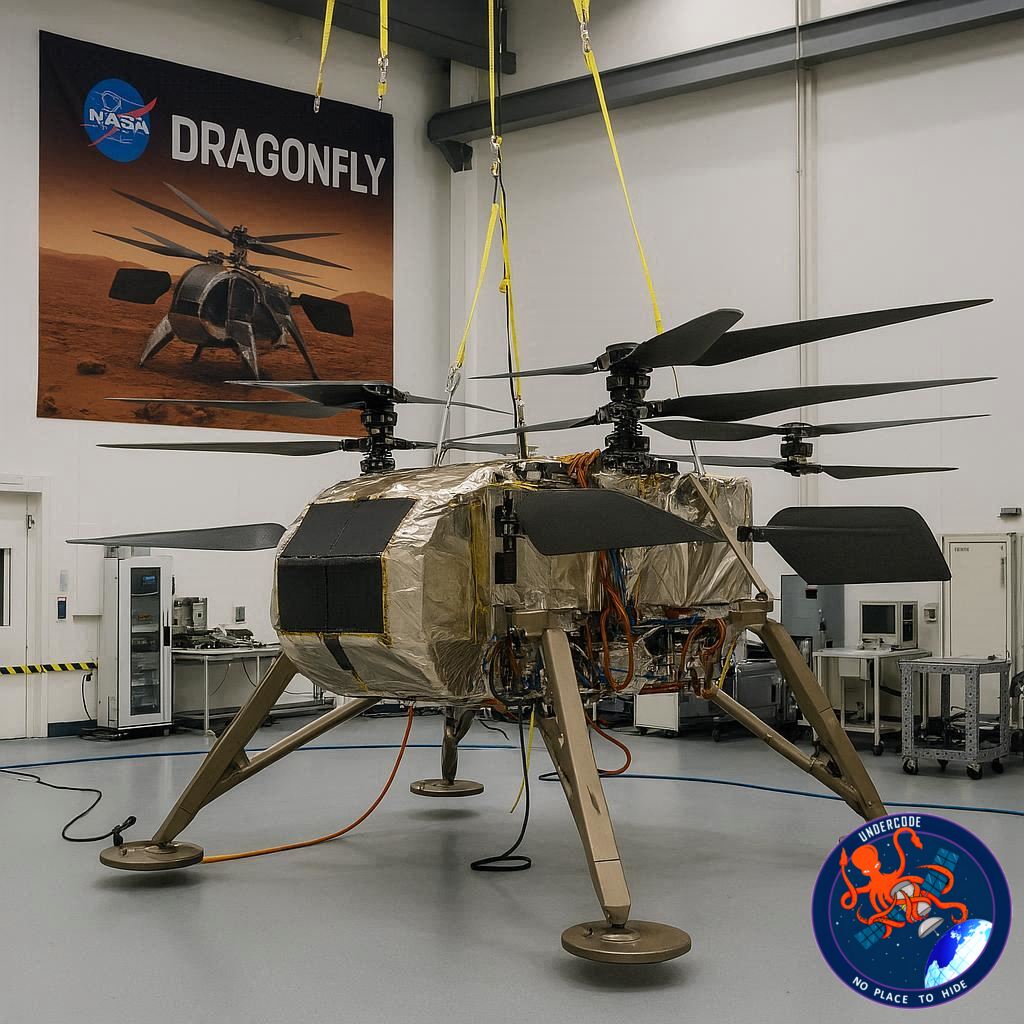
NASA’s ambitious Dragonfly mission is steadily transforming from concept to reality, marking a significant step toward exploring one of the most intriguing worlds in our solar system. Designed to fly across the hazy skies of Titan, Saturn’s largest moon, this rotorcraft lander promises to unlock secrets about prebiotic chemistry and the origins of life. With new structural components delivered and major systems undergoing testing, Dragonfly is entering a decisive phase that brings its 2028 launch closer into focus.
Building a Lightweight Giant
The Dragonfly rotorcraft is beginning to physically take form with the arrival of its primary structural panels. These panels are no ordinary spacecraft components. Engineered at Johns Hopkins Applied Physics Laboratory and built by Lockheed Martin Space, they are crafted from ultra-lightweight honeycomb materials specifically tailored for Titan’s unique environment.
Each panel features aluminum face sheets just 0.01 inches thick, an unusually slim design that pushes the boundaries of aerospace engineering. Despite this extreme thinness, the structure maintains remarkable strength. The entire frame weighs only about 230 pounds, yet it is built to endure the violent forces of launch and the harsh conditions of atmospheric entry on Titan. Engineers describe it as a balance never before achieved in spacecraft design.
Assembling the Core Structure
In early April, teams began assembling the fuselage, integrating essential structural components that will support Dragonfly’s systems during its long journey and mission operations. Among these elements is the mounting system for its nuclear power source, a radioisotope thermoelectric generator, which will be installed closer to launch.
Engineers also tested the fit of the top deck, which will carry key telecommunications equipment. These steps may seem routine, but they are crucial for ensuring that every component aligns perfectly before the spacecraft undergoes more intense testing.
Preparing for the Stress of Space
The next phase involves rigorous vibration and static-load testing. These tests are designed to simulate the extreme conditions Dragonfly will face during launch from Earth and its descent through Titan’s dense atmosphere. By subjecting the structure to these forces in controlled environments, engineers can validate its resilience and identify any weaknesses before the mission proceeds further.
This stage represents a transition from design to validation. Dragonfly is no longer just a blueprint. It is becoming a functional spacecraft.
Parachute System Clears Major Hurdle
A key milestone for the mission was achieved in February with successful parachute drop tests. These tests are vital for the entry, descent, and landing system that will safely deliver Dragonfly to Titan’s surface.
The testing effort, led by Airborne Systems in collaboration with NASA Langley Research Center and NASA Ames Research Center, marked the first full-scale trials of the parachute system. Conducted in Arizona, the tests included both drogue and main parachutes operating together, simulating Titan-like conditions as closely as possible on Earth.
These successful trials demonstrate that the mission’s landing system is progressing toward flight readiness. Additional qualification tests are planned before final flight hardware is constructed.
A Laboratory Designed for Another World
Dragonfly is not just a flying vehicle. It is also a mobile science laboratory. Its primary instrument, the Dragonfly Mass Spectrometer, is currently in the final stages of integration and testing at NASA Goddard Space Flight Center.
This sophisticated instrument is designed to analyze samples from Titan’s surface. It uses two complementary techniques: laser desorption and gas chromatography. Together, these systems can release and separate molecules from collected samples before identifying them based on their mass.
Recent tests of the laser system have confirmed its ability to detect and identify chemical compounds even in extremely small quantities. Upcoming integration of the gas chromatography system, provided by CNES, will further enhance Dragonfly’s analytical capabilities.
Mission Timeline and Goals
Dragonfly is scheduled to launch no earlier than 2028. After a six-year journey through space, it will arrive at Titan, where it will operate for approximately three years. Unlike traditional landers, Dragonfly will relocate between multiple sites, flying across Titan’s surface to explore diverse environments.
Its mission is to study the moon’s chemistry, geology, and atmosphere, offering insights into conditions that may resemble those of early Earth. By doing so, Dragonfly aims to deepen our understanding of how life’s building blocks may have formed.
What Undercode Say:
A Bold Shift from Static Exploration
Dragonfly represents a major evolution in planetary exploration strategy. Instead of landing in one place and analyzing its immediate surroundings, this mission introduces mobility as a core feature. This shift reflects a growing recognition that complex environments like Titan cannot be fully understood from a single location.
Engineering at the Edge of Possibility
The extreme lightweight design of Dragonfly’s structure highlights a broader trend in aerospace engineering. Reducing mass while maintaining structural integrity is not just beneficial. It is essential for missions that rely on atmospheric flight in alien environments. Titan’s dense atmosphere allows for flight, but it also imposes strict constraints on weight and energy efficiency.
Titan as a Scientific Goldmine
Titan is one of the most Earth-like bodies in the solar system in terms of chemical complexity. It has a thick atmosphere, liquid methane lakes, and organic molecules that resemble early Earth chemistry. Dragonfly’s ability to move between sites gives scientists a unique opportunity to compare different environments directly.
Risk and Reward in Mission Design
The mission is ambitious and carries significant risk. Flying a rotorcraft on another world introduces variables that have never been tested in real mission conditions. However, the potential rewards justify these risks. Discovering complex organic chemistry or even precursors to life would redefine our understanding of biology in the universe.
Collaboration Across Agencies and Nations
Dragonfly is not a single-agency effort. It involves collaboration between multiple NASA centers and international partners like CNES. This cooperative model reflects the increasing complexity of modern space missions, where expertise and resources must be shared globally.
Testing as the Backbone of Success
Every phase described in the article emphasizes testing. From structural validation to parachute deployment and instrument calibration, each step reduces uncertainty. This methodical approach is critical for missions that cannot be repaired once launched.
The Importance of Precision Instruments
The Dragonfly Mass Spectrometer is arguably the heart of the mission. Its ability to detect and analyze tiny amounts of material will determine the quality of scientific data returned. Precision at this level is what turns exploration into discovery.
A Long-Term Vision for Exploration
Dragonfly is part of a broader vision that includes exploring ocean worlds and chemically rich environments. It aligns with future missions that may target Europa, Enceladus, and beyond. Each mission builds on the technological and scientific lessons of the previous one.
Public and Scientific Impact
Beyond its scientific goals, Dragonfly has the potential to capture public imagination. A drone flying across an alien moon is a powerful image that can inspire interest in space science and technology.
The Countdown to 2028
With each successful test, the mission moves closer to launch readiness. While delays are always possible in projects of this scale, the steady progress indicates strong momentum. The coming years will be critical as Dragonfly transitions from testing to final assembly and launch preparation.
Fact Checker Results
✅ Dragonfly is scheduled to launch no earlier than 2028 and target Titan.
✅ The spacecraft uses a radioisotope thermoelectric generator for power.
❌ Dragonfly has not yet flown; all current results are based on Earth testing.
Prediction
🚀 Dragonfly will redefine planetary exploration by proving aerial mobility on other worlds is viable.
🧪 The mission is likely to detect complex organic molecules, advancing astrobiology significantly.
🌌 Success could accelerate similar rotorcraft missions to other moons like Europa or Enceladus.
🕵️📝✔️Let’s dive deep and fact‑check.
References:
Reported By: science.nasa.gov
Extra Source Hub (Possible Sources for article):
https://www.medium.com
Wikipedia
OpenAi & Undercode AI
Image Source:
Unsplash
Undercode AI DI v2
Bing
🔐JOIN OUR CYBER WORLD [ CVE News • HackMonitor • UndercodeNews ]
📢 Follow UndercodeNews & Stay Tuned:
𝕏 formerly Twitter 🐦 | @ Threads | 🔗 Linkedin | 🦋BlueSky | 🐘Mastodon


