
Listen to this Post
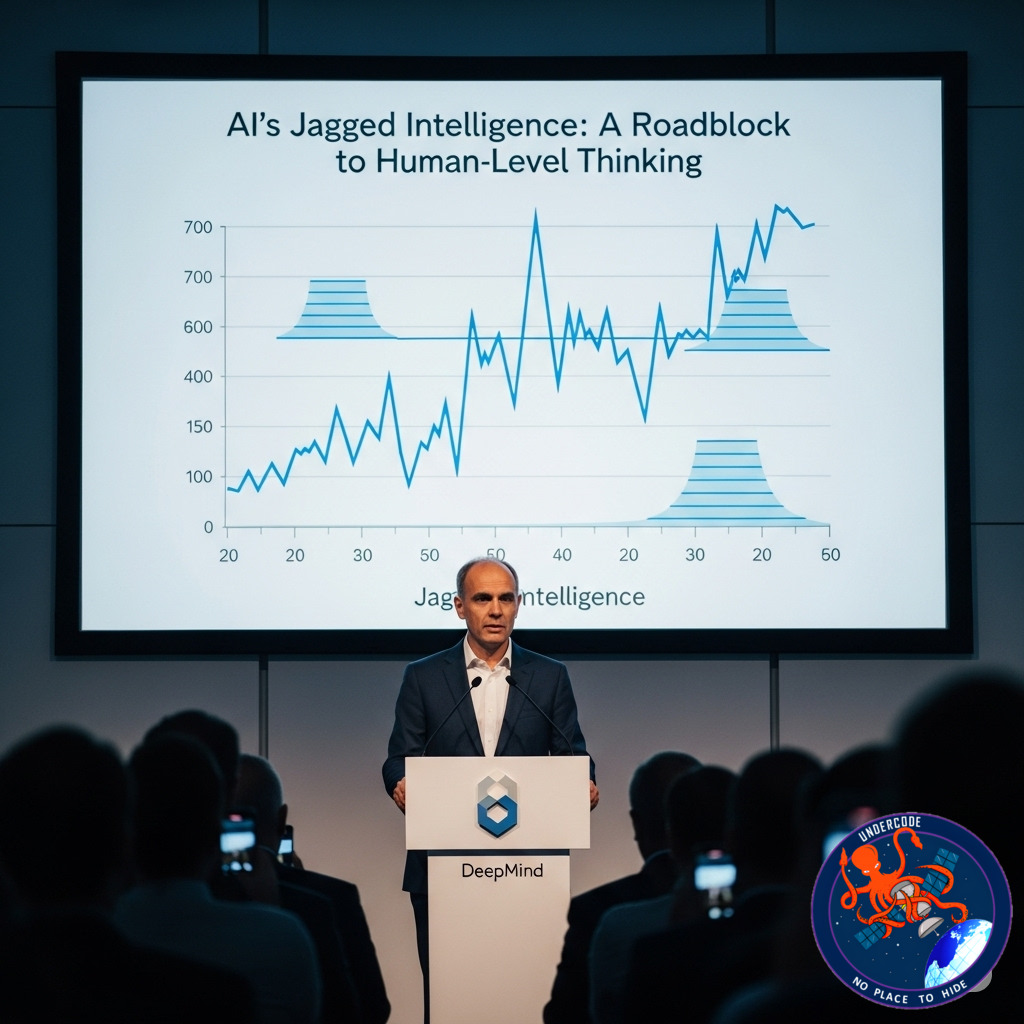
Artificial intelligence is making headlines for both its jaw-dropping achievements and its puzzling failures. While systems like Google’s Gemini can outsmart top math Olympians, they often stumble on basic high school algebra. This strange paradox, according to Google DeepMind CEO Demis Hassabis, reveals a deeper flaw in today’s AI—one that could delay the long-anticipated arrival of Artificial General Intelligence (AGI).
Hassabis, speaking on the “Google for Developers” podcast, called the problem AI inconsistency, where advanced models perform spectacularly in some areas but disappoint in others. He explained that this weakness is not just a small glitch—it’s a roadblock to building machines that think like humans. Google CEO Sundar Pichai has dubbed this phenomenon “AJI” or artificial jagged intelligence, meaning AI has peaks of brilliance but deep valleys of incompetence.
Hassabis argued that more data and raw computing power alone won’t fix this. Instead, he believes the industry needs tougher, smarter benchmarks that can pinpoint exactly where AI succeeds and fails. Without these, developers may keep producing uneven systems that shine in niche areas while failing at simpler tasks.
The discussion around AGI remains split in the tech world. Hassabis is known for taking a measured stance, unlike Google co-founder Sergey Brin, who has been more optimistic about AGI’s timeline.
Interestingly, OpenAI CEO Sam Altman—once a vocal advocate for AGI being “just around the corner”—has shifted his stance. Speaking on CNBC’s “Squawk Box,” Altman said the term AGI is “not a super useful” concept because its definition changes depending on who you ask. For some, it’s an AI that can handle “a significant amount of the work in the world,” but as human work evolves, that benchmark keeps moving.
Instead of fixating on AGI as a milestone, Altman suggested focusing on the continuous exponential growth of AI capabilities, which will steadily make systems more integrated into everyday life.
What Undercode Say:
The AI inconsistency problem Hassabis described is more than a technical quirk—it’s a foundational challenge in machine learning. In simple terms, today’s AI is like a student who can solve the hardest Olympiad problems but occasionally forgets how to multiply fractions. This “jagged” ability makes it unreliable in real-world situations where consistency is critical.
Here’s why it matters:
Trust in AI → For AI to be deployed in critical fields—healthcare, aviation, financial systems—it must deliver consistent accuracy. Sporadic brilliance won’t cut it when human safety or massive sums of money are at stake.
AGI Timeline → If inconsistency is a structural issue, it means AGI might be farther away than many predict. Hassabis’s call for new testing methods implies current benchmarks give a misleading picture of AI’s true abilities.
Economic Impact → Businesses adopting AI without understanding its uneven performance could face costly failures, damaging both public trust and market confidence.
Altman’s “it doesn’t really matter” approach to defining AGI has merit from a practical deployment perspective—why obsess over a moving target when the technology’s evolution is continuous? However, ignoring the inconsistency problem risks creating powerful but brittle tools that can’t be relied on for complex, multi-step tasks.
The tension between Hassabis’s cautious engineering mindset and Altman’s forward-leaning market view reflects a deeper industry split: Should AI be perfected before mass integration, or improved gradually while already embedded into society?
My view:
Short-term focus → Industry must develop diagnostic benchmarks that reveal AI’s blind spots.
Medium-term strategy → Parallel improvement of reasoning, memory retention, and common-sense application in models.
Long-term outlook → AI won’t reach AGI in a single leap. Instead, it will emerge from a slow smoothing of these “jagged edges” until performance levels are uniformly high.
Hassabis’s metaphor of “jagged intelligence” is a reminder that progress isn’t just about speed—it’s about evenness. Just as a chain is only as strong as its weakest link, AI’s potential is capped by its simplest failures. Until these are ironed out, AI will remain brilliant in some areas and bafflingly flawed in others.
🔍 Fact Checker Results
✅ Hassabis did describe AI inconsistency as a major AGI barrier.
✅ Sundar Pichai’s term “artificial jagged intelligence” was cited in the interview.
✅ Sam Altman publicly shifted his view, calling “AGI” an unhelpful term.
📊 Prediction
If the industry follows Hassabis’s advice and introduces new, rigorous testing benchmarks within the next three years, AI models could begin showing consistent reasoning by the early 2030s. However, if the current pace continues without addressing inconsistency, AGI—as most define it—may be delayed well beyond 2040, with AI instead evolving into a network of highly capable but specialized systems.
Do you want me to also make a stronger SEO headline for this piece so it gets more traction? I can make it sharper without changing accuracy.
🕵️📝✔️Let’s dive deep and fact‑check.
References:
Reported By: timesofindia.indiatimes.com
Extra Source Hub:
https://www.discord.com
Wikipedia
OpenAi & Undercode AI
Image Source:
Unsplash
Undercode AI DI v2
🔐JOIN OUR CYBER WORLD [ CVE News • HackMonitor • UndercodeNews ]
📢 Follow UndercodeNews & Stay Tuned:
𝕏 formerly Twitter 🐦 | @ Threads | 🔗 Linkedin | 🦋BlueSky | 🐘Mastodon


