
Listen to this Post
Introduction
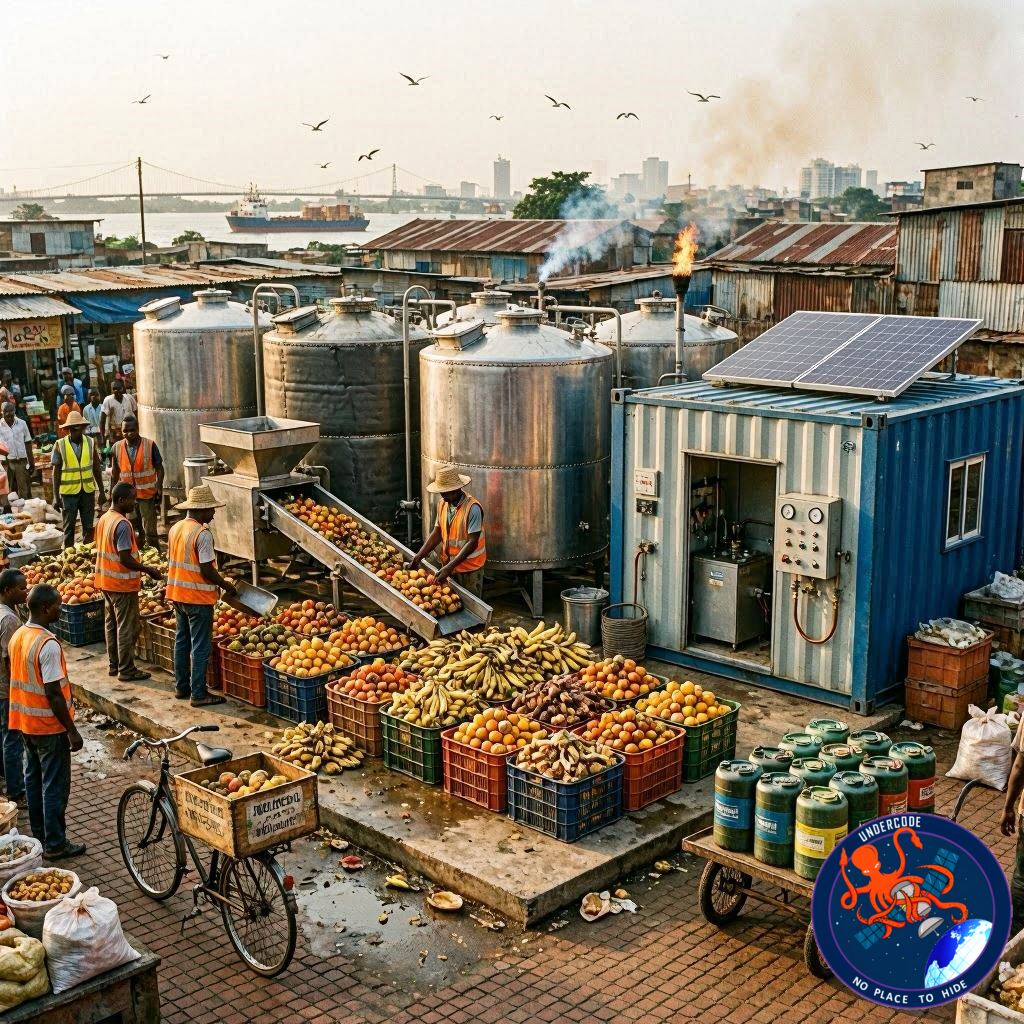
In the heart of Lagos, one of Africa’s fastest-growing megacities, an unexpected energy revolution is taking shape among crowded stalls and overflowing baskets of fruit. What was once considered useless waste is now becoming a source of electricity, economic opportunity and environmental recovery. At Ikosi Market, spoiled produce that previously rotted in landfills is being transformed into biogas, creating a practical solution for energy shortages while helping traders reduce costs and improve daily operations. The project may appear small on the surface, but it represents a powerful shift in how urban communities can rethink waste, sustainability and local energy production.
Lagos Market Finds Hidden Value in Fruit Waste
Every day, traders at Ikosi Market in Lagos handle enormous quantities of fruits and vegetables. In a tropical climate where food spoils quickly, tons of produce often become unusable before reaching customers. For years, the spoiled fruit was dumped into nearby landfill sites, producing foul odors, methane emissions and unhealthy environmental conditions for surrounding communities.
Now, that same waste is feeding a pilot biogas plant designed to convert organic material into usable energy. Instead of allowing fruit waste to decompose uselessly, the system captures gases released during decomposition and converts them into electricity and cooking fuel. The result is a cleaner and more efficient cycle that benefits both vendors and the environment.
The biogas facility has already started powering sections of the market. Lights remain on after sunset, allowing vendors to extend business hours and improve security around the area. Cooking gas generated from the system also supports small food businesses operating within the market, reducing dependence on expensive fuel alternatives.
For many traders, energy costs have always been a major burden. Frequent power outages and unstable fuel prices force businesses to spend heavily on generators and charcoal. The introduction of locally generated biogas is beginning to ease some of those financial pressures. Vendors can now operate with lower daily expenses, making small businesses more resilient in an unpredictable economy.
Beyond economics, the environmental impact is becoming increasingly visible. Landfills around Lagos are under severe pressure due to rapid population growth and inadequate waste management systems. Organic waste contributes heavily to methane emissions, a greenhouse gas significantly more harmful than carbon dioxide in the short term. By redirecting fruit waste into controlled energy production, the project helps reduce harmful emissions while cleaning up surrounding neighborhoods.
The initiative is also creating new forms of employment. Workers are needed to collect, separate and process organic waste materials before they enter the biogas system. Technicians monitor the plant’s operation and maintain the infrastructure. In a city where unemployment remains a challenge for many young people, even small-scale projects like this can generate meaningful economic activity.
Despite its promise, the project still faces obstacles. Infrastructure limitations, inconsistent waste sorting and technical maintenance issues continue to challenge long-term expansion. Scaling the model across larger districts would require stronger investment, government support and public education about waste management practices.
Another issue involves public perception. In some communities, waste-to-energy systems are still viewed with skepticism due to concerns about safety, hygiene or operational reliability. Building public trust will be critical if similar facilities are expected to spread across Nigeria or other African cities.
Yet the pilot project demonstrates that urban waste can become a resource instead of a liability. Cities across the developing world face similar problems: overflowing landfills, unstable electricity supplies and rising fuel costs. The Lagos experiment shows that one solution can potentially address all three problems at once.
Africa’s rapid urbanization makes innovations like this increasingly important. As populations expand, municipal systems struggle to keep pace with waste collection and energy demand. Traditional centralized infrastructure often fails to meet the needs of crowded urban districts. Smaller decentralized energy systems powered by local waste may become an essential part of future city planning.
The project also reflects a broader global movement toward circular economies. Instead of following the traditional pattern of produce-consume-discard, circular systems attempt to reuse materials continuously. In this case, spoiled fruit is no longer considered garbage. It becomes fuel for electricity, business activity and economic growth.
Local food sellers are already noticing the benefits. Better lighting attracts customers during evening hours, while cleaner surroundings improve the overall market atmosphere. Reduced dependence on diesel generators also lowers noise pollution, creating a more comfortable environment for workers and visitors alike.
Energy access remains one of Nigeria’s biggest development challenges. Millions of people still experience unreliable electricity despite living in major urban centers. While a single market-based biogas plant cannot solve the national energy crisis, it offers a scalable example of localized energy production that communities can manage independently.
The importance of community participation cannot be ignored. Traders supplying waste materials are central to the system’s success. Without consistent organic waste collection, the biogas plant cannot operate effectively. This creates a rare situation where waste management becomes economically valuable for ordinary citizens rather than simply being viewed as a public burden.
International environmental groups and sustainability experts are increasingly watching similar projects across Africa. Small-scale renewable energy systems are often more adaptable and affordable for developing economies than massive infrastructure projects requiring billions of dollars in investment.
As climate concerns intensify worldwide, projects like the one at Ikosi Market may eventually attract larger financial backing from environmental investors and development organizations. Sustainable urban energy systems are no longer experimental ideas confined to academic research. They are becoming practical tools for survival in rapidly expanding cities.
The Lagos market initiative proves that innovation does not always emerge from giant laboratories or corporate headquarters. Sometimes it begins in crowded marketplaces, among ordinary workers trying to solve immediate daily problems with available resources.
What Undercode Say:
The Ikosi Market biogas project represents something much larger than a local environmental experiment. It reflects a growing shift in how developing nations are redefining sustainability through necessity rather than ideology. In wealthy countries, renewable energy is often discussed in the language of climate goals and green policy. In Lagos, it is about survival, affordability and functionality.
That distinction matters.
Many African cities cannot afford to wait for perfect infrastructure systems or trillion-dollar energy transitions. Their populations are growing too quickly, and urban pressure is becoming too intense. What makes the Lagos model important is its practicality. It works with materials already available in massive quantities every single day.
Fruit waste is unavoidable in large urban markets. Instead of treating it as a sanitation problem alone, the project transforms it into an economic asset. That is the core philosophy behind successful circular economies. Waste becomes fuel for another process rather than the endpoint of consumption.
The most powerful aspect of this initiative is decentralization. Nigeria’s national power grid has struggled for decades with instability and undercapacity. Centralized systems frequently fail under heavy demand. Small community-level energy production systems could eventually reduce pressure on national infrastructure while giving neighborhoods more direct control over their energy supply.
There is also a hidden political dimension to projects like this. Energy independence at the local level reduces vulnerability to fuel price shocks, corruption in energy distribution and infrastructure failures. Communities generating part of their own electricity gain a level of resilience that centralized systems often cannot provide.
Another critical factor is scalability. The concept itself is not technologically complicated. Organic waste decomposition has been understood for generations. What changes now is the integration of modern processing systems with urban economic activity. Markets, farms, hotels and food-processing centers across Africa generate similar organic waste streams daily.
If replicated properly, thousands of mini biogas systems could emerge in dense urban areas over the next decade.
The economic implications are equally important. Youth unemployment remains one of the biggest long-term risks across many African economies. Renewable energy systems create entirely new categories of labor. Waste collection, system maintenance, gas processing, electrical distribution and environmental monitoring all generate employment opportunities.
Unlike many imported technologies, biogas systems can often be maintained locally with proper training. That reduces dependence on foreign expertise and expensive imported infrastructure.
There is also a climate reality that cannot be ignored. Africa contributes relatively little to global emissions compared to industrial powers, yet many African nations face some of the harshest climate consequences. Heatwaves, flooding and food instability are intensifying across multiple regions. Waste-to-energy systems provide a rare solution that combines environmental protection with immediate economic benefits.
Still, expansion will not be simple.
Corruption, poor maintenance culture and inconsistent public investment remain serious barriers. Many promising infrastructure projects across developing nations collapse not because the idea fails, but because long-term operational support disappears after initial publicity fades.
Public education will also determine success. Waste separation practices must improve significantly for these systems to operate efficiently. If organic waste becomes contaminated with plastics or hazardous materials, processing systems become unreliable and dangerous.
The Lagos initiative may also inspire private-sector involvement. Investors increasingly seek projects linked to carbon reduction and sustainable urban development. If measurable environmental and economic results continue emerging from Ikosi Market, larger companies may view waste-to-energy systems as profitable investments rather than charity-driven environmental programs.
The symbolism of the project is equally powerful.
A landfill traditionally represents failure, excess and decay. Turning landfill-bound waste into electricity changes that narrative entirely. It transforms urban neglect into productive infrastructure.
This is where developing cities may eventually surprise the world. Because they are not locked into rigid legacy systems, they can sometimes adopt flexible innovations faster than heavily industrialized regions burdened by outdated infrastructure.
The Lagos experiment may appear small today, but many global revolutions begin quietly. The early internet looked insignificant. Solar energy was once considered unrealistic. Electric vehicles were mocked for years before becoming mainstream investments.
Biogas systems alone will not solve Africa’s energy crisis. But they demonstrate a broader principle: future cities will likely depend on hybrid energy systems combining local renewable production with centralized infrastructure.
The project also challenges stereotypes about innovation. Too often, African technological progress is overlooked internationally unless driven by multinational corporations. Yet local engineers, traders and communities are increasingly creating practical solutions tailored specifically to regional realities.
That localized innovation may become one of Africa’s greatest strengths in the coming decades.
📊 Prediction
Renewable waste-to-energy systems will likely expand rapidly across African urban centers within the next 10 years. 🌍
Markets, agricultural hubs and food-processing districts could become decentralized energy producers instead of pollution hotspots. ⚡
If governments and private investors support scalable infrastructure, projects like Ikosi Market may evolve into a major component of Africa’s future urban energy strategy. 🚀
🔍 Fact Checker Results
✅ Organic waste can be converted into biogas through anaerobic digestion, producing electricity and cooking fuel.
✅ Landfills containing decomposing food waste release methane, a major greenhouse gas contributing to climate change.
❌ Small pilot biogas projects alone cannot fully solve national electricity shortages without broader infrastructure investment.
▶️ Related Video (82% Match):
🕵️📝Let’s dive deep and fact‑check.
References:
Reported By: www.dw.com
Extra Source Hub (Possible Sources for article):
https://www.reddit.com/r/AskReddit
Wikipedia
OpenAi & Undercode AI
Image Source:
Unsplash
Undercode AI DI v2
Bing
🔐JOIN OUR CYBER WORLD [ CVE News • HackMonitor • UndercodeNews ]
📢 Follow UndercodeNews & Stay Tuned:
𝕏 formerly Twitter 🐦 | @ Threads | 🔗 Linkedin | 🦋BlueSky | 🐘Mastodon


