
Listen to this Post
Introduction: A Silent but Sophisticated Threat Emerges
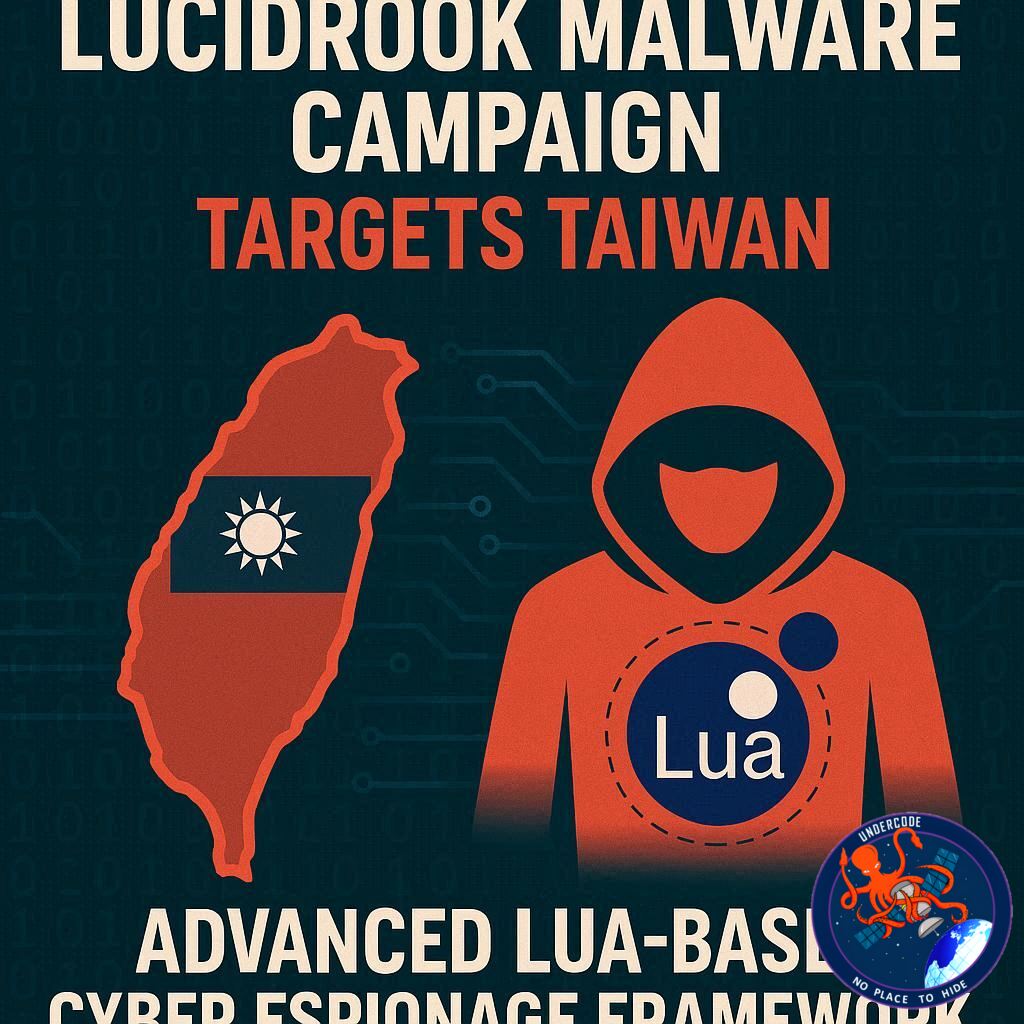
A newly discovered malware strain known as LucidRook has surfaced as part of highly targeted cyber-espionage campaigns aimed at NGOs and academic institutions in Taiwan. Identified by Cisco Talos, this threat is not a typical piece of malicious software but a carefully engineered attack framework designed for stealth, adaptability, and long-term infiltration. Delivered through convincing spear-phishing emails and backed by advanced technical execution, LucidRook represents a significant evolution in how attackers approach targeted intrusions in sensitive sectors.
Summary: Anatomy of the LucidRook Attack Campaign
LucidRook is a Lua-based malware deployed in spear-phishing campaigns that specifically target organizations in Taiwan. According to Cisco Talos, the attacks were traced back to a sophisticated threat actor group tracked as UAT-10362. In October 2025, attackers leveraged password-protected email attachments to distribute the malware, using what appeared to be legitimate email infrastructure, suggesting possible abuse of trusted systems.
The phishing emails contained shortened URLs that directed victims to download encrypted RAR archives. Notably, the password required to open these archives was conveniently included within the email itself, lowering suspicion and increasing the likelihood of execution. Inside the archives, victims encountered decoy documents themed around government or security topics, designed to distract them while malicious processes executed in the background.
Researchers identified two distinct infection chains. The first relies on LNK files, where opening a shortcut triggers a hidden dropper called LucidPawn. This dropper uses legitimate Windows tools and PowerShell scripts, a technique known as LOLBAS (Living Off the Land Binaries and Scripts), to evade detection. It decrypts and launches payloads, including a legitimate DISM executable that is abused through DLL sideloading to execute malicious code. Meanwhile, fake documents are displayed to keep the user unaware. Persistence is achieved by planting malicious shortcuts in the system startup folder.
The second infection chain uses a standalone EXE dropper built with .NET. Disguised as legitimate security software, it extracts Base64-encoded payloads and deploys multiple components, including the LucidRook stager and persistence mechanisms. Similar to the first method, it abuses trusted binaries and presents fake success messages to mislead victims.
At its core, LucidRook is a highly complex DLL-based stager that embeds a Lua interpreter alongside Rust-compiled libraries. This allows it to download encrypted Lua bytecode from a command-and-control server via FTP, validate it, and execute it locally. This modular approach enables attackers to dynamically change the malware’s behavior depending on the target.
The malware also performs extensive system reconnaissance, collecting data such as usernames, running processes, and installed applications. This information is encrypted using RSA and exfiltrated via FTP, often using compromised or publicly accessible servers. Advanced obfuscation techniques, including multi-layer XOR encoding, make analysis extremely difficult.
Additionally, LucidPawn includes geo-targeting capabilities, executing only on systems configured with Traditional Chinese language settings, thereby avoiding detection in non-target environments. Another related component, LucidKnight, functions as a reconnaissance tool that gathers system data and exfiltrates it via Gmail SMTP, disguised as harmless communications.
Cisco Talos noted that while they have not yet recovered a fully decryptable payload from LucidRook, the observed tactics strongly indicate a targeted and well-resourced operation rather than opportunistic malware distribution.
What Undercode Say: Strategic Implications of a Modular Cyber Weapon
The emergence of LucidRook highlights a clear shift in modern cyber-espionage tactics, where flexibility and stealth are prioritized over mass infection. This is not malware built for scale, but for precision. Every component in this campaign suggests deliberate engineering aimed at maximizing control while minimizing exposure.
One of the most striking aspects is the use of Lua as an execution layer. Lua is lightweight, highly portable, and rarely associated with malware, making it an excellent choice for evading traditional detection systems. By embedding a Lua interpreter directly into the malware, attackers gain the ability to dynamically update behavior without redeploying the entire payload. This essentially transforms LucidRook into a programmable attack platform rather than a static threat.
The integration of Rust further reinforces this sophistication. Rust’s memory safety and performance characteristics make it increasingly popular among advanced threat actors. Its compiled binaries are harder to reverse engineer, especially when combined with stripped symbols and obfuscation. This dual-language architecture, Lua for flexibility and Rust for performance and stealth, represents a new hybrid model in malware development.
Another critical insight is the abuse of legitimate infrastructure. By sending phishing emails through authorized systems and leveraging trusted binaries like DISM, attackers blur the line between normal and malicious activity. This tactic significantly reduces the effectiveness of traditional security tools that rely on signature-based detection or behavioral anomalies.
The use of password-protected archives is also not accidental. It bypasses email scanning systems, as encrypted files cannot be easily inspected. Including the password in the email may seem counterintuitive, but it serves a psychological purpose, it reassures the recipient that the content is intentional and secure.
Geo-targeting adds another layer of precision. By restricting execution to systems using Traditional Chinese, the malware avoids unnecessary exposure in sandbox environments, which are often configured with default English settings. This indicates a deep understanding of defensive technologies and how to bypass them.
The modular design involving LucidPawn, LucidRook, and LucidKnight suggests a toolkit approach rather than a single payload. Each component serves a specific role, from initial access to reconnaissance and data exfiltration. This modularity allows attackers to customize operations based on the target, increasing efficiency and reducing risk.
From a strategic standpoint, this campaign reflects a broader trend in cyber warfare, where attacks are increasingly tailored, persistent, and intelligence-driven. NGOs and universities are often targeted not for financial gain but for access to sensitive information, research data, or geopolitical insights.
The reliance on FTP and public servers for command-and-control communication is another subtle but effective tactic. It avoids the need for dedicated infrastructure, making attribution more difficult and allowing attackers to blend into normal network traffic.
Ultimately, LucidRook is not just a piece of malware, it is a framework for controlled, adaptive cyber intrusion. Its design suggests long-term objectives, likely aligned with intelligence gathering rather than immediate disruption.
Fact Checker Results
✅ LucidRook uses Lua and Rust components, confirmed by Cisco Talos analysis
✅ Campaign targets are highly specific, primarily NGOs and universities in Taiwan
❌ No confirmed attribution to a known nation-state actor, only medium-confidence assessment
Prediction
🔮 Targeted malware frameworks like LucidRook will become more common in geopolitical cyber operations
🔮 Use of uncommon programming languages such as Lua and Rust in malware will increase to evade detection
🔮 Future campaigns will likely expand beyond Taiwan, adapting similar techniques to other regions and sectors
▶️ Related Video (86% Match):
🕵️📝✔️Let’s dive deep and fact‑check.
References:
Reported By: securityaffairs.com
Extra Source Hub (Possible Sources for article):
https://www.digitaltrends.com
Wikipedia
OpenAi & Undercode AI
Image Source:
Unsplash
Undercode AI DI v2
Bing
🔐JOIN OUR CYBER WORLD [ CVE News • HackMonitor • UndercodeNews ]
📢 Follow UndercodeNews & Stay Tuned:
𝕏 formerly Twitter 🐦 | @ Threads | 🔗 Linkedin | 🦋BlueSky | 🐘Mastodon


