
Listen to this Post
Introduction: Reading the Universe’s Ancient Scars
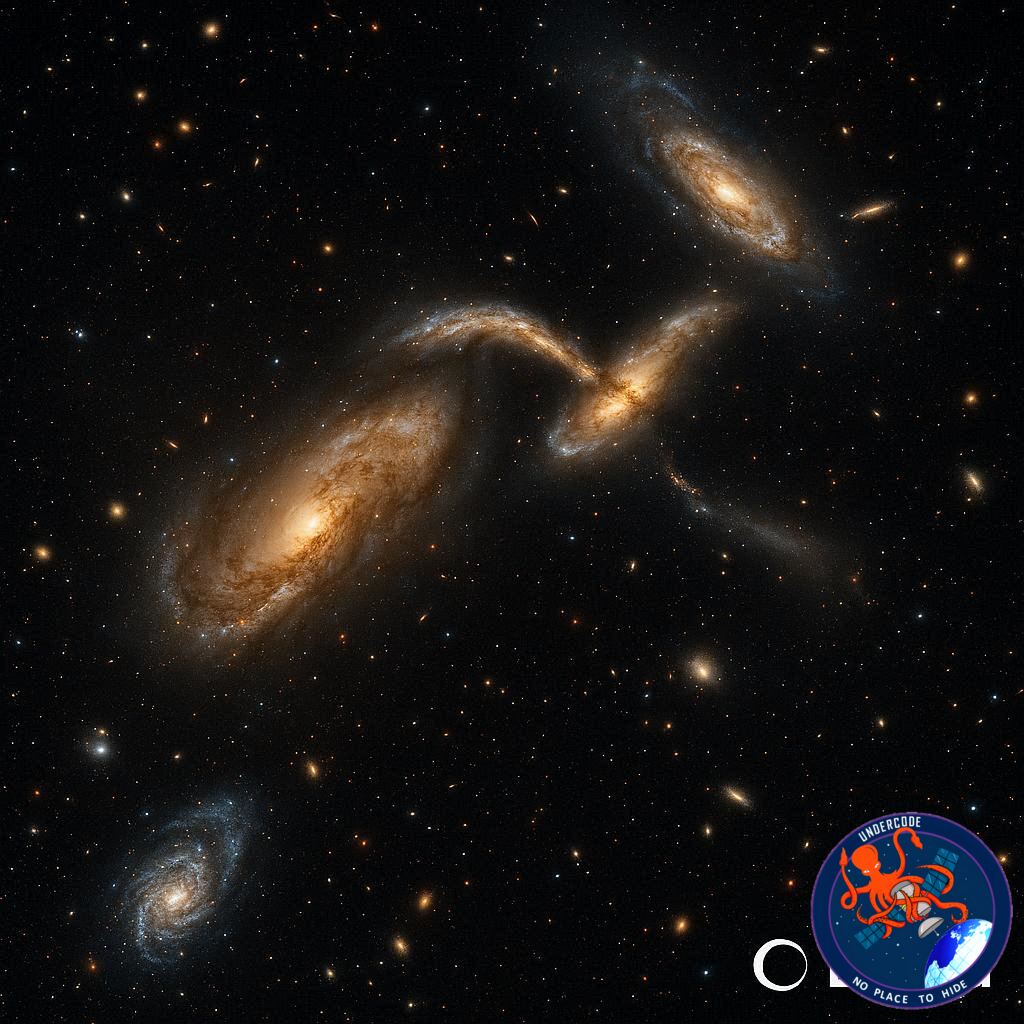
Across the vastness of space, galaxies are not isolated islands. They move, interact, and sometimes collide in spectacular cosmic encounters that unfold over millions or even billions of years. These interactions leave behind subtle but powerful signatures: elongated streams of stars, ghostly shells, and sweeping tidal tails stretching far beyond the galaxies themselves.
Today, thanks to the powerful imaging capabilities of the Euclid Space Telescope, astronomers are gaining an unprecedented view of these faint structures. The mission, led by the European Space Agency with major contributions from NASA, is producing some of the deepest and most detailed images of the cosmos ever captured.
But scientists are not working alone. Through the citizen-science project Galaxy Zoo: Tidal Tales, volunteers from around the world can help researchers identify the tell-tale signs of galactic interactions hidden inside these images. By simply classifying what they see, participants help build a massive catalog of galaxy mergers and train machine-learning models to detect these cosmic fingerprints automatically.
The Hidden Stories Written in Galactic Tidal Features
Galaxies carry the marks of their past like ancient scars. When two galaxies pass near each other or collide, gravitational forces pull on their stars, stretching them outward into long, thin streams known as tidal tails. These features can also appear as faint arcs, delicate shells, or wispy bridges connecting neighboring galaxies.
Such structures are not merely visual curiosities. They act as historical records of gravitational encounters that occurred long ago. Astronomers study them to reconstruct the sequence of events that shaped each galaxy’s evolution.
Detecting these faint structures has always been challenging. Many tidal features are extremely dim and spread across large regions of space. Traditional surveys often missed them due to limited sensitivity or resolution.
The Euclid mission changes that dramatically. Its deep, wide-field images allow astronomers to detect tidal streams and shells in far greater numbers than previously possible. This provides a new opportunity to study galaxy mergers on a much larger scale.
To fully take advantage of this enormous dataset, researchers launched the Galaxy Zoo: Tidal Tales project on Zooniverse, a platform known for hosting citizen-science initiatives that allow the public to assist in real scientific discovery.
Volunteers participating in the project examine real astronomical images and identify visual signs of galactic interaction. These may include tidal tails, stellar streams, shells, or other unusual distortions in galaxy shapes.
Every classification contributes to a growing database that astronomers can use to analyze how galaxies merge, interact, and evolve across cosmic time.
Beyond building a catalog, these human classifications also serve another important purpose. They train computer algorithms to recognize similar patterns automatically in future datasets, allowing artificial intelligence to assist astronomers in analyzing massive amounts of astronomical imagery.
In this way, the project combines human intuition with machine learning to accelerate our understanding of galaxy evolution.
Ultimately, the goal is to understand how collisions influence star formation, galaxy growth, and the overall structure of the universe.
What Undercode Say:
Galaxy collisions are among the most transformative events in cosmic history. While they unfold over timescales far longer than human observation allows, their visible aftermath provides a window into processes that shape the large-scale structure of the universe.
What makes the Euclid mission particularly significant is its ability to combine depth and scale. Previous telescopes could capture deep images of individual galaxies, but surveying large regions of the sky at this level of detail was far more difficult. Euclid bridges this gap by scanning enormous cosmic volumes while still detecting faint tidal signatures.
This capability opens the door to statistical analysis on a scale never before possible. Instead of studying a handful of galaxy mergers, astronomers can now analyze thousands or even millions of interactions across different epochs of cosmic history.
Another important aspect of the Galaxy Zoo: Tidal Tales initiative is the role of citizen science in modern astronomy. Large-scale astronomical surveys now produce far more data than professional researchers alone can analyze. Human volunteers provide a powerful solution by helping classify images while also generating training data for machine learning systems.
This collaboration between humans and artificial intelligence is becoming increasingly important in astrophysics. While algorithms can process massive datasets rapidly, humans still outperform machines in recognizing subtle visual patterns. By combining the strengths of both, researchers can dramatically accelerate scientific discovery.
The project also highlights a broader shift in how scientific research is conducted. Rather than limiting participation to academic institutions, platforms like Zooniverse allow anyone with an internet connection to contribute directly to cutting-edge science.
From an astrophysical perspective, galaxy mergers play a critical role in shaping galaxy morphology and star formation activity. When galaxies collide, gas clouds can compress, triggering bursts of star formation that may last for hundreds of millions of years.
At the same time, mergers can feed supermassive black holes at galactic centers, igniting powerful active galactic nuclei that influence the surrounding interstellar environment.
Understanding how often these mergers occur and how they evolve over time is therefore essential for building accurate models of cosmic structure formation.
Euclid’s observations will likely transform this field by providing the first truly comprehensive census of tidal features across a large portion of the observable universe.
As machine learning models become better trained through citizen-science classifications, future surveys may eventually identify these features automatically in real time.
This combination of advanced space telescopes, public participation, and artificial intelligence represents a new era of collaborative astronomy.
Fact Checker Results
✅ The Euclid Space Telescope is a real mission led by the European Space Agency with major contributions from NASA.
✅ The Galaxy Zoo: Tidal Tales project allows volunteers to classify galaxy interactions using images from Euclid.
✅ Tidal features such as streams, shells, and tails are well-known signatures of galaxy mergers studied in modern astrophysics.
Prediction
🔭 Citizen-science datasets will increasingly train AI systems capable of detecting galaxy mergers automatically across massive sky surveys.
🌌 Euclid’s deep imaging is likely to reveal far more tidal structures than previously recorded, reshaping models of galaxy evolution.
🚀 Future missions and surveys will combine AI, citizen science, and high-resolution space telescopes to map cosmic interactions at an unprecedented scale.
🕵️📝✔️Let’s dive deep and fact‑check.
References:
Reported By: science.nasa.gov
Extra Source Hub (Possible Sources for article):
https://www.reddit.com/r/AskReddit
Wikipedia
OpenAi & Undercode AI
Image Source:
Unsplash
Undercode AI DI v2
Bing
🔐JOIN OUR CYBER WORLD [ CVE News • HackMonitor • UndercodeNews ]
📢 Follow UndercodeNews & Stay Tuned:
𝕏 formerly Twitter 🐦 | @ Threads | 🔗 Linkedin | 🦋BlueSky | 🐘Mastodon


