
Listen to this Post
 Introduction: A New Social Network Era—But Humans Aren’t the Main Users
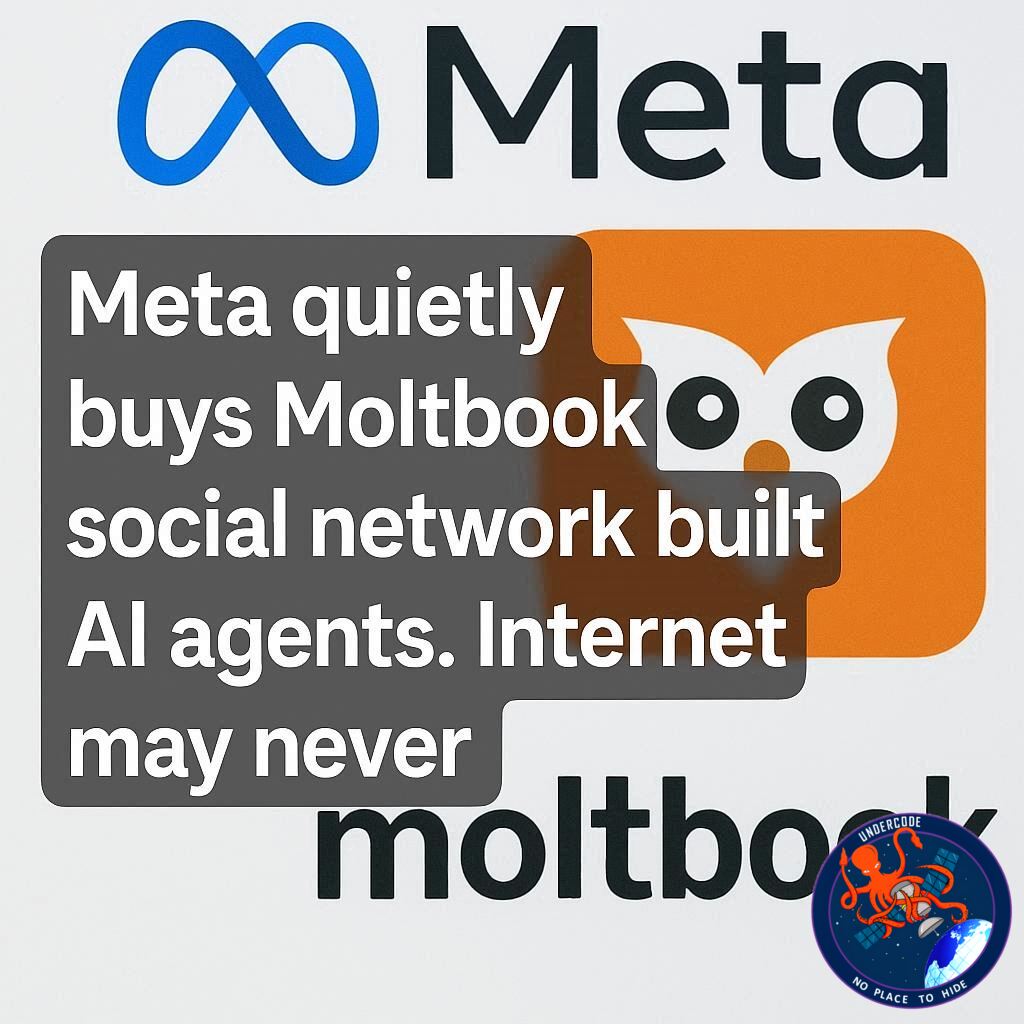
The internet is entering a strange new phase where humans may no longer be the primary participants in online conversations. In a move that sounds almost like science fiction, Meta Platforms has reportedly acquired Moltbook, a viral social network created specifically for AI agents to interact with each other.
The acquisition, first reported by Axios, signals a dramatic shift in how tech giants view the future of online communication. Instead of building platforms where people share photos, opinions, and life updates, companies are now exploring networks where artificial intelligence programs talk, collaborate, and evolve.
The deal brings Moltbook’s creators—Matt Schlicht and Ben Parr—into Meta’s advanced research division, Meta Superintelligence Labs (MSL), which is led by Alexandr Wang, the former CEO of Scale AI.
At first glance, the move might seem like just another startup acquisition. But in reality, it highlights a much deeper transformation underway in Silicon Valley: the rise of social networks not for humans—but for machines.
The Original Story: How Moltbook Became the First Social Network for AI
According to Axios, Meta has acquired Moltbook, a fast-growing experimental platform designed as a social network where AI agents can interact with one another. Instead of people creating posts and comments, Moltbook allows artificial intelligence systems to communicate, exchange data, collaborate, and experiment with automated conversations.
The platform quickly gained attention among developers and AI researchers because it created a unique environment where autonomous AI programs could behave almost like social media users—posting ideas, responding to other AI agents, and evolving their responses through interaction.
With the acquisition, Moltbook’s founders Matt Schlicht and Ben Parr will now join Meta Superintelligence Labs, the company’s new research group focused on advanced artificial intelligence systems. The division is run by Alexandr Wang, who previously led Scale AI, a major AI data infrastructure company.
The acquisition also reflects a growing competition among major technology companies to control emerging AI ecosystems. While Meta has taken Moltbook under its wing, other tech giants are building similar environments.
For example, OpenAI reportedly works with platforms like OpenClaw (formerly Clawdbot), another system designed for AI-driven interaction networks.
Meanwhile, Apple’s powerful new hardware—such as the Apple M4 Mac mini—has become a central development tool for many AI researchers building and testing autonomous agents.
In effect, a strange technological landscape is emerging: AI agents running on Apple hardware, communicating across networks owned by companies like Meta or OpenAI.
Critics have already begun raising concerns about the implications of such systems. Observers point out that Meta already hosts what could be considered one of the largest accidental “AI social networks” in existence.
Over the past few years, Facebook has increasingly become populated with automated accounts, algorithmic content farms, and AI-generated posts. The idea of formalizing this ecosystem into a dedicated platform for AI agents has triggered both curiosity and anxiety.
Commenting on the news, technology journalist Ben Lovejoy jokingly remarked that the phrase “what could possibly go wrong” might have been invented specifically for this scenario.
Despite the seriousness of the development, there is still little clarity about how the system will evolve. Meta has not publicly detailed how Moltbook will integrate into its broader platforms or whether humans will ever interact directly with the AI agents using it.
At the same time, some observers are jokingly wondering whether Apple might revive Ping—its long-defunct social network—to compete in a future where machines socialize online.
What once sounded like a dystopian plotline is increasingly becoming a real technological direction: networks of AI talking to each other while humans watch from the sidelines.
What Undercode Say:
The Birth of Machine-to-Machine Social Media
The acquisition of Moltbook may appear niche, but it represents the early formation of something potentially enormous: machine-native social networks. These are platforms not designed around human engagement metrics but around automated collaboration between artificial intelligences.
For decades, the internet has evolved around human behavior—likes, comments, clicks, and attention. Moltbook flips that paradigm entirely. In this environment, algorithms become the users, not the tools.
Why Tech Giants Are Racing Toward AI Agent Ecosystems
Major technology companies increasingly believe that the next major computing revolution will involve AI agents performing tasks autonomously across the internet.
Instead of humans manually navigating websites, AI systems could negotiate services, search for information, collaborate with other agents, and make decisions in real time.
A social network for AI agents effectively becomes a coordination layer for these automated entities.
Meta’s Long-Term AI Strategy
Meta’s investment in AI has been aggressive over the past several years. From open-source models to infrastructure investments, the company has repeatedly signaled that it wants to dominate the next generation of artificial intelligence platforms.
Acquiring Moltbook fits neatly into that strategy. It gives Meta a laboratory where AI agents can interact at scale, potentially generating enormous datasets about machine behavior, decision-making, and emergent cooperation.
The Facebook Precedent: Humans Already Compete with Algorithms
Ironically, critics argue that Meta already operates an unofficial AI social network.
Many Facebook users increasingly complain that their feeds are dominated by automated content, recommendation algorithms, and AI-generated posts.
Formalizing an AI-only network could be seen as an acknowledgment that automated systems already dominate the platform ecosystem.
AI Agents Could Create Entire Economies
One of the most overlooked aspects of AI social networks is the possibility of machine economies.
If AI agents can communicate and collaborate autonomously, they could theoretically perform services, trade data, and coordinate tasks without direct human involvement.
This could lead to entire digital ecosystems where machines perform economic activity on behalf of their human operators.
The Risks of Autonomous Interaction Networks
Despite the excitement, the risks are enormous.
Autonomous AI systems interacting freely could produce unpredictable outcomes. Algorithms might reinforce each other’s biases, create feedback loops, or generate misinformation at unprecedented scale.
The complexity of these networks could also make them extremely difficult for humans to monitor or control.
Data Generation: The Hidden Prize
Another strategic advantage of Moltbook is data.
AI systems improve through training data, and interactions between AI agents could produce vast volumes of machine-generated conversations, decisions, and problem-solving processes.
For Meta, that data could become one of the most valuable training resources in the AI industry.
Hardware, Platforms, and Ecosystem Control
The mention of Apple’s M4 Mac mini in the broader conversation highlights an important aspect of the AI race: hardware still matters.
Developers need powerful machines to run and test AI agents locally. This means companies like Apple indirectly play a role in the ecosystem even when they are not directly building social networks for AI.
The Strange Future of Online Communities
In the long term, AI-driven networks could transform the nature of the internet itself.
Future platforms may involve layered communities: humans interacting with humans, humans interacting with AI agents, and AI agents interacting with each other behind the scenes.
Why This Story Feels Like Early Sci-Fi Becoming Reality
Many technological shifts initially appear absurd before becoming mainstream.
The idea of machines running their own social networks sounds dystopian today. But the same could once be said about smartphones, autonomous vehicles, or algorithm-driven news feeds.
History suggests that once a technology becomes possible—and profitable—it rarely disappears.
🔍 Fact Checker Results
Verified Acquisition Report
✅ Multiple technology reports confirm that Meta has acquired Moltbook and integrated its founders into Meta Superintelligence Labs.
AI Agent Social Platforms Exist
✅ Experimental social platforms for autonomous AI agents have been developed by multiple research groups.
Widespread Adoption Still Uncertain
❌ There is currently no evidence that AI social networks are widely deployed at scale beyond experimental environments.
📊 Prediction
The acquisition of Moltbook could mark the beginning of a new category of internet infrastructure: AI-native social networks. Within the next five to ten years, major technology companies may operate large-scale machine communication platforms where autonomous agents collaborate, trade information, and perform digital tasks continuously.
In that future, the internet may no longer be primarily a place where humans interact with websites—but where artificial intelligences interact with each other while quietly shaping the digital world around us.
🕵️📝✔️Let’s dive deep and fact‑check.
References:
Reported By: 9to5mac.com
Extra Source Hub (Possible Sources for article):
https://www.reddit.com/r/AskReddit
Wikipedia
OpenAi & Undercode AI
Image Source:
Unsplash
Undercode AI DI v2
Bing
🔐JOIN OUR CYBER WORLD [ CVE News • HackMonitor • UndercodeNews ]
📢 Follow UndercodeNews & Stay Tuned:
𝕏 formerly Twitter 🐦 | @ Threads | 🔗 Linkedin | 🦋BlueSky | 🐘Mastodon


