
Listen to this Post
Introduction
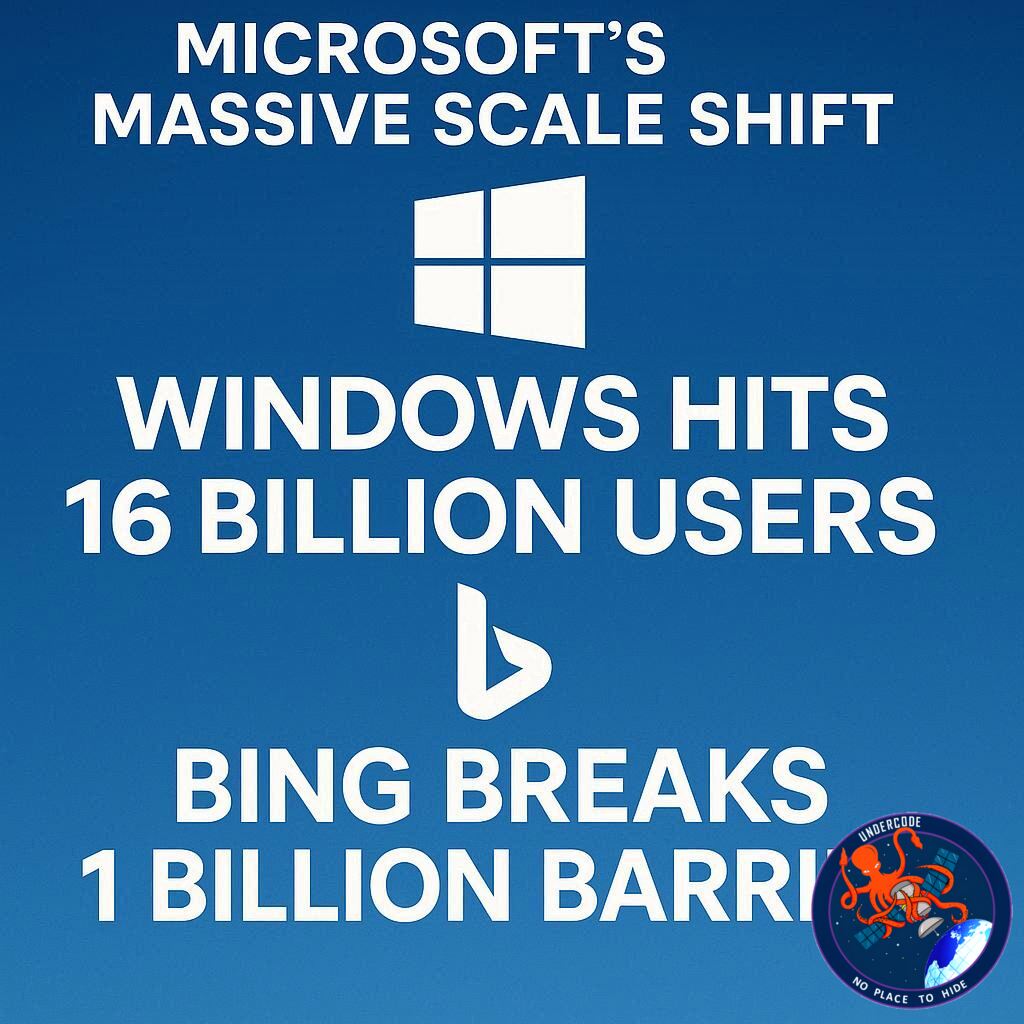
Microsoft has quietly entered a new phase of its ecosystem expansion, revealing user numbers that highlight both stability and surprising growth across its core platforms. Windows, the company’s long-standing operating system, continues to dominate with an estimated 1.6 billion monthly active users, while Bing, often underestimated in global search competition, has crossed a major milestone of 1 billion monthly active users for the first time. These figures were shared during Microsoft’s Q3 earnings call led by CEO Satya Nadella, alongside broader strategic commentary about Windows modernization, AI integration, and ecosystem-wide engagement. While Windows’ number reflects steady maturity, Bing’s growth suggests a deeper shift in how users interact with Microsoft’s AI-driven search and services landscape.
Summary of the Original
Microsoft has reported that Windows now reaches 1.6 billion monthly active users across active PCs worldwide. This figure reinforces the operating system’s dominant global footprint, even though Microsoft does not regularly break down growth by specific Windows versions or detailed adoption metrics. The company also confirmed that Bing has surpassed 1 billion monthly active users, marking a significant milestone for a search engine often seen as secondary to competitors. This growth aligns with earlier market share estimates suggesting Bing holds roughly 13 percent of the search market.
During the Q3 earnings call, CEO Satya Nadella emphasized Microsoft’s renewed focus on Windows fundamentals, signaling an effort to improve core system performance, stability, and user satisfaction. He stated that Microsoft intends to “win back” Windows users by strengthening the operating system experience and improving engagement across key products like Edge and Bing. Microsoft also highlighted ongoing improvements to Windows updates, performance optimizations, and better efficiency on low RAM systems, which reflect a broader effort to make Windows more accessible across a wide range of devices.
The company did not provide detailed breakdowns of Windows growth drivers, such as whether increases are linked to Windows 10 end of life transitions or organic expansion. Microsoft also historically avoids sharing precise market share data, relying instead on third party estimates. For comparison, Microsoft reported approximately 1.5 billion Windows powered devices in 2018, indicating relatively stable long term growth.
Alongside Windows and Bing, Microsoft also discussed broader ecosystem performance. Edge has reportedly gained browser market share for 20 consecutive quarters, while LinkedIn continues to grow with 1.3 billion members globally. Microsoft 365 consumer subscriptions have reached nearly 95 million users, with early signs suggesting increased user satisfaction due to AI driven features like Agent Mode.
Nadella further emphasized the role of Windows as a foundation for “unmetered intelligence at the edge,” pointing toward deeper integration of AI capabilities across devices. This reflects Microsoft’s strategy of embedding artificial intelligence across its entire ecosystem, including Windows, Bing, Edge, and productivity tools.
Bing’s growth was particularly highlighted as unexpected by many observers, especially given its historically lower public perception compared to competitors. However, Microsoft attributes this rise to improved AI integration, better user experience, and ecosystem synergy with Windows and Edge. Users are increasingly engaging with Bing not only as a search engine but as an AI assisted discovery platform.
What Undercode Say:
Microsoft’s reported figures are less about sudden explosive growth and more about ecosystem consolidation at scale. Windows reaching 1.6 billion users shows that the operating system has entered a maturity phase where expansion is incremental rather than disruptive, yet still massive in global footprint. The lack of detailed breakdowns is intentional, as Microsoft avoids exposing weaknesses between legacy Windows versions and newer deployments.
Bing crossing 1 billion monthly users is more strategically significant than it appears at first glance. This milestone suggests that AI integration has fundamentally changed user behavior. Bing is no longer just a search engine competing on keyword results but an AI enhanced interface embedded into Windows and Edge experiences.
The 13 percent market share context is critical because it shows Bing is not just surviving but gradually expanding relevance in a space long dominated by a single competitor. The integration of AI chat, summarization, and conversational search likely plays a central role in this shift.
Microsoft’s emphasis on Windows fundamentals signals that the company recognizes user frustration with complexity, updates, and performance inefficiencies. Optimizing for low RAM systems is especially important for emerging markets where hardware limitations are common, meaning Microsoft is targeting global inclusivity rather than premium only users.
The mention of “winning back Windows fans” is also telling. It implies that Microsoft is aware of declining emotional attachment to Windows as a brand, despite its dominance. The company is trying to reposition Windows as not just functional but enjoyable and responsive.
Edge’s 20 consecutive quarters of growth is another understated but important indicator. Browser competition is extremely rigid, so steady incremental gains suggest deep integration advantages rather than standalone user migration.
LinkedIn’s growth to 1.3 billion members reinforces Microsoft’s strength in professional data ecosystems. Combined with Microsoft 365 reaching 95 million subscribers, this shows a tightly interconnected productivity network.
The broader strategy becomes clear: Microsoft is building a unified AI powered ecosystem where Windows is the foundation, Bing is the intelligence layer, Edge is the access point, and LinkedIn plus Microsoft 365 provide professional context and productivity depth.
AI is not just an added feature here. It is becoming the structural core of Microsoft’s entire product philosophy. The phrase “unmetered intelligence at the edge” suggests a long term vision where computation and AI inference happen locally on devices, reducing dependence on centralized cloud processing.
This approach also strengthens Microsoft’s position against competitors by embedding AI deeply into everyday operating system interactions rather than limiting it to standalone applications.
From a competitive standpoint, Bing reaching 1 billion users should not be underestimated. Even if engagement per user varies, scale alone gives Microsoft significant leverage in data collection, AI training, and monetization strategies.
Windows’ stability at 1.6 billion users indicates that desktop computing is not declining as some predicted, but instead stabilizing with slower hardware turnover cycles and increased integration into hybrid work environments.
The biggest takeaway is that Microsoft is no longer treating products as isolated entities. Instead, it is building a connected intelligence ecosystem where each platform reinforces the others, creating lock-in through utility rather than restriction.
Fact Checker Results
Windows user count of 1.6 billion aligns with historical Microsoft statements but lacks independent verification granularity. ✅
Bing reaching 1 billion monthly users is plausible but depends heavily on internal Microsoft reporting metrics. ⚠️
Market share figures and AI impact claims require external third party validation for full accuracy assessment. ❌
Prediction
Microsoft will likely continue merging AI features deeper into Windows and Bing, making search and operating system interaction increasingly indistinguishable.
Bing’s growth may stabilize rather than accelerate, but user engagement quality is expected to rise significantly due to AI integration.
Windows will shift further toward an AI native operating system model, where local and cloud intelligence operate seamlessly together across devices.
🕵️📝Let’s dive deep and fact‑check.
References:
Reported By: www.windowslatest.com
Extra Source Hub (Possible Sources for article):
https://www.reddit.com
Wikipedia
OpenAi & Undercode AI
Image Source:
Unsplash
Undercode AI DI v2
Bing
🔐JOIN OUR CYBER WORLD [ CVE News • HackMonitor • UndercodeNews ]
📢 Follow UndercodeNews & Stay Tuned:
𝕏 formerly Twitter 🐦 | @ Threads | 🔗 Linkedin | 🦋BlueSky | 🐘Mastodon


