
Listen to this Post
The Rise of a New AI Force in Silicon Valley
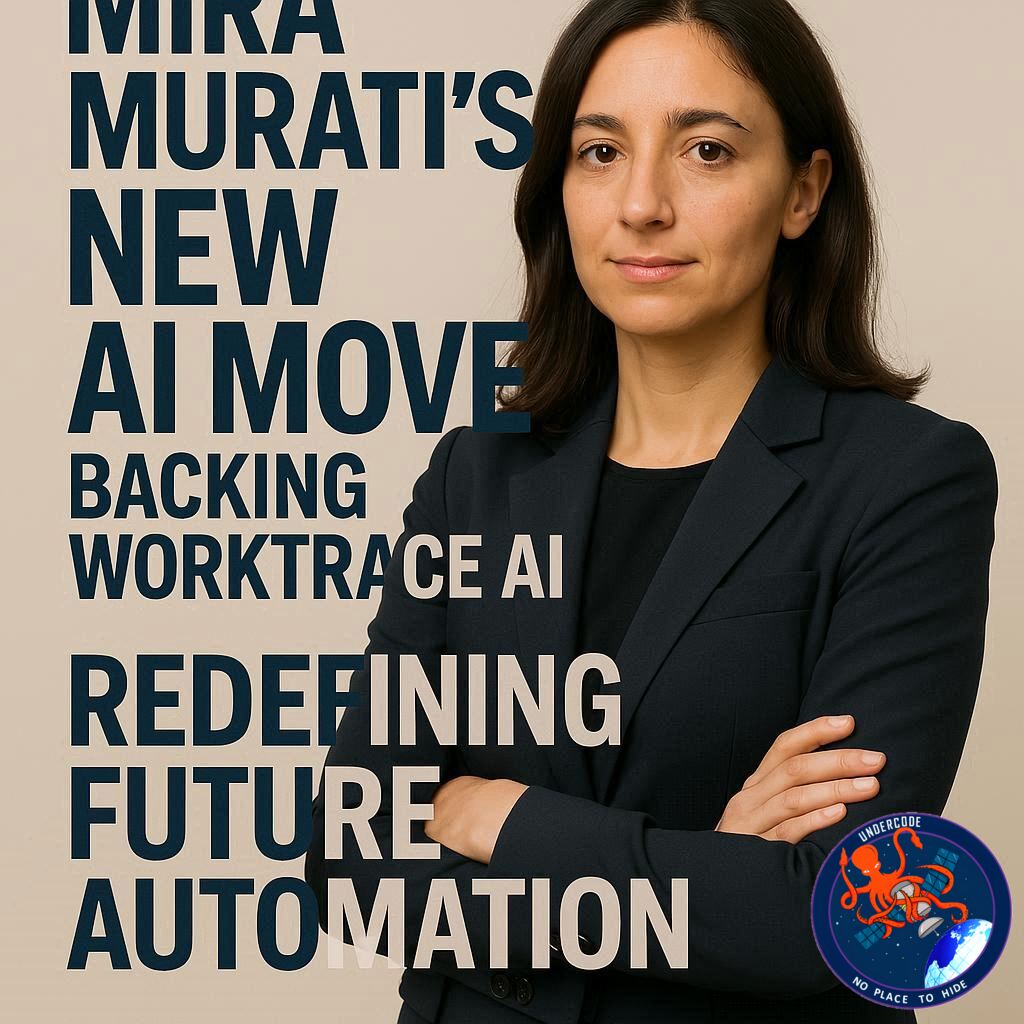
Mira Murati, the former Chief Technology Officer at OpenAI, has once again made headlines with her involvement in another ambitious artificial intelligence venture — Worktrace AI. The project, led by her former OpenAI colleague Angela Jiang, signals yet another powerful collaboration among ex-OpenAI visionaries shaping the next frontier of intelligent automation.
Angela Jiang, who served as one of the earliest product managers at OpenAI, has launched Worktrace AI to revolutionize how large enterprises identify and automate repetitive workflows. Business Insider reports that the company was in talks earlier this year to raise $10 million in seed funding, valuing the startup at an impressive $50 million before its public debut.
Angela Jiang’s Journey from OpenAI to Entrepreneurial Innovation
Jiang’s journey reflects the evolution of OpenAI’s most promising talent. After helping build the GPT models that propelled ChatGPT to viral fame in 2022, she later shifted to OpenAI’s policy team, bridging the gap between technical development and ethical deployment. Her exit in December 2024 marked a transition from research to entrepreneurship — a trend that has become common among OpenAI’s alumni.
A Wave of OpenAI Alumni Startups
Worktrace AI joins a rapidly growing list of startups founded by former OpenAI leaders. These include Mira Murati’s Thinking Machines Lab, Ilya Sutskever’s Safe Superintelligence, and William Fedus’s Periodic Labs — each commanding billion-dollar valuations even before shipping commercial products. This emerging ecosystem is not just a cluster of startups; it’s a movement that’s redefining AI’s competitive landscape.
Murati’s Expanding Influence in the AI Economy
Murati’s decision to back Worktrace AI follows her own blockbuster success with Thinking Machines Lab, a company that secured $2 billion in seed funding and hit a $12 billion valuation in 2025. Her growing presence in Silicon Valley’s AI ecosystem underlines her influence as both a technologist and investor — one capable of guiding the industry’s next generation of AI-driven enterprises.
Worktrace AI’s Mission: The Automation of Observation
According to Worktrace AI’s website, the company focuses on helping organizations “find and automate repetitive tasks by observing employees.” This mission suggests a deep commitment to building AI systems that learn from human workflows — blending productivity enhancement with adaptive learning. The goal is clear: bring advanced automation to the world’s largest corporations by using AI not just as a tool, but as a strategic partner in operational efficiency.
Powerhouse Backing from OpenAI Insiders
The startup’s investor list reads like a who’s who of OpenAI’s leadership circle. Among its backers are Nick Turley, Head of ChatGPT; Jason Kwon, OpenAI’s Chief Strategy Officer; and Joanne Jang, a pivotal figure in defining ChatGPT’s behavioral architecture. Moreover, Worktrace AI has received support from the OpenAI Startup Fund, 8VC, and Conviction, positioning it within an elite network of AI innovation capital.
The Silent Launch That Speaks Volumes
Despite an active website and LinkedIn presence, Worktrace AI has yet to make a formal public announcement. This stealthy approach suggests a deliberate strategy — building quietly, testing extensively, and revealing only when the product is truly ready. Such secrecy mirrors the pattern of previous OpenAI spin-offs, which prefer progress over publicity.
What Undercode Say:
The story of Worktrace AI is more than another startup launch — it’s the unfolding of a new AI era led by the old guard of OpenAI. Mira Murati’s involvement as both a founder and investor reflects how top-tier technologists are evolving from research-focused leadership into ecosystem builders who fund, shape, and connect AI innovation pipelines.
From an analytical standpoint, Worktrace AI represents a strategic leap in how artificial intelligence interacts with enterprise systems. By emphasizing task observation and automation, the company could redefine the concept of workplace intelligence. Traditional automation focuses on pre-defined rules and process mapping, while Worktrace AI aims to create adaptive AI systems that learn by watching, similar to how human apprentices learn from experts.
This transition toward “observational AI” has immense implications. It reduces dependency on manual workflow analysis and introduces a model where AI becomes a cognitive layer — capable of understanding human actions, predicting inefficiencies, and optimizing entire business ecosystems. If successful, Worktrace AI could emerge as the “GitHub Copilot of enterprise workflows.”
Murati’s backing, meanwhile, adds a layer of strategic credibility. Her experience leading OpenAI through the GPT revolution gives her unmatched insight into scaling deep learning systems responsibly. With her portfolio now including both Thinking Machines Lab and Worktrace AI, she’s positioning herself at the center of AI’s next industrial wave — one where companies use generative intelligence not just for creativity but for corporate optimization.
This trend among ex-OpenAI founders highlights a deeper phenomenon: the decentralization of AI innovation. Instead of one giant leading the charge, the ecosystem now features multiple micro powerhouses, each specializing in unique niches — safety, automation, reasoning, and superintelligence. This diversification accelerates innovation while also creating a competitive safeguard against monopolization of AI capabilities.
For investors, Worktrace AI’s $50 million valuation at the seed stage may look bold, but given its pedigree and backing, it’s not surprising. The startup is positioned at the intersection of enterprise automation, machine learning observation, and AI-driven workforce intelligence — three markets projected to explode in valuation through 2030.
From a technical lens, this approach could also redefine data ethics. Observing employees introduces sensitive questions around privacy, consent, and transparency. To succeed, Worktrace AI must balance operational insight with ethical oversight, ensuring that automation enhances productivity without crossing into surveillance.
Still, given the team’s background in policy and safety from OpenAI, it’s reasonable to expect that Worktrace AI will build with privacy at its core. Angela Jiang’s prior policy experience could prove to be a defining advantage, making the company one of the first to commercialize ethical automation effectively.
Overall, this venture showcases how OpenAI’s alumni are not just creating startups — they are building a distributed innovation network capable of accelerating progress across the AI landscape. Each spin-off extends OpenAI’s intellectual legacy while diversifying its technological reach.
Fact Checker Results
✅ Verified: Mira Murati is indeed supporting Worktrace AI founded by Angela Jiang.
✅ Verified: The company has sought $10 million in seed funding at a $50 million valuation.
⚠️ Unconfirmed: Worktrace AI’s launch timeline and product specifics remain undisclosed.
Prediction
By 2026, Worktrace AI is likely to become a major enterprise automation player, potentially integrating with existing corporate AI systems to enhance operational intelligence. With Mira Murati’s influence and the pedigree of OpenAI’s alumni network, the company could achieve a valuation exceeding $1 billion before its first full-scale product release. 🚀
🕵️📝✔️Let’s dive deep and fact‑check.
References:
Reported By: timesofindia.indiatimes.com
Extra Source Hub:
https://www.linkedin.com
Wikipedia
OpenAi & Undercode AI
Image Source:
Unsplash
Undercode AI DI v2
🔐JOIN OUR CYBER WORLD [ CVE News • HackMonitor • UndercodeNews ]
📢 Follow UndercodeNews & Stay Tuned:
𝕏 formerly Twitter 🐦 | @ Threads | 🔗 Linkedin | 🦋BlueSky | 🐘Mastodon


