
Listen to this Post
Introduction: Telco AI Reaches a Critical Moment
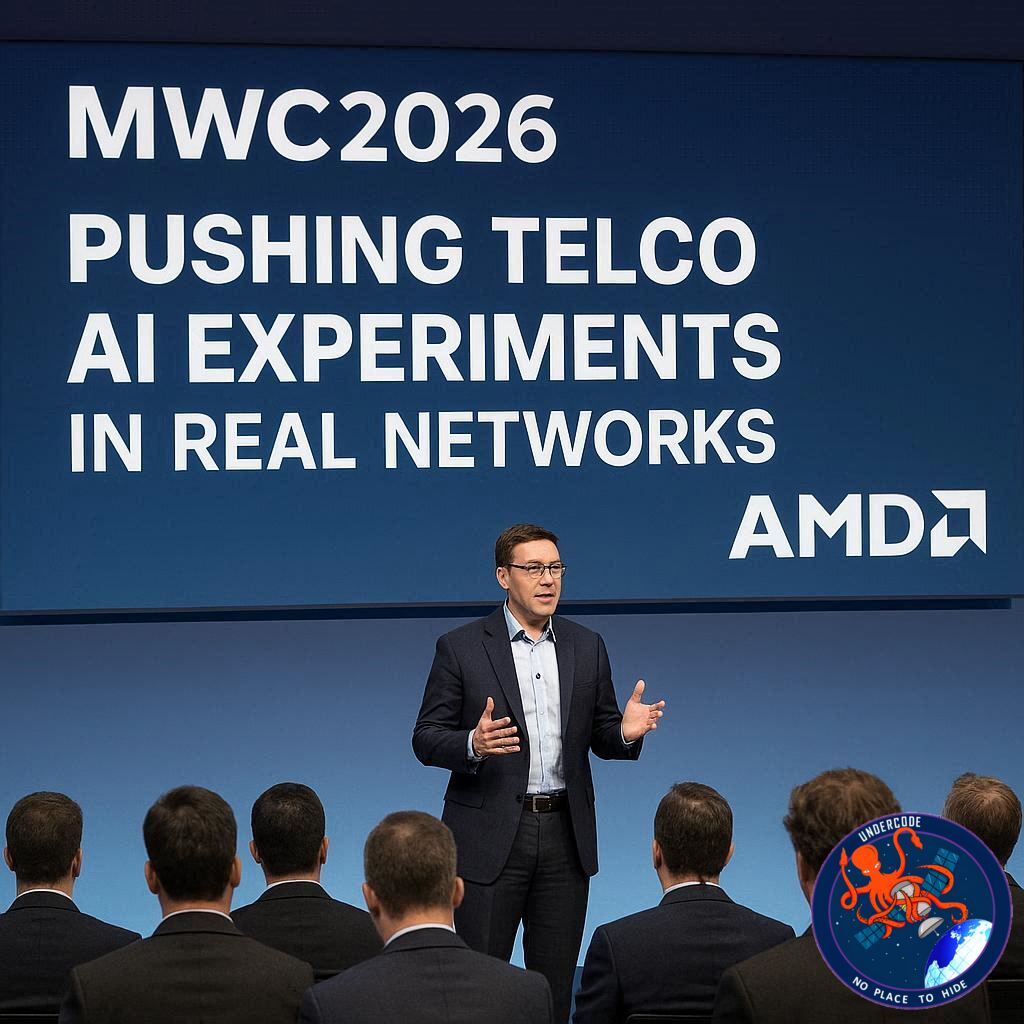
Telecommunications networks are entering a decisive phase in their AI journey. After years of pilots, proofs of concept, and isolated deployments, operators are under pressure to move artificial intelligence into full production. This shift is happening at the same time as the industry transitions from traditional radio access networks to open and virtualized architectures. At MWC2026 in Barcelona, AMD presents a clear message: telco-grade AI cannot succeed in silos. It requires open collaboration, production-ready software, and hardware designed specifically for distributed edge environments where reliability and efficiency matter as much as raw performance.
A New Reality for Telco Networks
Modern telco networks are among the most complex systems ever built. They must deliver uninterrupted service to billions of users while constantly adapting to traffic patterns, failures, and new applications. AI promises dynamic optimization, predictive maintenance, and automated operations, but translating model improvements into live network value has proven difficult. Operators need more than better algorithms. They need an ecosystem that aligns data, software, and compute at scale.
MWC2026 as a Turning Point
At MWC2026 in Barcelona, AMD highlights its role in enabling this transition. Rather than focusing on a single product, the company positions itself as a platform provider supporting open industry initiatives, enterprise-grade AI software, and right-sized hardware for both data centers and the edge. The goal is to help operators move from experimentation to production without locking themselves into closed systems.
The Challenge of Telco-Grade AI
Unlike consumer or enterprise AI use cases, telco AI operates in mission-critical environments. Any failure can impact emergency services, business communications, and national infrastructure. AI models must perform consistently under real-world conditions, integrate with legacy systems, and scale across thousands of distributed sites. Despite rapid advances in generative AI, adoption in telecom remains limited. According to industry research, only a small fraction of generative AI deployments are currently running on live networks.
The Gap Between Models and Networks
One of the core problems is that general-purpose AI models are not designed for telecom workloads. Network data is highly specialized, time-sensitive, and governed by strict regulatory requirements. Without shared datasets, benchmarks, and validation frameworks, operators struggle to trust AI systems in production. This gap has slowed adoption and created fragmentation across vendors and regions.
Open Telco AI Takes Shape
To address these challenges, AMD joins forces with industry leaders in the Open Telco AI initiative. Led by GSMA, the program is designed to accelerate the development of telco-grade AI through open collaboration. Participants include major operators such as AT&T, infrastructure providers, and cloud specialists like TensorWave.
A Shared Foundation for Innovation
At the heart of the initiative is the launch of open-telco.ai, a portal that brings together operators, vendors, researchers, and developers. The platform provides shared datasets, tools, and benchmarks tailored to telecom use cases. By lowering barriers to entry, the initiative aims to transform isolated experiments into reusable, validated models that the entire ecosystem can build upon.
AMD’s Role in Open Telco AI
AMD contributes compute and software expertise to the collaboration. Its AMD Instinct GPUs are used to train Open Telco AI models, turning shared datasets into practical solutions for real networks. Combined with the ROCm software platform, these GPUs offer an open alternative for training and inference, enabling faster iteration from research to validation.
From Training to Trust
Training accurate models is only the first step. Telco operators need confidence that AI systems can be deployed, monitored, and governed at scale. This requires standardized workflows, reproducibility, and transparency. Open Telco AI addresses these needs by aligning models with shared benchmarks and encouraging cross-vendor validation.
The Importance of Enterprise-Grade AI Software
Even the best models fail without a reliable operational layer. AI must be deployed as a service, integrated with existing systems, and managed throughout its lifecycle. Recognizing this, AMD introduces the Enterprise AI Suite as a bridge between experimentation and production.
Inside the AMD Enterprise AI Suite
The Enterprise AI Suite connects open-source frameworks and generative AI models with an enterprise-ready platform optimized for AMD hardware. It is designed for organizations running GPU infrastructure at scale, providing tools for model serving, validated workflows, governance, and developer environments.
Built for DevOps and MLOps
The suite follows a Kubernetes-native, container-based approach. This design allows it to fit naturally into existing DevOps and MLOps practices used by large operators. Security, multiteam governance, and reproducibility are built into the platform, addressing key concerns for regulated industries like telecom.
Practical Benefits for Telco Operators
For network operators, the Enterprise AI Suite offers a realistic path from domain-trained models to production services. These services include network automation, anomaly detection, and operational intelligence. Importantly, the platform remains open, avoiding vendor lock-in while meeting enterprise requirements.
The Edge as the Next Battleground
As networks become more virtualized, much of the intelligence moves closer to the edge. This shift introduces new constraints around power consumption, space, and thermal limits. Hardware designed for centralized data centers often struggles in these environments.
The Need for an Efficient CPU Foundation
While GPUs handle training and inference, CPUs remain critical for orchestration, control planes, and latency-sensitive workloads. At the edge, efficiency and predictability matter more than peak performance. Operators need processors that can handle demanding workloads without excessive power or cooling requirements.
AMD EPYC 8005 Server CPUs
To meet these needs, AMD introduces the AMD EPYC 8005 Server CPUs. These processors are optimized for telco deployments, offering high compute density for virtual RAN workloads and support for compute-intensive Layer 1 processing.
Designed for Real-World Deployments
The EPYC 8005 CPUs are built for challenging environments. They support wide thermal operating ranges, enabling deployment in rugged, outdoor, and space-constrained locations. This flexibility allows equipment manufacturers to certify NEBS-compliant platforms suitable for carrier-grade networks.
Supporting vRAN at Scale
As operators scale commercial virtual RAN deployments, infrastructure choices directly impact operating costs and performance. The EPYC 8005 family helps balance compute density with energy efficiency, aligning technical decisions with long-term business priorities.
An End-to-End Vision
What stands out in AMD’s MWC2026 message is the end-to-end approach. From open collaboration and shared models to enterprise software and edge-optimized hardware, the company positions itself as an enabler rather than a gatekeeper. This strategy reflects the realities of telecom, where interoperability and longevity matter more than short-term gains.
Industry Implications
If successful, initiatives like Open Telco AI could redefine how innovation happens in telecom. Shared benchmarks and open models reduce duplication of effort, while standardized platforms accelerate deployment. For operators, this means faster time to value and lower risk.
The Competitive Landscape
AMD’s push also increases competitive pressure across the ecosystem. By promoting open standards and alternatives, it challenges closed, proprietary stacks that have traditionally dominated telecom infrastructure. This shift could reshape vendor relationships over the next decade.
A Gradual but Meaningful Shift
AI adoption in telecom will not happen overnight. However, the combination of open collaboration, production-ready software, and purpose-built hardware signals a maturing market. MWC2026 may be remembered as the moment when telco AI began to move decisively from promise to practice.
What Undercode Say:
Open Collaboration as a Survival Strategy
The telecom industry no longer has the luxury of fragmented innovation. Open Telco AI reflects a recognition that no single vendor can solve telco AI alone. Shared datasets and benchmarks are not just convenient. They are essential for trust and scale.
AMD’s Strategic Positioning
AMD is positioning itself less as a component supplier and more as a platform orchestrator. By aligning GPUs, CPUs, and software around open initiatives, it reduces friction for operators who are wary of lock-in.
Software Is the Real Differentiator
Hardware performance matters, but software determines adoption. The Enterprise AI Suite addresses one of the biggest pain points in telco AI: operationalization. Without this layer, even the best models remain stuck in labs.
Edge Efficiency Will Define Winners
As AI moves closer to the network edge, efficiency becomes a competitive advantage. EPYC 8005 CPUs are a clear signal that edge deployments are no longer secondary considerations.
Risk Reduction Over Raw Innovation
Telco operators prioritize reliability over novelty. Open standards, validated workflows, and enterprise governance reduce perceived risk, making AI adoption more politically and operationally feasible inside large organizations.
Long-Term Ecosystem Impact
If Open Telco AI gains traction, it could standardize how telco AI models are trained, validated, and deployed. This would lower barriers for smaller players and accelerate innovation across the industry.
Fact Checker Results
Industry Collaboration Claims
AMD’s participation in Open Telco AI alongside GSMA, AT&T, and TensorWave is consistent with public MWC2026 announcements. ✅
Adoption Statistics Context
The low percentage of generative AI deployments in live telco networks aligns with recent GSMA research. ✅
Hardware Positioning Accuracy
The described capabilities of AMD Instinct GPUs and EPYC 8005 CPUs match their stated product positioning for telco and edge use cases. ✅
Prediction
Short-Term Adoption Acceleration
Open Telco AI will likely increase pilot-to-production conversion rates within the next two years as shared benchmarks reduce deployment risk 🚀
Stronger Push Toward Open Architectures
Operators will increasingly favor vendors aligned with open ecosystems, accelerating the decline of closed, proprietary telco stacks 🔓
Edge-Centric AI Growth
By 2028, edge-optimized CPUs and GPUs will become a primary battleground for telco AI infrastructure, with efficiency outweighing raw performance ⚡
🕵️📝✔️Let’s dive deep and fact‑check.
References:
Reported By: www.amd.com
Extra Source Hub (Possible Sources for article):
https://www.reddit.com/r/AskReddit
Wikipedia
OpenAi & Undercode AI
Image Source:
Unsplash
Undercode AI DI v2
Bing
🔐JOIN OUR CYBER WORLD [ CVE News • HackMonitor • UndercodeNews ]
📢 Follow UndercodeNews & Stay Tuned:
𝕏 formerly Twitter 🐦 | @ Threads | 🔗 Linkedin | 🦋BlueSky | 🐘Mastodon


