
Listen to this Post
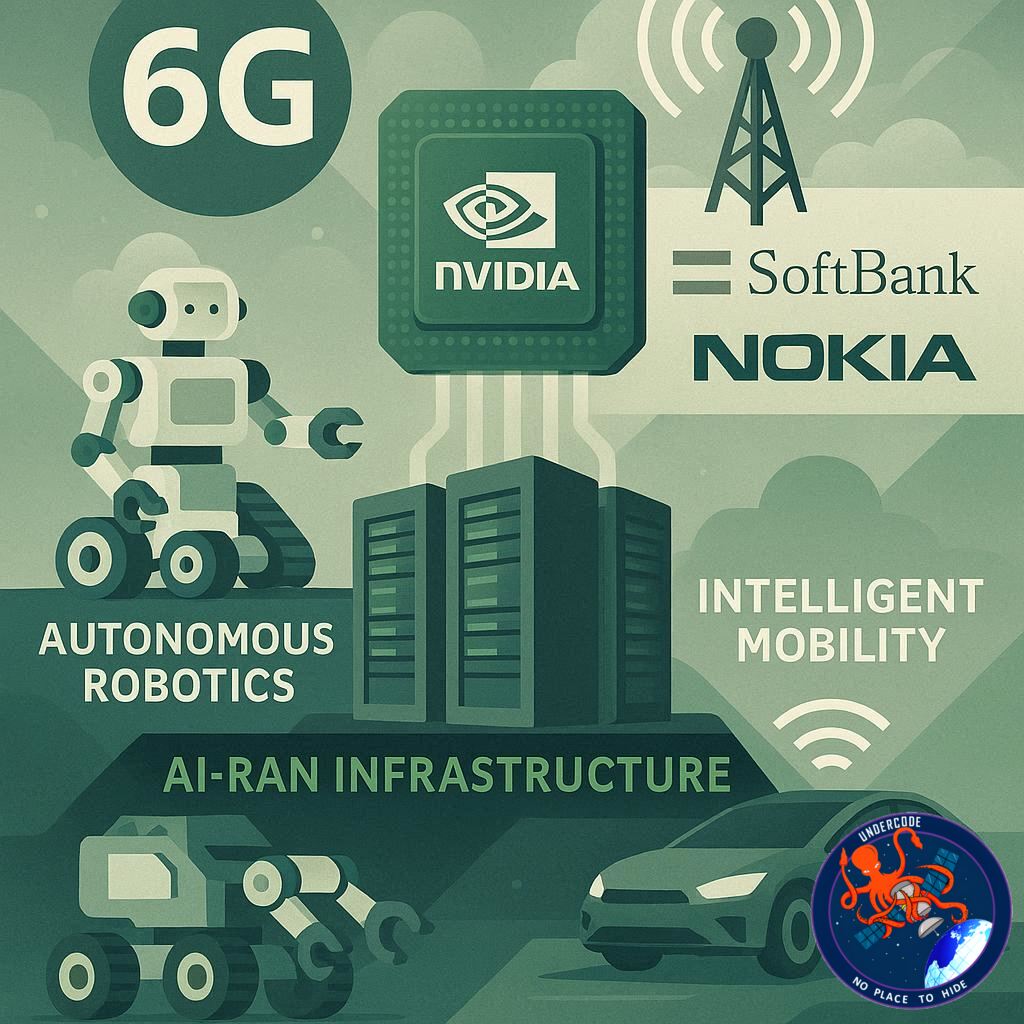
The race toward 6G has quietly shifted from theoretical research to strategic alliances. NVIDIA, long known for dominating the AI chip market, is now stepping decisively into the telecommunications battlefield. By partnering with SoftBank and Nokia, the company is laying the groundwork for a next-generation communications infrastructure designed not merely for faster smartphones, but for AI-powered robots, autonomous vehicles, and intelligent machines that demand real-time decision-making. This development signals a broader transformation of mobile networks into computational ecosystems where connectivity and artificial intelligence operate as a unified system rather than separate layers.
NVIDIA’s Strategic Leap into 6G Infrastructure
US semiconductor giant NVIDIA announced plans to collaborate with major telecom operators to build infrastructure for the next-generation wireless standard known as 6G. The initiative centers on integrating artificial intelligence directly into the network architecture. Rather than treating AI as an external application running on cloud servers, NVIDIA aims to embed it into the communication backbone itself.
This move positions the company beyond chip manufacturing. It represents a strategic expansion into network architecture, where computing and connectivity merge into one programmable framework.
Partnership with SoftBank and Nokia
To realize this vision, NVIDIA is working alongside SoftBank and Nokia. Both companies bring deep telecommunications expertise and global infrastructure experience. SoftBank’s advanced network investments and Nokia’s radio technology leadership provide the operational backbone necessary to deploy AI-driven communication systems at scale.
The collaboration aims to accelerate the deployment of 6G-ready systems capable of supporting data-intensive AI applications. By combining semiconductor innovation with telecom engineering, the alliance seeks to redefine how future mobile networks operate.
Building AI-RAN: Integrating Intelligence into the Network Core
At the heart of the project is AI-RAN, or Artificial Intelligence Radio Access Network. Traditional RAN systems connect user devices to core networks through base stations. AI-RAN transforms this model by embedding machine learning algorithms directly into radio infrastructure.
In this framework, AI dynamically manages traffic, allocates bandwidth, optimizes latency, and processes massive volumes of real-time data. Instead of reactive network management, the system becomes predictive and adaptive. Communication efficiency improves, costs decrease, and new use cases become viable.
Enabling AI-Powered Robots and Autonomous Vehicles
The primary target of this infrastructure is not just consumer mobile users. The design anticipates AI-powered robots, industrial automation systems, and autonomous vehicles that require ultra-low latency and uninterrupted connectivity.
Self-driving cars must communicate with cloud systems, traffic infrastructure, and other vehicles instantly. AI-driven robots operating in factories or cities need reliable, high-bandwidth data channels. The proposed AI-RAN architecture aims to support such mission-critical environments where milliseconds determine safety and efficiency.
6G as a Computational Platform, Not Just a Network
6G is still under development globally, but its vision extends beyond speed improvements over 5G. It is expected to integrate sensing, AI computation, and advanced wireless technologies into a single programmable platform.
NVIDIA’s involvement suggests that future telecom networks may double as distributed AI data centers. Instead of sending all data to remote cloud servers, processing will occur at the network edge. This reduces latency and supports real-time decision-making for machines.
Industry Context: The MWC Global Stage
These announcements align with broader industry discussions leading into the world’s largest mobile technology exhibition, Mobile World Congress. The event, scheduled from March 2 to March 5, 2026, in Barcelona, gathers global telecom leaders to showcase innovations shaping future connectivity.
Major telecom groups, including Japan’s NTT Group, KDDI, and Rakuten Group, as well as China’s Huawei and SpaceX’s Starlink satellite network, are expected participants. The competitive landscape underscores how aggressively companies are positioning themselves for leadership in post-5G infrastructure.
A Competitive Landscape Beyond Traditional Telecom
The entry of chipmakers like NVIDIA into telecom architecture signals a convergence of industries. Telecommunications is no longer confined to carriers and equipment vendors. Cloud providers, semiconductor designers, and AI developers now view network infrastructure as strategic territory.
By embedding AI into radio systems, NVIDIA challenges traditional telecom boundaries. It also places itself at the center of a technological transition where connectivity and computation become inseparable.
The Broader Implications for Global Digital Infrastructure
If successful, AI-RAN could reshape digital infrastructure worldwide. Smart cities, connected healthcare systems, industrial robotics, and autonomous transportation networks depend on ultra-reliable, intelligent connectivity.
This initiative suggests that 6G will not simply increase download speeds. It will transform networks into intelligent systems capable of learning, adapting, and optimizing themselves in real time. The infrastructure becomes proactive rather than reactive.
What Undercode Say:
AI-RAN Signals the Fusion of Silicon and Spectrum
This partnership reflects more than a technical upgrade. It represents the fusion of semiconductor dominance with spectrum control. NVIDIA already controls the AI training ecosystem through its GPUs. By moving into telecom infrastructure, it extends influence from data centers into the physical communication layer itself.
This vertical integration strengthens its competitive moat. Instead of selling chips to telecom companies, NVIDIA helps define the architecture those chips operate within.
Telecom Operators Seek Survival Through AI Efficiency
For carriers like SoftBank and Nokia, the pressure is different. Telecom margins are shrinking. Infrastructure costs are rising. Embedding AI into RAN systems promises automation, predictive maintenance, and optimized energy consumption.
AI-managed base stations can dynamically adjust power usage, reduce congestion, and improve spectrum efficiency. These improvements translate into cost savings and improved service reliability.
6G Development as a Geopolitical Battlefield
6G is not purely technological. It is geopolitical. Countries are racing to set standards and influence intellectual property frameworks. The involvement of companies from the United States, Japan, and Finland highlights a strategic alignment in Western-led telecom ecosystems.
With Huawei also competing aggressively in advanced telecom solutions, alliances like this one reinforce alternative supply chains outside Chinese-dominated infrastructure.
Edge Computing Becomes the Core of Future Networks
Traditional telecom networks were built to move data. Future networks will compute data. AI-RAN implies that every base station could function as a micro data center. This dramatically alters infrastructure planning, energy demand, and hardware requirements.
Edge computing reduces reliance on centralized hyperscale facilities. It distributes intelligence geographically, which is critical for robotics and autonomous systems operating in real-world environments.
Autonomous Mobility Demands Deterministic Connectivity
Autonomous vehicles cannot tolerate unpredictable latency. Current 5G networks offer improvements, but they were not originally designed around AI-native architectures.
By embedding intelligence into traffic routing and signal allocation, AI-RAN aims to deliver deterministic connectivity, where performance variability is minimized. This is essential for public safety applications.
Economic Incentives Behind the Collaboration
There is also a strong financial incentive. AI-driven robotics and smart mobility represent trillion-dollar markets over the next two decades. Whoever controls the enabling infrastructure gains leverage across multiple industries.
NVIDIA’s entry into telecom therefore appears less experimental and more strategic. It ensures that the computational requirements of AI-heavy industries remain aligned with its hardware ecosystem.
Risk Factors and Execution Challenges
Yet risks remain. 6G standards are not finalized. Deployment timelines stretch years into the future. Integration complexity between AI software layers and legacy telecom equipment could slow adoption.
Moreover, telecom operators are traditionally conservative. Large-scale infrastructure transformation requires regulatory approvals, capital expenditure commitments, and ecosystem coordination.
Still, the partnership signals early positioning rather than immediate rollout. It reflects long-term infrastructure planning in an era where AI increasingly defines industrial competitiveness.
Fact Checker Results
✅ NVIDIA officially announced collaboration with SoftBank and Nokia to develop AI-driven 6G infrastructure.
✅ AI-RAN refers to integrating artificial intelligence into radio access networks.
❌ 6G commercial deployment has not yet begun and remains under global development standards.
Prediction
🚀 AI-RAN pilots will expand in Asia and Europe before large-scale global deployment.
📡 6G standardization discussions will intensify between 2026 and 2028, accelerating competitive alliances.
🤖 Autonomous robotics and smart mobility industries will drive early demand for AI-native network infrastructure.
🕵️📝✔️Let’s dive deep and fact‑check.
References:
Reported By: xtechnikkeicom_e9ab22d5dded5f6977df1a64
Extra Source Hub (Possible Sources for article):
https://www.medium.com
Wikipedia
OpenAi & Undercode AI
Image Source:
Unsplash
Undercode AI DI v2
Bing
🔐JOIN OUR CYBER WORLD [ CVE News • HackMonitor • UndercodeNews ]
📢 Follow UndercodeNews & Stay Tuned:
𝕏 formerly Twitter 🐦 | @ Threads | 🔗 Linkedin | 🦋BlueSky | 🐘Mastodon


