
Listen to this Post
Introduction: A Strategic Healthcare Bet on India’s Cardiac Crisis
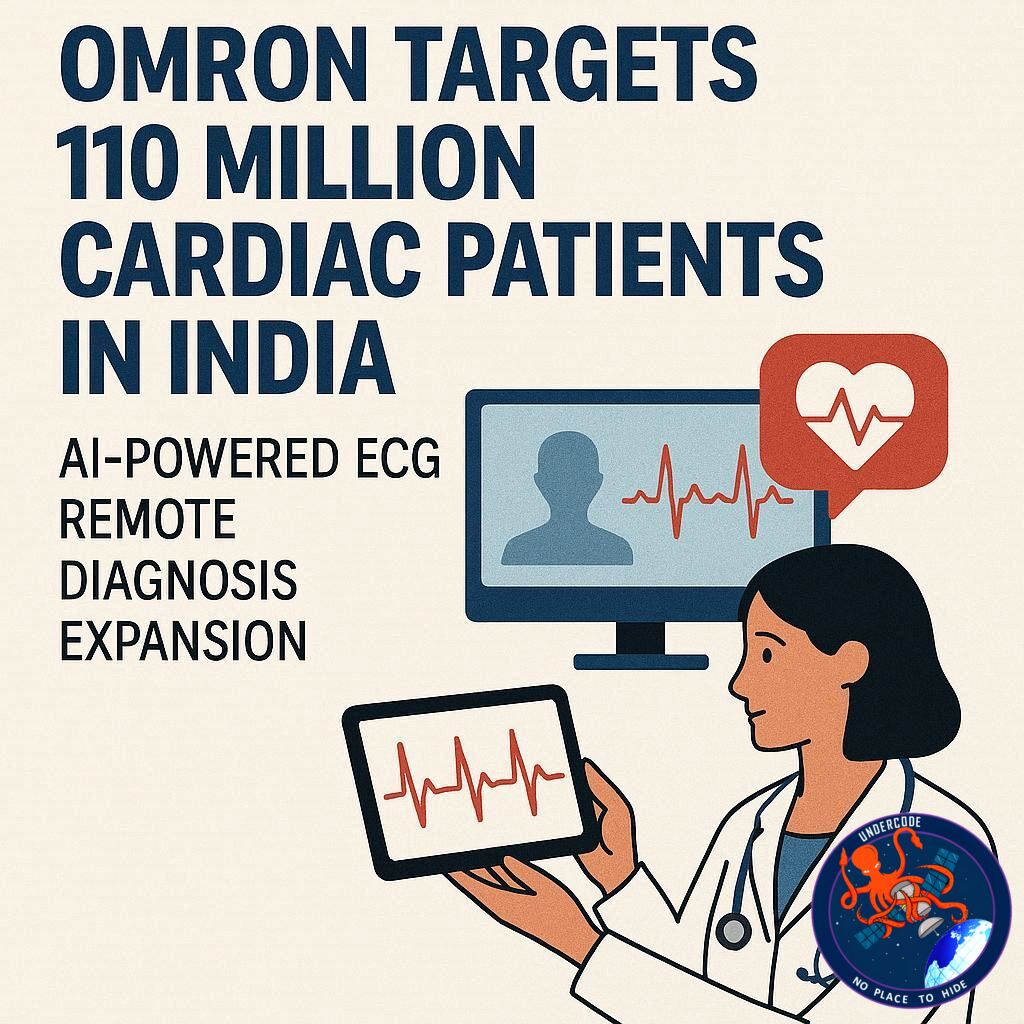
Japan’s healthcare technology giant OMRON is preparing a bold entry into one of the world’s most underserved yet rapidly growing cardiac care markets. Beginning in fiscal year 2026, the company plans to launch a full-scale remote electrocardiogram diagnostic service powered by artificial intelligence in India. The move signals more than a product expansion. It represents a calculated response to a healthcare gap affecting an estimated 110 million people suffering from cardiovascular disease across the country. By combining its ECG hardware with advanced AI analytics, OMRON aims to shorten diagnosis time to as little as ten seconds, offering faster clinical decisions in a nation where cardiologists remain scarce and access to testing remains uneven.
Strategic Partnership with Tricog Health to Accelerate AI Diagnostics
OMRON’s Indian expansion will be executed through a partnership between its subsidiary, OMRON Healthcare, and Singapore-based digital health startup Tricog Health. The collaboration is designed to integrate OMRON’s ECG devices with Tricog’s AI-driven interpretation platform. Through this system, ECG data captured at homes or clinics can be transmitted digitally and analyzed within seconds. The partnership reflects a convergence of Japanese precision hardware and Southeast Asian AI innovation, tailored specifically for emerging markets where diagnostic delays often prove fatal.
India’s Cardiovascular Burden and the 110 Million Patient Market
India faces one of the largest cardiovascular disease burdens in the world, with an estimated 110 million individuals affected. Compared to developed nations, the country has significantly fewer cardiologists per capita. Rural regions and smaller cities struggle even more, with limited diagnostic infrastructure and delayed treatment pathways. ECG testing, which serves as a frontline tool for detecting arrhythmias and ischemic heart disease, has not reached optimal penetration due to workforce shortages and infrastructure gaps. This imbalance creates both a healthcare emergency and a commercial opportunity. OMRON’s strategy directly targets this structural weakness.
Ten-Second AI Analysis: Speed as a Clinical Advantage
One of the most striking aspects of OMRON’s initiative is its promise of AI-based ECG interpretation within approximately ten seconds. Speed in cardiac care is not merely a convenience; it is a determinant of survival. In acute coronary syndromes, minutes can decide outcomes. By dramatically reducing interpretation time, AI-supported diagnostics may allow earlier triage, faster referrals, and potentially lower mortality rates. The system is expected to operate seamlessly, enabling non-specialist healthcare workers to capture ECG readings and receive near-instant analytical feedback.
Expanding Hardware Sales Through Data-Driven Services
OMRON’s plan is not limited to selling ECG machines. The company is building a data-centric healthcare ecosystem. By embedding AI diagnostic capability into its devices, OMRON transforms hardware into a recurring service platform. Increased ECG adoption is likely to drive device sales, while diagnostic services generate additional revenue streams. In effect, the firm is shifting from a product-only model to a hybrid device-plus-data business strategy. This evolution mirrors global healthcare technology trends, where data analytics and subscription-based services are increasingly central to growth.
Remote Diagnostics as a Solution to Specialist Shortages
India’s healthcare system faces an acute shortage of cardiologists, especially outside metropolitan areas. Remote ECG interpretation bridges that gap. Instead of requiring a specialist to be physically present, AI can deliver preliminary assessments instantly. Cardiologists can then focus on complex cases rather than routine screenings. Such task-shifting improves efficiency across the care continuum. In regions where travel to tertiary hospitals may take hours, remote AI diagnostics could serve as a lifeline.
Home-Based Monitoring and Decentralized Cardiac Care
The integration of ECG devices into homes marks a transition toward decentralized healthcare. Patients with chronic heart conditions may no longer need frequent hospital visits for routine monitoring. Instead, they can record ECG readings at home, transmit data securely, and receive timely analysis. This model aligns with global telemedicine expansion and reflects lessons learned during pandemic-era healthcare disruptions. Decentralization enhances accessibility while reducing system overload.
Competitive Landscape in Digital Cardiology
OMRON’s entry into AI-powered ECG diagnostics positions it within an increasingly competitive digital cardiology space. Startups and multinational medical device firms alike are exploring AI-enhanced remote monitoring. However, OMRON’s global brand recognition and existing consumer healthcare footprint may provide a competitive edge. Its blood pressure monitors and home-use devices already enjoy strong market presence in India, creating natural distribution channels for advanced ECG solutions.
Revenue Diversification Beyond Traditional Devices
By leveraging ECG data analytics, OMRON opens the door to new business models. Data insights can support preventive health programs, insurance collaborations, and large-scale screening initiatives. The ability to aggregate anonymized population health data may also generate epidemiological insights. In emerging economies, where chronic disease management remains underdeveloped, such analytics hold transformative potential.
What Undercode Say:
OMRON’s move into AI-driven ECG diagnostics in India is not merely expansion. It is a calculated pivot toward long-term digital health dominance. The company recognizes that future medical device profitability will not rely solely on hardware margins. The real value lies in diagnostic intelligence, data ecosystems, and scalable platforms.
India represents a perfect storm of opportunity and necessity. A massive cardiovascular patient base, limited specialist availability, growing middle-class healthcare awareness, and rapid digital infrastructure adoption converge into a high-growth environment. AI becomes not a luxury enhancement but a structural necessity.
The ten-second diagnostic promise is strategically powerful. In healthcare marketing, measurable speed improvements resonate strongly. More importantly, in cardiology, early detection directly translates into improved survival rates. OMRON is positioning itself as a solution provider rather than a device seller.
Yet risks remain. AI diagnostic accuracy must meet rigorous clinical standards. Regulatory approval pathways in India may evolve as digital health oversight strengthens. Data privacy considerations will intensify as patient information flows across platforms. Trust, therefore, becomes central to adoption.
The partnership with Tricog Health is also revealing. Rather than building AI capabilities entirely in-house, OMRON opted for collaboration. This suggests recognition that agility and localized expertise are critical in emerging markets. Startups often move faster than legacy corporations in AI development cycles.
Economically, the 110 million patient estimate highlights market scale, but monetization depends on affordability. India’s healthcare system is price-sensitive. Success will hinge on balancing advanced AI features with cost accessibility. If pricing aligns with middle-income realities, adoption could scale rapidly.
There is also a geopolitical dimension. Japan’s healthcare technology firms expanding into South Asia strengthen regional medical innovation ties. As China and Western firms compete in digital health, Japan’s presence in India adds another layer to Asia’s healthcare technology race.
From a strategic lens, OMRON is hedging against saturation in developed markets. Japan and Europe offer stability but limited growth. India offers volume, demographic expansion, and rising healthcare spending. AI-powered diagnostics serve as the entry point into broader digital health ecosystems.
Most importantly, this initiative signals the transformation of ECG testing from episodic hospital-based measurement to continuous, distributed cardiac intelligence. The companies that master this transition will shape the next decade of cardiovascular care.
Fact Checker Results
✅ OMRON plans to enter India’s AI-based remote ECG market in fiscal 2026.
✅ The initiative targets an estimated 110 million cardiovascular patients in India.
✅ The partnership involves Singapore-based Tricog Health for AI diagnostic integration.
Prediction
📊 India’s AI-driven cardiac diagnostics market is likely to expand rapidly as telemedicine infrastructure matures.
📊 OMRON could transition from device manufacturer to full digital cardiac ecosystem provider in South Asia.
📊 Increased regulatory oversight of medical AI in India may emerge within the next five years.
▶️ Related Video (80% Match):
🕵️📝✔️Let’s dive deep and fact‑check.
References:
Reported By: xtechnikkeicom_f514949dff26b4f250f913b0
Extra Source Hub (Possible Sources for article):
https://www.medium.com
Wikipedia
OpenAi & Undercode AI
Image Source:
Unsplash
Undercode AI DI v2
Bing
🔐JOIN OUR CYBER WORLD [ CVE News • HackMonitor • UndercodeNews ]
📢 Follow UndercodeNews & Stay Tuned:
𝕏 formerly Twitter 🐦 | @ Threads | 🔗 Linkedin | 🦋BlueSky | 🐘Mastodon


