
Listen to this Post
Introduction
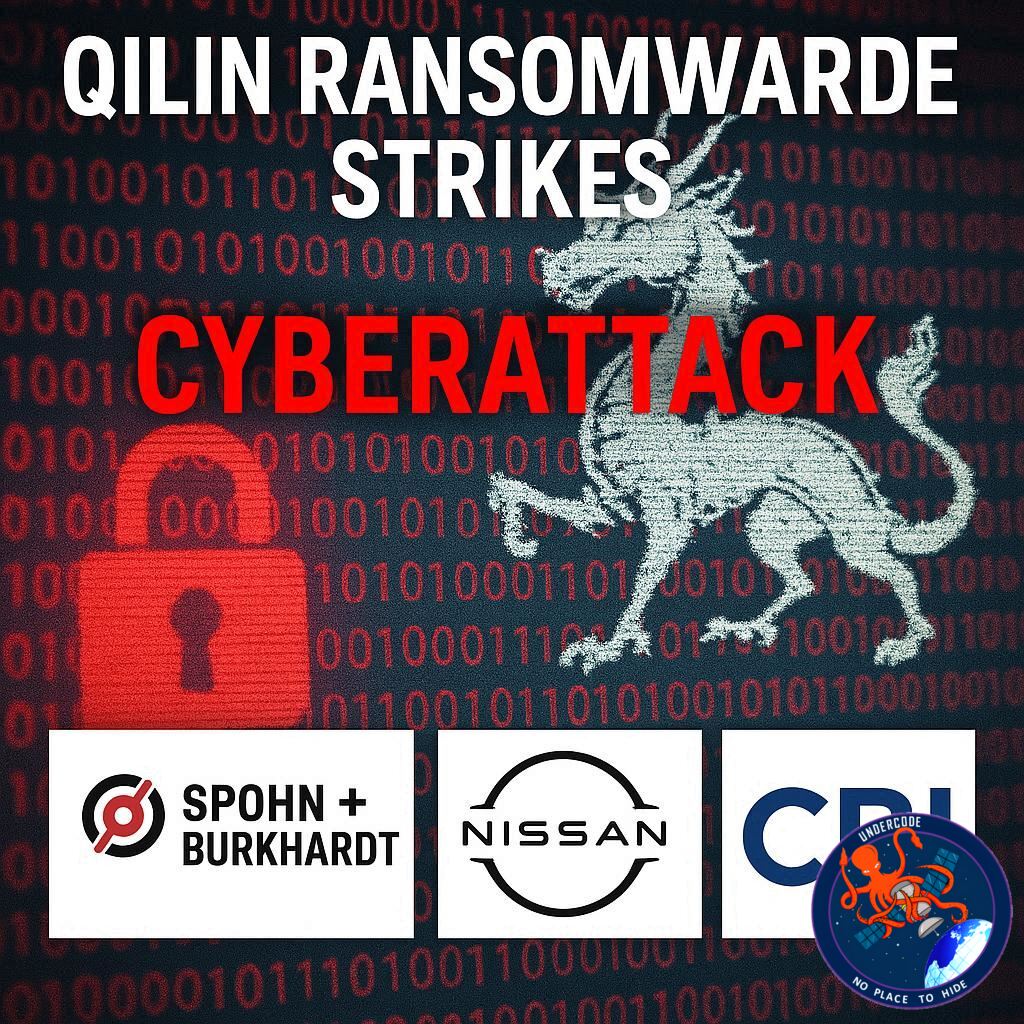
In the ever-evolving world of cybercrime, ransomware groups continue to wreak havoc on global businesses. One of the most notorious groups, Qilin, has once again made headlines after claiming responsibility for fresh attacks on two major companies—Spohn + Burkhardt GmbH & Co KG and Nissan CBI. The report was first highlighted by the ThreatMon Threat Intelligence Team, who monitor underground forums and the dark web for ransomware activity. These incidents reveal the growing scale of targeted attacks that exploit vulnerabilities across industries, creating both financial and reputational damage.
the Reported Attacks
According to ThreatMon Ransomware Monitoring, two new ransomware incidents were detected on August 21, 2025.
The first case involved Spohn + Burkhardt GmbH & Co KG, a respected German company known for its industrial solutions. The attack was reported at 17:35:12 UTC+3, with the Qilin group listing the firm on its victim list. While details about ransom demands or data leaks remain unclear, the inclusion of the company highlights that industrial sectors remain a prime target for cybercriminals.
Earlier the same day, another attack was attributed to the Qilin ransomware group targeting Nissan CBI, an automotive division linked to the globally recognized Nissan brand. The incident was logged at 08:36:19 UTC+3. The attack not only threatens the confidentiality of sensitive corporate data but also poses risks to supply chain operations and customer trust.
These attacks are part of a broader pattern in which ransomware groups exploit large corporations with critical infrastructure, leveraging their dependency on operational continuity to demand hefty ransoms. The Qilin group, in particular, has built a reputation for high-impact strikes, often publicizing victims on dark web leak sites to pressure them into payment.
The incidents have sparked concern among cybersecurity experts, as they reinforce the trend of sophisticated, targeted ransomware campaigns. The attacks underline the urgent need for stronger cybersecurity defenses, proactive monitoring, and international collaboration to disrupt these criminal networks.
What Undercode Say:
The Qilin ransomware group’s repeated activity signals a calculated and persistent strategy. Unlike opportunistic attackers, Qilin carefully selects high-value targets, focusing on companies with critical data and global reach.
For Spohn + Burkhardt GmbH & Co KG, the choice reflects Qilin’s interest in industrial and manufacturing firms—industries that often face higher downtime costs. Interrupting such companies means attackers gain stronger leverage in ransom negotiations.
The attack on Nissan CBI is even more concerning. Automotive manufacturers and their suppliers manage vast networks of intellectual property, sensitive blueprints, and confidential trade data. Any compromise could have ripple effects across the global supply chain, making this attack not just a company-level issue but an industry-wide risk.
Qilin’s strategy mirrors the larger ransomware-as-a-service (RaaS) model, where affiliates carry out attacks under the Qilin banner. This enables the group to scale operations while remaining harder to track. Their presence on the dark web, combined with ThreatMon’s monitoring capabilities, demonstrates how visibility into underground activity is critical for early warnings.
Moreover, the timing of these attacks shows that Qilin operates with precision—striking multiple companies within hours. Such synchronization suggests well-funded operations, experienced affiliates, and possibly insider knowledge of corporate vulnerabilities.
The attacks also raise questions about data exfiltration. Even if companies refuse ransom payments, stolen data could still be sold or leaked, creating lasting reputational harm. In industries like automotive and manufacturing, leaked blueprints or supplier contracts could empower competitors or be exploited by malicious actors.
From a defensive standpoint, organizations must prioritize:
Zero-trust security models to limit internal movement after a breach.
Dark web monitoring to detect early signs of targeting.
Incident response drills to minimize downtime in case of attacks.
Employee training to prevent phishing—the most common entry vector.
Ultimately, the Qilin ransomware incidents underscore a broader reality: no sector is immune. Attackers are increasingly bold, and businesses must treat cybersecurity not as a cost but as a core investment for survival.
✅ Fact Checker Results
Qilin ransomware has indeed been active on the dark web targeting global corporations.
ThreatMon confirmed monitoring and reporting of these two new victims.
Details on ransom amounts or stolen data remain undisclosed ❌.
🔮 Prediction
Given Qilin’s aggressive momentum, it is highly likely that more industrial and automotive companies will be targeted in the coming months. The group’s success in breaching high-profile firms may inspire copycat operations, intensifying ransomware threats globally. Unless strong countermeasures and intelligence-sharing frameworks are reinforced, Qilin could escalate its attacks toward critical infrastructure sectors, posing risks that extend beyond corporate losses into national security concerns.
🕵️📝✔️Let’s dive deep and fact‑check.
References:
Reported By: x.com
Extra Source Hub:
https://www.quora.com
Wikipedia
OpenAi & Undercode AI
Image Source:
Unsplash
Undercode AI DI v2
🔐JOIN OUR CYBER WORLD [ CVE News • HackMonitor • UndercodeNews ]
📢 Follow UndercodeNews & Stay Tuned:
𝕏 formerly Twitter 🐦 | @ Threads | 🔗 Linkedin | 🦋BlueSky | 🐘Mastodon


