
Listen to this Post
Introduction
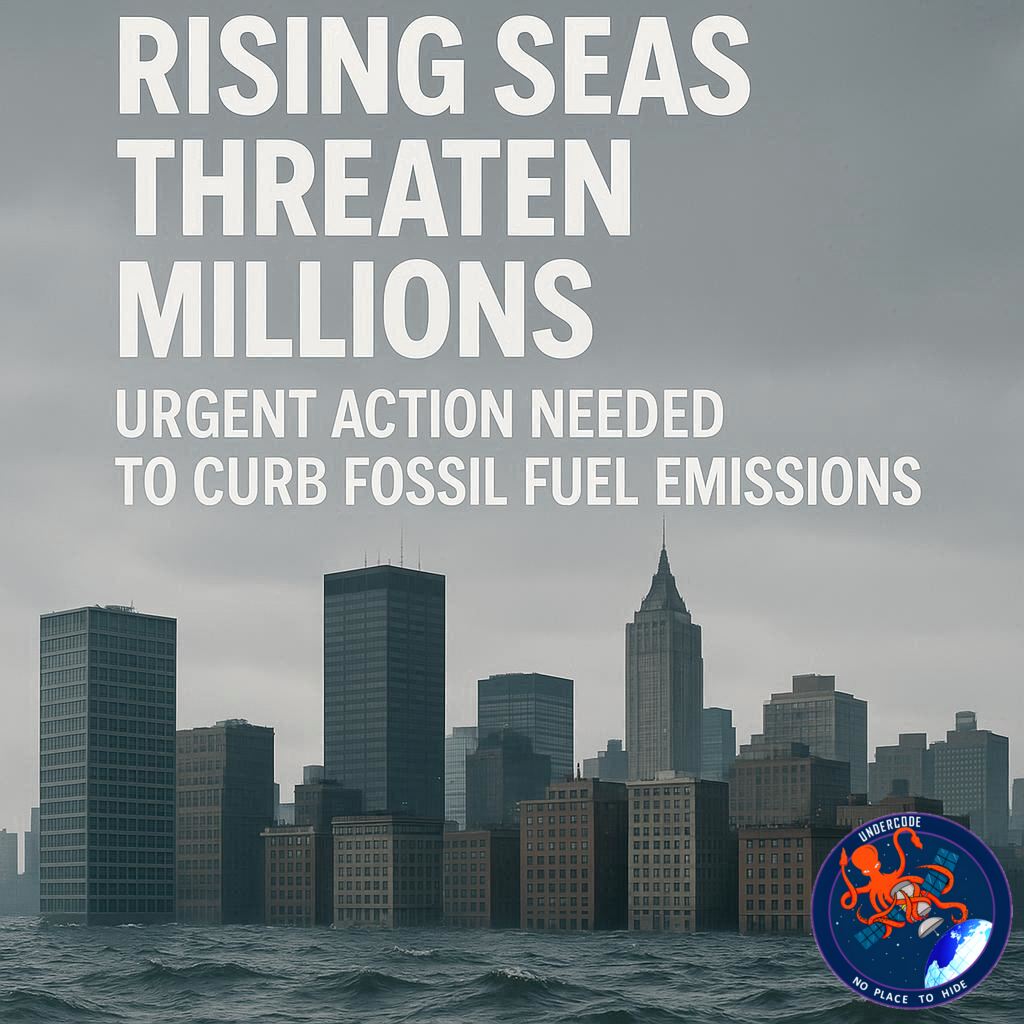
Global warming is no longer a distant threat—it’s reshaping coastlines and endangering millions of homes and infrastructure. New research highlights a stark reality: if fossil fuel emissions continue unchecked, sea levels could rise dramatically, putting countless buildings in the Global South and beyond at risk of regular flooding. From bustling cities in Southeast Asia to coastal towns in Africa and Latin America, the consequences of inaction are severe and long-lasting.
The Global Flood Risk Crisis
A groundbreaking study, published in Urban Sustainability, conducted the first large-scale, building-by-building assessment of coastal infrastructure across the Global South. Covering regions in Africa, Southeast Asia, and Central and South America, researchers used satellite maps and elevation data to estimate how many buildings would be inundated under different sea-level rise scenarios, ranging from 0.5 to 20 meters over the coming centuries.
Even a modest sea-level rise, predicted to occur even if emissions are drastically reduced, would put approximately three million buildings at risk of regular flooding. Professor Natalya Gomez of McGill University explains that sea-level rise is “a slow, but unstoppable consequence of warming” already affecting coastal populations, and warns that without rapid fossil fuel reductions, levels could rise by many meters over the centuries.
Entire Neighborhoods at Risk
The study reveals that rising seas could impact entire neighborhoods, particularly in densely populated, low-lying areas. If sea levels reach five meters or more—a plausible scenario in a few hundred years—over 100 million buildings could be threatened. Professor Jeff Cardile of McGill University notes that coastal topography and building locations create significant disparities in exposure, meaning some countries will face much higher risks than others.
Europe Is Not Safe Either
Although the McGill study focuses on the Global South, Europe faces similar threats. Research in Scientific Reports estimated that under a high emissions scenario, sea-level rise could cost the EU and UK economies a staggering €872 billion by 2100. Regions most vulnerable include Veneto and Emilia-Romagna in Italy, areas around the Baltic Sea, the Belgian coast, western France, and Greece.
The impacts are already visible: in Barcelona, artificial beaches are gradually disappearing, Venice has suffered catastrophic floods, and UNESCO heritage sites on the Greek island of Delos are experiencing structural damage due to rising waters.
What Undercode Say: 🌐
The findings of this study emphasize that coastal flooding is not a hypothetical future—it is a present-day reality accelerating due to fossil fuel emissions. Rapid, decisive climate action is the only way to limit catastrophic sea-level rise. Urban planners and policymakers must prioritize adaptive infrastructure, sustainable coastal development, and flood defenses to safeguard vulnerable populations.
This research also underlines the importance of global cooperation. Countries in the Global South often face higher vulnerability due to lower resources and denser coastal populations. Without international support, these regions may experience disproportionate damage, exacerbating inequality and economic instability.
Moreover, the economic ramifications extend beyond immediate damage. Rising seas threaten critical infrastructure like hospitals, schools, and transportation networks. Losses in productivity, disrupted supply chains, and migration pressures could ripple globally. Urban sustainability and climate resilience strategies must integrate predictive modeling, emphasizing both mitigation and adaptation measures.
From a scientific perspective, the study showcases the power of satellite mapping and building-level assessments to predict climate risks with high precision. Policymakers can use such data to prioritize investment in protective measures, evacuation planning, and land-use zoning. Coastal urbanization must be reconsidered, especially in low-lying areas, to prevent future disaster scenarios.
Lastly, public awareness is key. Local communities need accessible information about their exposure to flooding risks, combined with actionable plans for emergency preparedness. Public-private partnerships in infrastructure investment could play a critical role in implementing solutions at scale.
Fact Checker Results ✅❌
✅ The study confirms millions of buildings in the Global South are at risk from rising sea levels.
✅ Europe is also vulnerable, with potential economic losses reaching hundreds of billions by 2100.
❌ Claims that sea-level rise is “sudden” are misleading; it is gradual but persistent and unstoppable without emission reductions.
Prediction 🔮
If global fossil fuel emissions are not rapidly reduced, future sea-level rises could transform entire coastal regions into flood-prone zones. Millions of buildings will face recurrent flooding, entire neighborhoods may become uninhabitable, and global economic losses will escalate dramatically. By 2100, proactive climate policies and infrastructure planning will determine whether we avert widespread disaster or accept it as the new reality. 🌊🏘️
🕵️📝✔️Let’s dive deep and fact‑check.
References:
Reported By: www.euronews.com
Extra Source Hub:
https://www.medium.com
Wikipedia
OpenAi & Undercode AI
Image Source:
Unsplash
Undercode AI DI v2
🔐JOIN OUR CYBER WORLD [ CVE News • HackMonitor • UndercodeNews ]
📢 Follow UndercodeNews & Stay Tuned:
𝕏 formerly Twitter 🐦 | @ Threads | 🔗 Linkedin | 🦋BlueSky | 🐘Mastodon


