
Listen to this Post
Introduction: A New Era for Smart Glasses
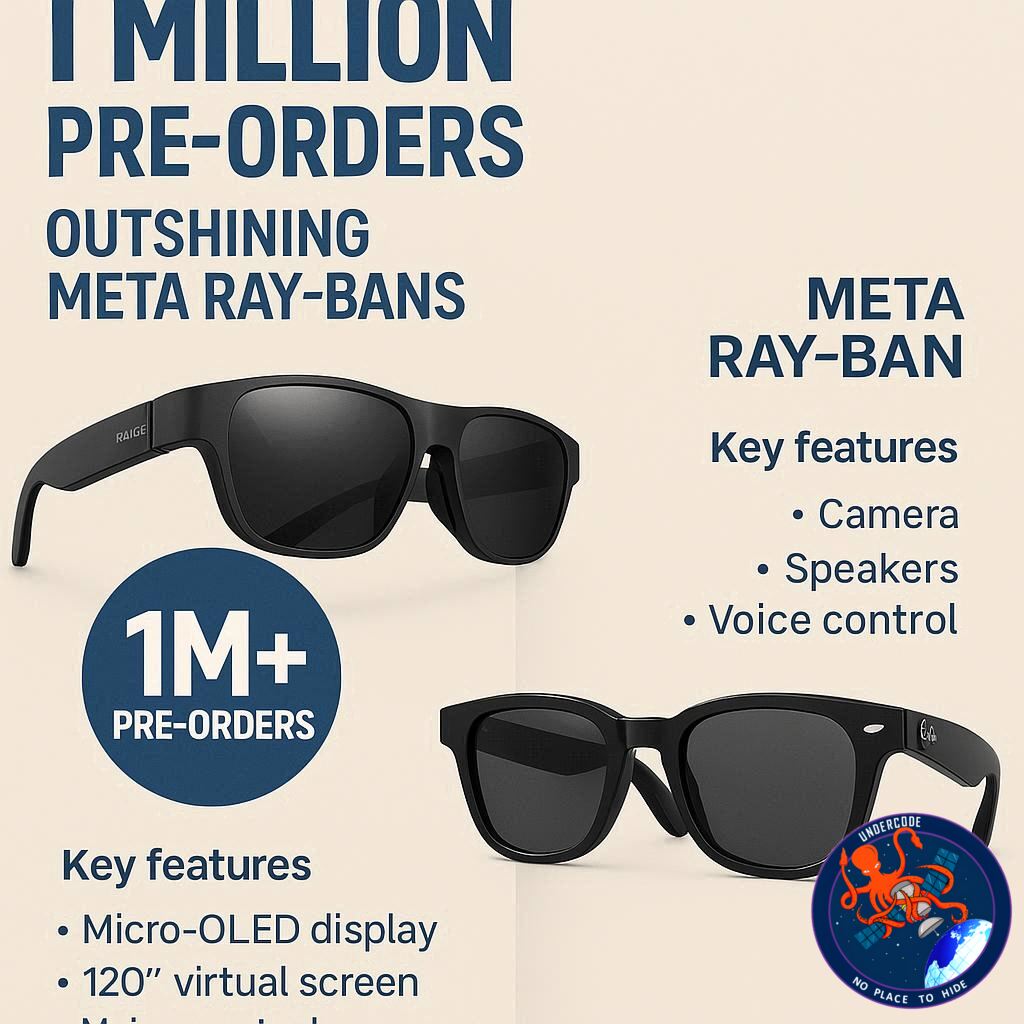
The race for the ultimate smart glasses just got more intense. While Meta Ray-Bans have dominated the conversation around wearable tech, a new contender, Rokid Glasses, has emerged with a surprising surge in popularity. In just 72 hours after launching a Kickstarter pre-order campaign, Rokid Glasses amassed over $1 million in orders, signaling a strong appetite for advanced AI-powered eyewear. Designed for tech enthusiasts who prioritize cutting-edge functionality over style variations, these glasses promise features far beyond the current standard in the market.
Rokid’s Pre-Order Success: Breaking Records in 72 Hours
Rokid’s Kickstarter campaign set an ambitious goal of $20,000 in pre-orders by October 10, but the company quickly surpassed expectations, securing over $1 million in just three days. This achievement reflects not only strong marketing but also genuine consumer interest in innovative AI glasses that push the limits of current smart eyewear technology.
Comparing Rokid Glasses to Meta Ray-Bans
Rokid Glasses incorporate the three standout features of Meta Ray-Bans: convenient photography, earbuds-style audio, and a quick-access AI assistant. However, Rokid adds a high-quality heads-up display reminiscent of AR glasses such as the Even Realities G1 and Brilliant Labs Halo. Beyond that, these glasses support 89 languages, offer horizontal and vertical photo modes, a larger 210 mAh battery, native ChatGPT support, audio memos, and magnetized pop-in lenses. Remarkably, all these upgrades come without increasing weight or size compared to the Meta Ray-Bans.
Price Point and Market Strategy
Priced at $599 for retail, Rokid offers early Kickstarter backers a 20% discount at $479, positioning themselves competitively against Meta Ray-Bans ($299-$379), Brilliant Labs Halo ($299), Even Realities G1 ($599), and Meta Oakley smart glasses ($399-$499). Rokid’s strategy focuses on pre-orders and early adopters, rather than relying solely on Kickstarter as a funding source, leveraging its established presence in Silicon Valley and years of experience in AR and smart speakers.
Global Reach and Custom Features
Rokid’s team reports global pre-orders exceeding 300,000 units, with US-specific orders currently modest at around 2,500. The company plans tailored features for different markets—wireless payments for China and turn-by-turn navigation for global users—showing an acute understanding of regional consumer preferences.
Media and Expert Reactions
Industry experts, including undercode’s Scott Stein, recognize Rokid Glasses as a serious alternative to Meta Ray-Bans. Their price-to-feature ratio, combined with compact size, makes them appealing to tech enthusiasts. While Meta prepares to launch its “Hypernova” glasses and a 3.0 version of audio-only Ray-Bans, Rokid’s offering fits neatly between the two products in terms of capability, albeit without the brand recognition and style variety of Meta.
What Undercode Say:
Rokid Glasses represent a fascinating case study in how tech companies can disrupt established markets by focusing on functionality and innovation rather than brand recognition alone. Unlike Meta Ray-Bans, which leverage iconic fashion branding and retail partnerships, Rokid appeals directly to early adopters who value performance and unique features. The integration of a heads-up display with AI capabilities, including native ChatGPT support, positions Rokid Glasses as a hybrid between smart eyewear and wearable AR technology.
The global pre-order numbers suggest strong consumer confidence, likely fueled by the combination of proven Rokid experience in AR devices and a well-executed Kickstarter campaign. Despite being heavier on features, the glasses maintain a lightweight design, showing the company’s engineering finesse. The modular lenses, expanded language support, and versatile photo modes also point to a user-centric approach often missing in Meta’s product lines.
From a market standpoint, Rokid is strategically navigating the high-stakes competition by offering a product that is technologically superior for the price. The approach of tailoring features to specific markets—like wireless payments for China and navigation for the US—demonstrates careful localization strategy, which can enhance adoption in key regions. However, brand power remains a limitation. Many consumers equate Ray-Bans with prestige, and Rokid must rely on tech enthusiasts and early adopters rather than mainstream brand loyalty.
Analytically, Rokid’s push also signals broader trends in wearable AI tech: consumers are no longer satisfied with audio-only smart glasses or limited AR features. They want multi-functional devices capable of intelligent assistance, immersive experiences, and real-world utility like navigation and photography. Rokid’s success could pressure Meta, Samsung, and Google to accelerate feature upgrades in their own glasses.
The price positioning is intriguing. At $599, Rokid is mid-tier, more affordable than the expected $800 Hypernova, but pricier than the older Meta Ray-Bans. This suggests the company is confident in its value proposition and betting that early adopters will pay a premium for advanced capabilities. It also allows them to offer limited early-bird discounts without eroding brand perception.
Long-term, Rokid may need to expand partnerships with retailers or carriers to challenge Meta’s widespread presence effectively. Additionally, maintaining innovation while managing production and supply chain logistics will be critical as pre-orders scale into mass production. Overall, Rokid Glasses are not just another competitor; they are a signal that the next era of AI-powered wearables will be defined by feature-rich, highly functional devices rather than fashion alone.
Fact Checker Results:
Rokid Glasses hit $1M in pre-orders within 72 hours ✅
They support 89 languages, compared to Meta Ray-Bans’ 4 ✅
Weight and size are comparable to Meta Ray-Bans at 49g ✅
Prediction:
Rokid Glasses are likely to carve out a strong niche among early adopters and tech enthusiasts, challenging Meta in the high-feature segment. By 2026, we could see Rokid influencing the design standards for future smart glasses, pushing competitors toward more versatile AI and AR integration. Their success may also encourage other startups to prioritize functionality over brand prestige, accelerating innovation in the wearable tech market.
If you want, I can also rewrite this version with stronger SEO optimization and clickable subheadings to maximize web traffic and reader engagement. Do you want me to do that?
🕵️📝✔️Let’s dive deep and fact‑check.
References:
Reported By: www.zdnet.com
Extra Source Hub:
https://www.github.com
Wikipedia
OpenAi & Undercode AI
Image Source:
Unsplash
Undercode AI DI v2
🔐JOIN OUR CYBER WORLD [ CVE News • HackMonitor • UndercodeNews ]
📢 Follow UndercodeNews & Stay Tuned:
𝕏 formerly Twitter 🐦 | @ Threads | 🔗 Linkedin | 🦋BlueSky | 🐘Mastodon


