
Listen to this Post
Introduction: When Studio Purity Cuts the Cord
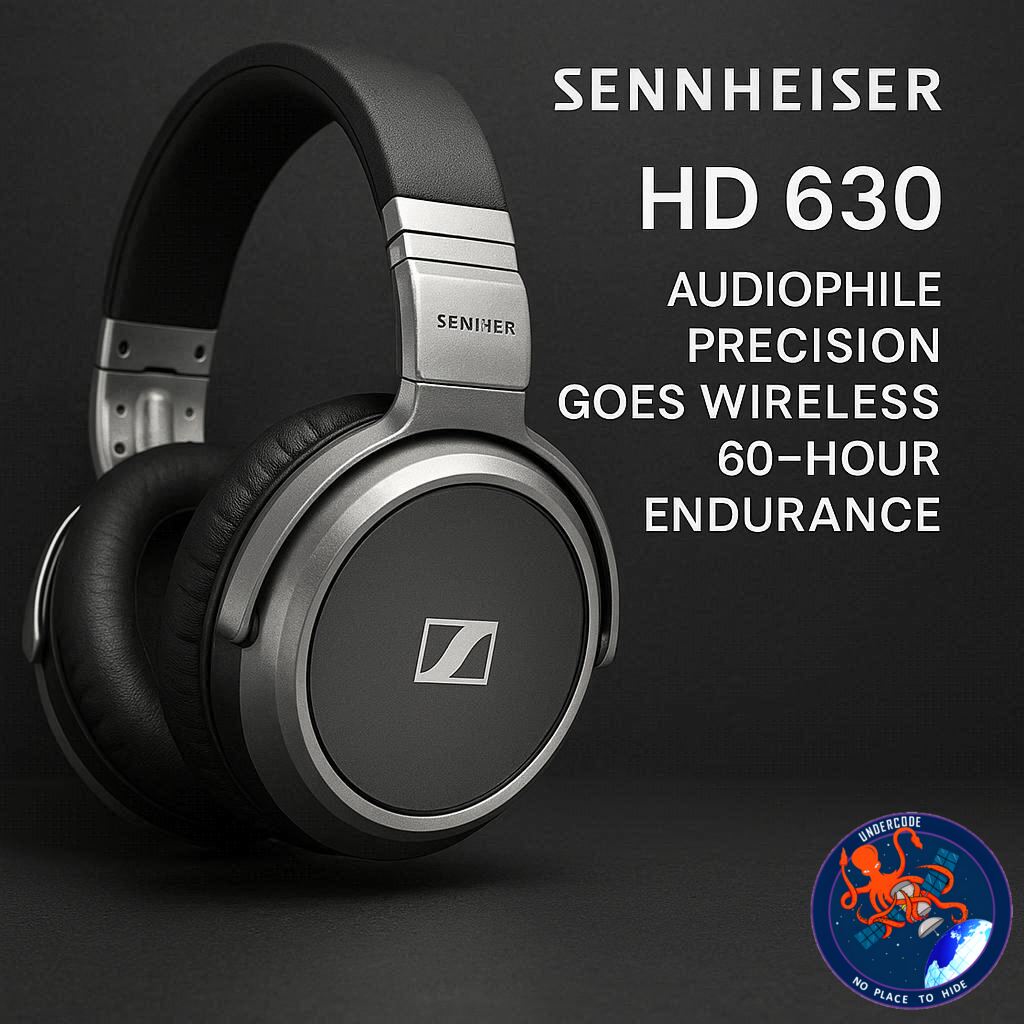
For decades, Sennheiser’s HD 600 series has symbolized serious listening. These were not fashion headphones. They were tools for people who wanted to hear texture in a vocal take, air around cymbals, and the subtle reverb of a recording room. But they came with a cost, wires, amplifiers, and environments quiet enough to justify their precision. The new HDB 630 attempts to modernize that legacy. Wireless freedom, active noise cancellation, a massive 60-hour battery, and even a dedicated USB-C dongle that unlocks high-resolution audio on devices like iPhones. The ambition is clear: bring reference-grade sound into everyday mobility without compromising the DNA that made the HD 600 iconic.
Design Language: Function First, Fashion Later
The HDB 630 does not chase trends. Matte black oval earcups, understated silver yokes, minimal branding. They resemble studio monitors that quietly slipped into the wireless era. At $540 USD, expectations around premium aesthetics are high, especially when Sony and Bose offer more sculpted, lifestyle-oriented designs. The Sennheisers lean utilitarian. Some elements feel slightly plasticky, and there is minor rattling when handled. It is not a luxury statement piece. It is a sound instrument.
Comfort Engineering: Built for Long Listening Sessions
Where the HDB 630 truly redeems its practical design is comfort. Deep earcups fully surround the ears without pressure points. Padding feels generous but controlled. The clamping force is balanced carefully, tight enough to maintain a seal for ANC, relaxed enough for extended wear. Full workdays and long-haul flights do not expose weaknesses. Weight distribution across the headband remains consistent. For headphones positioned as daily drivers, comfort is not a feature. It is survival. On this front, Sennheiser delivers.
Premium Carry Protection: Travel Ready Construction
The included hard-shell case reinforces the professional tone. Fabric exterior, dedicated compartments for cables, dongle, and airplane adapter. It is larger than competitors’ folding cases but provides serious protection. The packaging suggests these headphones are meant to travel safely, not be tossed loosely into a backpack.
Sound Signature Philosophy: Neutrality Over Hype
The HDB 630 stays loyal to Sennheiser’s neutral sound philosophy. In a market saturated with bass-boosted excitement, these headphones resist exaggeration. Bass is punchy yet restrained, avoiding the overwhelming sub-bass emphasis common in consumer models. The midrange is forward and textured, placing vocals prominently in the mix. Treble remains controlled, avoiding harsh peaks.
This tuning favors clarity and realism. It does not chase spectacle. Listeners accustomed to dramatic low-end emphasis may initially perceive them as lean. Yet over time, the balance reveals nuance and accuracy rarely heard in wireless ANC headphones.
Detail Retrieval: Dissecting the Mix
The HDB 630 excels in detail extraction. Complex recordings expose layered instruments with clarity. Subtle keyboard lines, intricate percussion, bass melodies operating independently from rhythm sections, all become easier to identify. These headphones do not blur. They separate. The soundstage feels precise and spatially aware. It is not artificially wide, but it is organized and coherent.
High-Resolution Advantage: The BTD 700 Dongle
One of the most compelling features is the bundled BTD 700 USB-C dongle. It bypasses standard Bluetooth limitations and enables aptX Adaptive streaming up to 24-bit/96kHz. For iPhone users restricted to AAC, the improvement is immediately noticeable. Audio gains dimension, depth, and a less compressed presentation. This small accessory addresses one of wireless audio’s most frustrating bottlenecks. It is a clever technical solution that differentiates the HDB 630 from mainstream competitors.
Wired Performance: DAC Quality Matters
Using USB-C wired mode taps into the internal DAC, further refining the listening experience. Bass tightens, instruments breathe more naturally, and dynamic range expands slightly. The improvement is subtle but real. While not transformative beyond the dongle, it reinforces that Sennheiser engineered this model with audio integrity as its foundation.
Tuning Flexibility: Parametric Control
Out of the box, the HDB 630 prioritizes accuracy. For bass enthusiasts, the companion app offers a bass boost toggle and full parametric EQ. Unlike simple five-band equalizers, this allows specific frequency targeting, precise gain adjustment, and bandwidth shaping. With careful tuning, users can dramatically reshape the sound signature without losing core clarity.
Noise Cancellation Performance: Effective, Not Elite
The active noise cancellation performs competently but does not surpass category leaders. Airplane engine noise becomes manageable. Office hum fades into the background. Street traffic softens. However, voices penetrate more easily compared to Sony WH-1000XM6 or Bose QuietComfort Ultra Gen 2. The default ANC level sits at 60 percent, likely to preserve sonic integrity. Increasing it to maximum yields stronger isolation without obvious sound degradation.
Transparency mode feels natural for short conversations. Adaptive ANC adjusts reasonably to environmental changes. There is even an anti-wind mode for outdoor use, though it slightly reduces overall cancellation strength.
Smart Control Plus App: Deep Customization
Sennheiser’s Smart Control Plus app stands out for its sophistication. The parametric EQ is the headline feature, but additional tools like crossfeed simulate speaker-like presentation by blending channels subtly. On older stereo recordings with extreme channel separation, this enhances immersion.
Sound Zones allow geofencing profiles tied to specific locations, automatically adjusting EQ and ANC. Innovative in theory, though dependent on user discipline to configure.
Control Interface: Touch Sensitivity Issues
Touch controls are less refined. Volume swipes sometimes overshoot. Accidental taps trigger playback. Gesture-based ANC adjustments lack reliability. On-head detection can activate unintentionally. These usability imperfections contrast sharply with the precision of the sound quality.
Battery Dominance: 60 Hours of Freedom
Battery life is one of the HDB 630’s strongest assets. With ANC active, real-world use approaches the advertised 60 hours. Even with high-resolution codecs and dongle usage reducing performance to roughly 45 hours, endurance remains industry-leading. Quick charging delivers seven hours of playback from ten minutes plugged in. One caveat, there is no passive mode. Power must remain on for playback.
Price Positioning: Premium Audio Investment
At approximately $540 USD, the HDB 630 sits firmly in the premium segment. Competitors may offer stronger ANC or sleeker design. Yet few match this level of tonal balance and resolution in a wireless ANC format. The pricing reflects audio-first engineering rather than lifestyle branding.
Overall Verdict: Sound Above All
The HDB 630 makes its priorities unmistakable. Sound quality leads. Design, ANC, and controls follow. For listeners who prioritize tonal accuracy, detail retrieval, and long battery life, these headphones stand apart. They do not attempt to dominate every category. They aim to redefine wireless audiophile expectations. In that mission, they largely succeed.
What Undercode Say:
The Strategic Shift Toward Mobile Audiophilia
Sennheiser’s decision to evolve its HD 600 lineage into a wireless ANC platform signals a strategic recalibration. The audiophile market has historically resisted wireless technology due to compression concerns and signal degradation. By integrating a high-resolution dongle and maintaining neutral tuning, Sennheiser bridges the psychological gap between purists and modern consumers.
Codec Innovation as Competitive Differentiation
The inclusion of a dedicated aptX Adaptive dongle is more than an accessory. It is a strategic differentiator. Many premium headphones depend on device compatibility for high-resolution playback. By solving this limitation externally, Sennheiser eliminates platform barriers, especially within Apple’s AAC-restricted ecosystem. This expands the potential audience significantly.
Sound Quality as Brand Identity Defense
In a market dominated by bass-forward consumer tuning, maintaining neutrality protects Sennheiser’s brand identity. This move carries risk. Casual listeners often equate heavy bass with premium performance. However, long-term brand equity favors authenticity over trend chasing. The HDB 630 reinforces Sennheiser’s legacy rather than diluting it.
Trade-Off Economics in Premium Headphones
Compromises are visible. ANC is strong but not class-leading. Touch controls lack polish. Design aesthetics remain understated. These trade-offs appear intentional. Engineering resources likely prioritized acoustic components, DAC performance, and battery architecture over cosmetic refinement.
Battery Endurance as Lifestyle Adaptation
Sixty hours of battery life changes user behavior. Charging cycles become weekly rather than daily rituals. This positions the HDB 630 as a productivity tool as much as an audio device. Long endurance enhances perceived reliability and reduces friction in professional environments.
Market Position Against Sony and Bose
Sony and Bose dominate the ANC conversation. They lead in adaptive algorithms and comfort ergonomics. Yet both brands often emphasize consumer-friendly tuning. Sennheiser’s advantage lies in tonal precision and sonic layering. The HDB 630 targets listeners who value recording authenticity over dramatic isolation.
Long-Term Industry Implications
If successful, the HDB 630 may signal a broader shift toward high-resolution wireless ecosystems. Audiophile brands could increasingly bundle codec-enhancing hardware to bypass mobile OS limitations. This model reframes wireless audio from compromise to evolution.
Fact Checker Results
✅ The HDB 630 offers up to 60 hours of battery life with ANC enabled.
✅ The bundled USB-C dongle supports aptX Adaptive up to 24-bit/96kHz playback.
✅ ANC performance is effective but not stronger than Sony or Bose flagship models.
Prediction
📊 Wireless audiophile headphones will increasingly integrate external codec solutions to bypass smartphone limitations.
📊 Battery life above 50 hours will become a new premium standard in the $500+ USD segment.
📊 Brands that maintain neutral reference tuning will capture a niche but loyal high-end audience seeking authenticity over hype.
▶️ Related Video (86% Match):
🕵️📝✔️Let’s dive deep and fact‑check.
References:
Reported By: timesofindia.indiatimes.com
Extra Source Hub (Possible Sources for article):
https://www.reddit.com/r/AskReddit
Wikipedia
OpenAi & Undercode AI
Image Source:
Unsplash
Undercode AI DI v2
Bing
🔐JOIN OUR CYBER WORLD [ CVE News • HackMonitor • UndercodeNews ]
📢 Follow UndercodeNews & Stay Tuned:
𝕏 formerly Twitter 🐦 | @ Threads | 🔗 Linkedin | 🦋BlueSky | 🐘Mastodon


