
Listen to this Post
Introduction: When Politics Supercharge AI Popularity
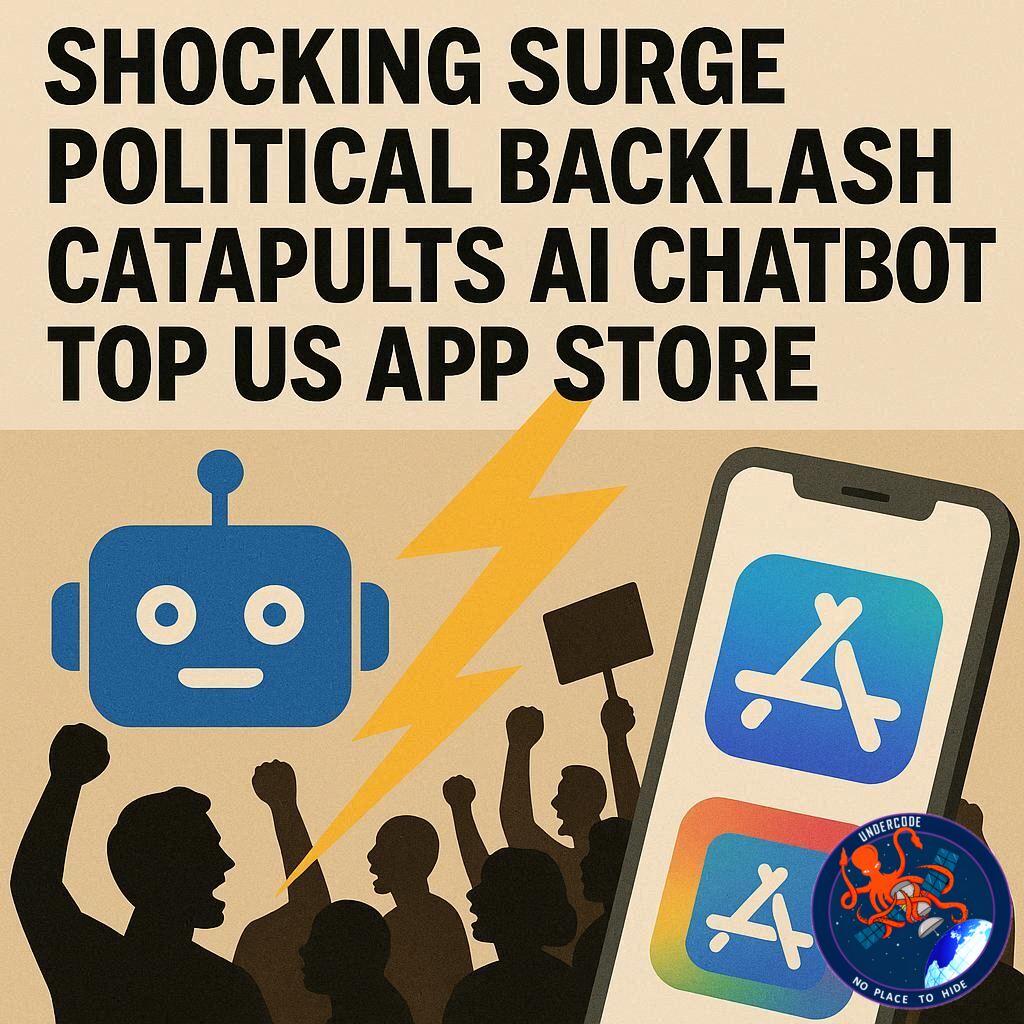
Artificial intelligence rarely dominates headlines for political reasons—but this week, it did exactly that. In an unexpected twist, a high-profile confrontation between a leading AI company and the US government has reshaped the App Store rankings overnight. What looks like a routine app-download story is actually a collision of national security, ethics, free expression, and public curiosity—one that pushed AI chatbots into the very center of mainstream attention.
the Original
AI chatbots have seized the top three positions on the US App Store’s most downloaded charts, marking a dramatic shift in consumer interest. The most notable rise belongs to Anthropic’s chatbot Claude, which jumped from 42nd place just two months ago to the number-one spot nationwide. Following closely behind are ChatGPT from OpenAI and Gemini from Google, securing second and third place respectively.
This surge was not triggered by a major product update or breakthrough feature. Instead, it appears to be driven by a highly publicized political dispute between Anthropic and the US government. The controversy escalated when Donald Trump and Department of War Secretary Pete Hegseth publicly criticized Anthropic.
In a statement posted on X, Hegseth announced that the federal government would cease using Anthropic’s technology and that the Department of War would designate the company as a national security supply-chain risk. He further stated that US military contractors and partners would be barred from conducting commercial activity with Anthropic, while allowing a six-month transition period to alternative services.
Anthropic responded by clarifying its refusal to support certain military applications. The company cited two main concerns: the unreliability of current AI models for fully autonomous weapons, and the belief that mass domestic surveillance violates fundamental civil rights. While the long-term consequences of this standoff remain uncertain, the immediate effect is clear—Anthropic’s public visibility and app downloads have surged dramatically, suggesting a short-term win in public mindshare among iPhone users.
What Undercode Say:
Political Controversy as an Accidental Growth Strategy
This episode highlights a recurring pattern in modern tech culture: controversy drives adoption. Anthropic did not launch a flashy update, slash prices, or run a marketing campaign. Instead, political confrontation acted as a catalyst, transforming Claude into a household name almost overnight.
The “Streisand Effect” in the AI Era
Attempts by governments to restrict or condemn technology often have the opposite effect. By publicly denouncing Anthropic, officials inadvertently amplified public curiosity. Millions of users who had never heard of Claude now downloaded it simply to see what the fuss was about.
Ethics as a Competitive Differentiator
Anthropic’s refusal to support autonomous weapons and domestic surveillance positioned the company as an “ethical AI” alternative. In a market crowded with similar-sounding chatbots, moral boundaries suddenly became a branding advantage rather than a limitation.
AI Is No Longer Just a Tech Product
This incident confirms that AI platforms are now political actors by default. Their policies influence national security debates, civil liberties discussions, and public trust. As a result, users are choosing chatbots not only for performance, but for values.
App Store Rankings Reflect Cultural Moments
The App Store has become a real-time barometer of social sentiment. Claude’s meteoric rise shows that downloads increasingly reflect headlines, ideology, and controversy—not just usability or innovation.
Short-Term Popularity vs Long-Term Risk
While Anthropic is winning attention now, the costs could be significant. Losing government and military contracts may hurt long-term revenue and institutional influence, even as consumer adoption spikes.
OpenAI and Google Benefit Indirectly
Although Anthropic took center stage, OpenAI and Google quietly benefited from the broader AI spotlight. Their apps occupying second and third place suggests that political drama lifted the entire category, not just one company.
A Warning Sign for Governments
This clash signals that heavy-handed restrictions can backfire in the digital age. Public opinion moves faster than policy, and consumers increasingly rally behind companies perceived as resisting state overreach.
Fact Checker Results 🔍
Verification of Key Claims
✅ Claude did rise from outside the top 40 to the number-one spot on the US App Store in a short timeframe
✅ US officials publicly criticized Anthropic and announced restrictions on its government use
❌ No evidence suggests Anthropic released a major feature update during the surge
Prediction 📊
What Comes Next for AI Chatbots
📈 Public interest in “ethics-first” AI platforms will continue to grow over the next 6–12 months
⚖️ Governments will face increased resistance when attempting to restrict consumer AI tools
🤖 AI app rankings will become more volatile, increasingly shaped by political and cultural events rather than technical upgrades alone
🕵️📝✔️Let’s dive deep and fact‑check.
References:
Reported By: 9to5mac.com
Extra Source Hub (Possible Sources for article):
https://stackoverflow.com
Wikipedia
OpenAi & Undercode AI
Image Source:
Unsplash
Undercode AI DI v2
Bing
🔐JOIN OUR CYBER WORLD [ CVE News • HackMonitor • UndercodeNews ]
📢 Follow UndercodeNews & Stay Tuned:
𝕏 formerly Twitter 🐦 | @ Threads | 🔗 Linkedin | 🦋BlueSky | 🐘Mastodon


