
Listen to this Post
Introduction
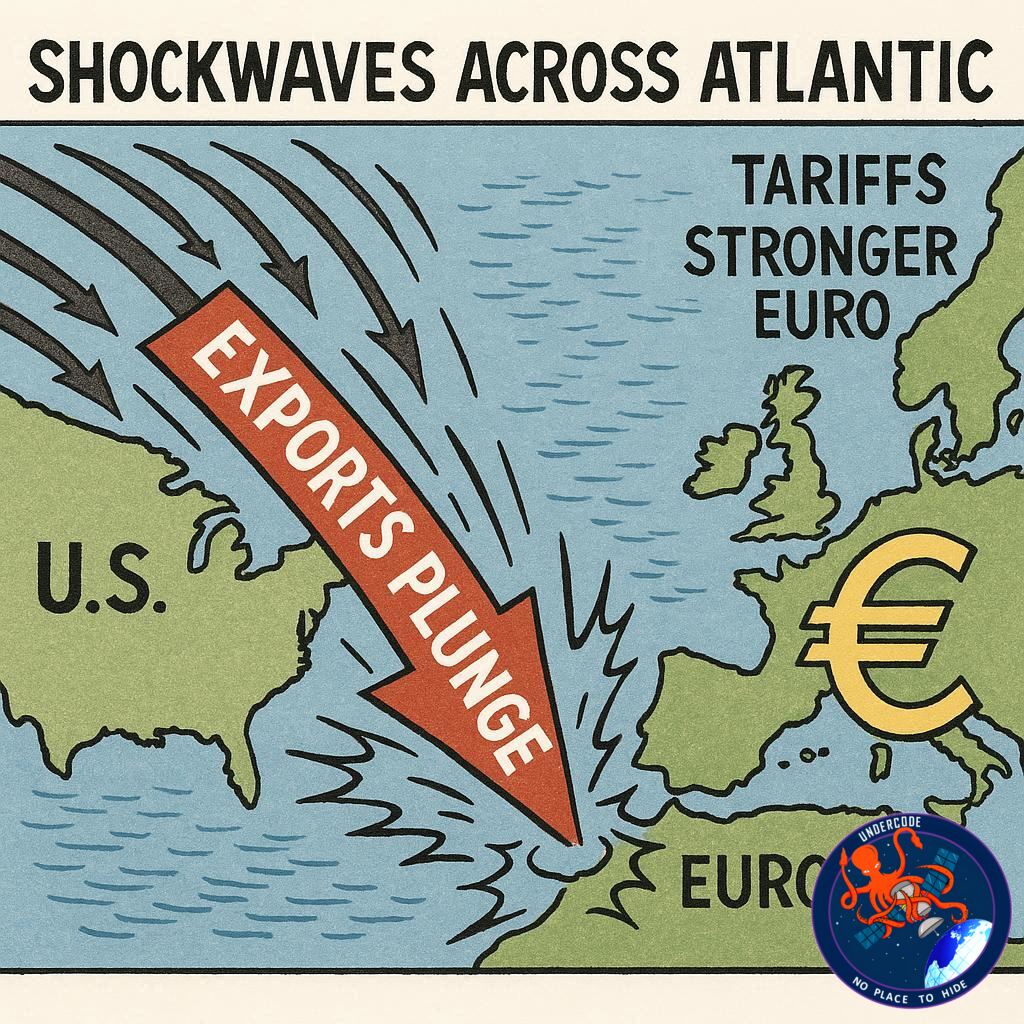
The economic partnership between the European Union and the United States has long been a cornerstone of global trade. However, in 2025, this relationship is showing signs of strain. A combination of new US tariffs introduced by Donald Trump’s administration and the strengthening euro has shaken European exports to their core. From automobiles to pharmaceuticals, key sectors are reeling under pressure, leading to a sharp drop in the EU’s trade surplus with the US. This decline highlights the fragility of transatlantic trade and raises concerns about the long-term implications for European industries dependent on the American market.
EU Exports to the US: A Sharp Decline
European exports to the United States have fallen significantly, squeezed by rising tariffs from Washington and a stronger euro.
According to UN Comtrade data, in July 2025 the US imported $53.7 billion (€46.6bn) worth of goods from the EU, a 10% drop compared to July 2024. Over the last three reported months, EU exports totaled $168.1 billion (€147.1bn), compared to $213.2bn (€197.3bn) in the previous quarter.
This dramatic decline was partly masked earlier in the year by a surge in imports during March, as US firms scrambled to stock up before tariffs came into effect on April 2.
Pharmaceuticals and Cars Hit Hardest
Pharmaceuticals and cars — two of Europe’s most important export sectors — have taken the largest hit. In July 2025, pharmaceutical exports to the US dropped from $11.5bn (€10.6bn) a year earlier to $9.5bn (€8.2bn). The auto sector fared even worse, with exports falling to $4.68bn (€4bn) from $6.2bn (€5.7bn) the previous year.
The three-month figures underscore the decline:
Car exports: $13.6bn (€11.9bn) vs. $16.23bn (€15bn) in the previous quarter, and $19.3bn (€17.9bn) a year earlier.
Pharma exports: Following a similar trajectory, signaling growing vulnerability in one of Europe’s strongest industries.
Trade Surplus Shrinks Dramatically
Europe’s trade surplus with the US has nearly halved. In July 2025, the EU recorded a surplus of $11.97bn, compared to $23.6bn a year earlier.
On a three-month basis, the surplus fell to $40.4bn (€35.4bn), down from $85.8bn (€79.7bn) the previous quarter, and $61.9bn (€57.2bn) during the same period in 2024.
Tariffs and Currency Pressures
Two major factors explain this downward spiral:
- Tariffs: On April 2, dubbed “Liberation Day” by the Trump administration, the US imposed a 20% tariff on EU imports, later reduced to 15% in July. While less severe than tariffs faced by India and Brazil, they remain five times higher than last year’s rates. Car tariffs were reduced from 27.5% to 15%, but the damage had already been done.
- Stronger Euro: The euro strengthened from $1.02 in January 2025 to $1.18 in September 2025, making European exports pricier in dollar terms. Compared to July 2024, the euro gained over 8%, eroding EU exporters’ competitiveness.
Outlook: Uncertainty Ahead
Economists warn that the road ahead remains unpredictable. While the reduced tariff rate has slightly eased uncertainty, US trade policy remains volatile. Coupled with a strong euro, Europe’s exporters may continue to struggle in the second half of 2025.
What Undercode Say:
The trade battle between the EU and the US is not just about numbers — it represents a deeper economic shift.
The Strategic Role of the US Market
For Europe, the US has always been a critical export destination, particularly for high-value goods such as pharmaceuticals, luxury vehicles, and machinery. A shrinking surplus signals weakening dominance in these fields and exposes European industries to vulnerabilities in global supply chains.
The Trump Factor
Trump’s aggressive trade stance is not just about tariffs — it’s a political message aimed at reshoring production. By making European imports more expensive, his administration seeks to boost US domestic manufacturing. For Europe, this means a forced rethinking of export strategies, possibly pivoting more toward Asia and emerging markets.
The Euro’s Double-Edged Sword
A strong euro is often seen as a sign of economic resilience, but in this case, it is proving to be a competitive handicap. While European consumers may enjoy cheaper imports, exporters are finding themselves squeezed. Luxury cars, pharmaceuticals, and industrial goods are all price-sensitive when entering the US market, and even an 8% appreciation can be the difference between growth and contraction.
Sectoral Breakdown
Automobiles: Once the pride of EU trade, now facing a steep decline due to tariffs and higher costs. German automakers, in particular, are at risk.
Pharmaceuticals: Though traditionally resilient, pricing pressures and regulatory uncertainties are adding strain.
Machinery and Electronics: Less affected so far, but vulnerable to future tariff escalations.
Ripple Effects on Jobs and Investment
If exports continue to slide, the impact will be felt domestically across Europe. Factories may cut shifts, investment plans could be delayed, and political pressure may mount on EU leaders to retaliate against Washington.
The Bigger Picture: A Fragmenting Global Trade Order
The EU-US trade slowdown is a symptom of a broader fragmentation of globalization. With tariffs, currency wars, and shifting alliances, businesses face a less predictable landscape. Europe must either diversify its trade partners or risk long-term dependence on volatile US policy shifts.
✅ Fact Checker Results
US tariffs on EU imports were raised to 20% in April 2025, later cut to 15%.
The euro strengthened by more than 8% compared to July 2024.
EU exports to the US fell 10% year-on-year in July 2025.
🔮 Prediction
If the euro remains strong and US tariffs stay elevated, Europe could face prolonged export weakness into 2026. Expect automakers to shift production closer to the US, while pharmaceutical companies may ramp up lobbying for exemptions. The EU might retaliate with targeted tariffs, sparking another round of trade tensions before the year ends.
🕵️📝✔️Let’s dive deep and fact‑check.
References:
Reported By: www.euronews.com
Extra Source Hub:
https://www.stackexchange.com
Wikipedia
OpenAi & Undercode AI
Image Source:
Unsplash
Undercode AI DI v2
🔐JOIN OUR CYBER WORLD [ CVE News • HackMonitor • UndercodeNews ]
📢 Follow UndercodeNews & Stay Tuned:
𝕏 formerly Twitter 🐦 | @ Threads | 🔗 Linkedin | 🦋BlueSky | 🐘Mastodon


