
Listen to this Post
A New Milestone for South Korean Stocks
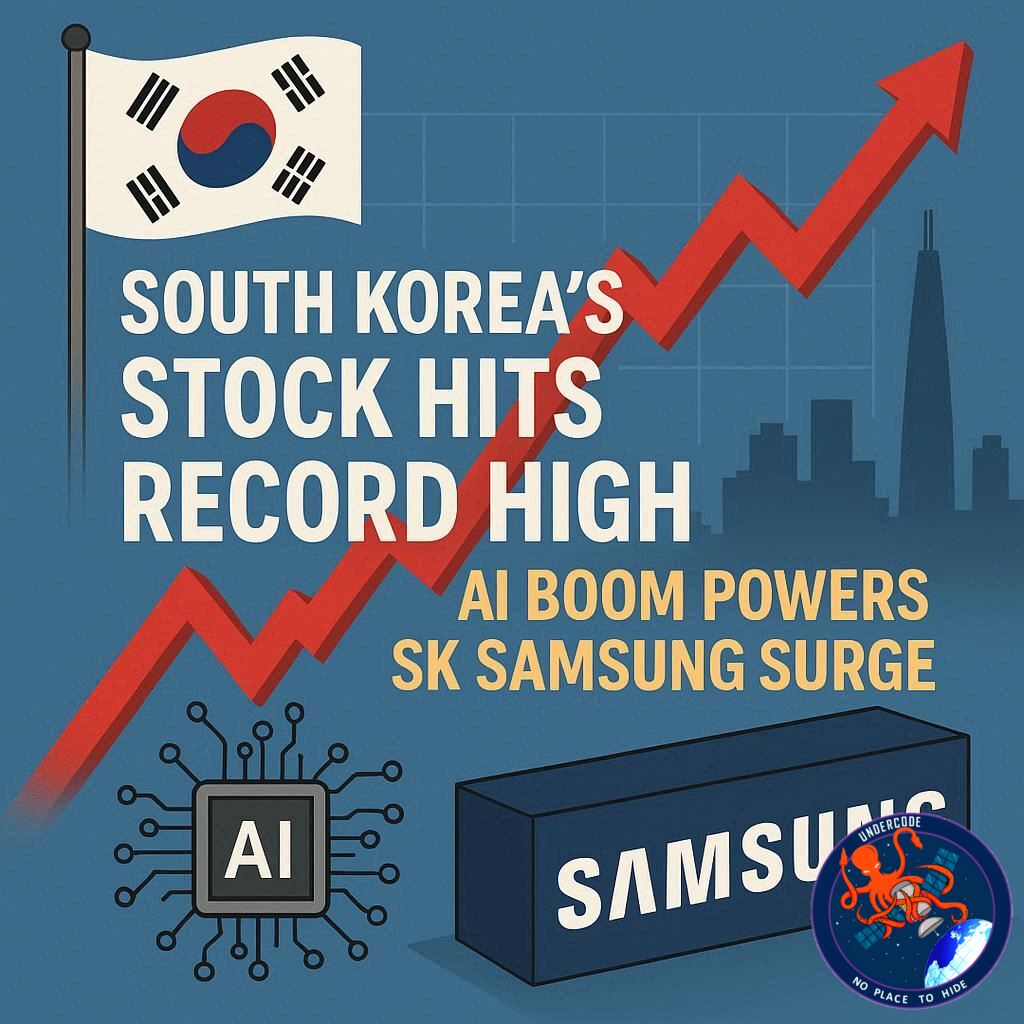
South Korea’s stock market roared back to life after the holiday break, marking a major turning point that reflects the global frenzy surrounding artificial intelligence (AI). On October 10, the KOSPI index climbed for the third consecutive day, closing up 1.72% (61.39 points) at 3,610.60, breaking above the 3,600 mark for the first time in history.
This surge was primarily driven by strong investor confidence in AI-related industries, following an announcement that OpenAI and Advanced Micro Devices (AMD) would form a strategic partnership to expand AI computing capabilities. The news sparked optimism across global markets, and South Korea was no exception.
Major tech heavyweights like Samsung Electronics and SK Hynix saw sharp increases in their share prices, reflecting renewed enthusiasm for AI-driven semiconductors. These companies are seen as vital players in the global AI infrastructure, supplying the advanced memory chips and processors necessary to train large-scale AI models.
The rally also came amid expectations that AI demand will reshape the semiconductor industry in 2025, with Korean firms positioned at the center of this technological transformation. Despite global economic concerns and ongoing geopolitical tensions, investors appeared confident that the AI revolution could fuel sustained growth for Korea’s tech giants.
What Undercode Say:
AI Momentum Ignites the Korean Market
The recent performance of the KOSPI demonstrates a powerful alignment between global AI optimism and Korea’s industrial strengths. Investors are not simply reacting to hype — they’re betting on real technological capabilities. SK Hynix and Samsung control key parts of the semiconductor supply chain, particularly high-bandwidth memory (HBM) chips, which are essential for AI computations.
The Ripple Effect from OpenAI and AMD
The partnership between OpenAI and AMD has acted as a psychological and strategic spark for investors worldwide. It signals diversification beyond Nvidia, showing that AMD is stepping up in AI hardware. Since Korean chipmakers supply critical components to both American and European AI developers, this partnership directly benefits South Korea’s semiconductor exports.
Breaking Through Investor Anxiety
South Korea’s markets have often been sensitive to U.S. Federal Reserve policies and Chinese economic performance. However, this rally indicates a partial decoupling from macroeconomic fear — at least temporarily — as investors prioritize technological opportunity over traditional financial caution.
The Power of Institutional Buying
Institutional investors, including pension funds and asset management firms, have significantly increased their exposure to AI-related equities. This has amplified market confidence and triggered a chain reaction of retail buying, creating a feedback loop that sustains momentum in key tech sectors.
Semiconductors as the New Gold
Much like oil in the 20th century, semiconductors have become the lifeblood of the digital age. With AI training demanding immense computing power, demand for HBM, DRAM, and NAND chips is skyrocketing. Korean firms, leading this sector, are now enjoying unprecedented pricing leverage and strategic importance.
Market Sentiment and the Global Tech Race
Global investors are increasingly viewing South Korea as Asia’s AI frontier, given its expertise in materials science, semiconductor design, and advanced manufacturing. The market’s latest performance suggests that the AI revolution is not just an American phenomenon — it’s a global one, with Seoul standing as one of its epicenters.
Balancing Growth with Caution
Despite the bullish trend, analysts warn of potential volatility. Rapid gains in tech-heavy sectors often invite speculative bubbles. Still, the fundamental strength of Korea’s semiconductor exports, coupled with AI demand, suggests a long-term growth trajectory rather than a temporary spike.
Looking Beyond 2025
By 2025, AI-driven applications in cloud computing, autonomous vehicles, and robotics will require exponentially more computing power. South Korean companies are already investing heavily in R&D, expanding fabrication capacity, and forming international partnerships to capture this growth.
The National Advantage
Korea’s government is actively supporting AI and semiconductor innovation, providing subsidies, tax incentives, and infrastructure support. This coordinated strategy between state and industry echoes the nation’s historic rise in electronics, setting the stage for another industrial renaissance.
The Undercode Perspective
The KOSPI’s recent breakthrough above 3,600 is not just a number; it’s a signal of confidence in Korea’s future. If AI remains the defining theme of this decade, Korea’s dominance in chipmaking ensures it will remain one of the biggest winners.
Fact Checker Results
✅ KOSPI closed at 3,610.60 on October 10, its highest level ever recorded.
✅ The rally was led by Samsung Electronics and SK Hynix, driven by AI optimism.
✅ The trigger came from the OpenAI–AMD partnership, which boosted semiconductor demand expectations.
Prediction
Looking ahead, Korean tech equities are poised for sustained growth as global AI integration accelerates. However, volatility may return if U.S. rate policies shift or global chip supply tightens. If current momentum holds, 2026 could see KOSPI surpass 3,800, solidifying South Korea as a core AI economy in the Asia-Pacific region. 🚀
🕵️📝✔️Let’s dive deep and fact‑check.
References:
Reported By: xtechnikkeicom_a30ac2ea86374bc80bc9de8d
Extra Source Hub:
https://www.digitaltrends.com
Wikipedia
OpenAi & Undercode AI
Image Source:
Unsplash
Undercode AI DI v2
🔐JOIN OUR CYBER WORLD [ CVE News • HackMonitor • UndercodeNews ]
📢 Follow UndercodeNews & Stay Tuned:
𝕏 formerly Twitter 🐦 | @ Threads | 🔗 Linkedin | 🦋BlueSky | 🐘Mastodon


