
Listen to this Post
Introduction
Critical infrastructure companies are increasingly becoming prime targets for cybercriminals, and the latest enforcement action from the UK’s Information Commissioner’s Office (ICO) highlights the devastating consequences of weak cybersecurity practices. South Staffordshire Water Plc and its parent company have now been fined nearly £1 million after a cyberattack exposed sensitive personal data belonging to hundreds of thousands of customers and employees.
The incident, which remained undetected for almost two years, demonstrates how a single phishing email can evolve into a full-scale compromise affecting an essential public utility. Beyond the financial penalty, the case also raises broader concerns about outdated systems, poor monitoring practices, and the growing risks faced by water and energy providers worldwide.
ICO Confirms Massive Data Exposure Following Long-Term Network Compromise
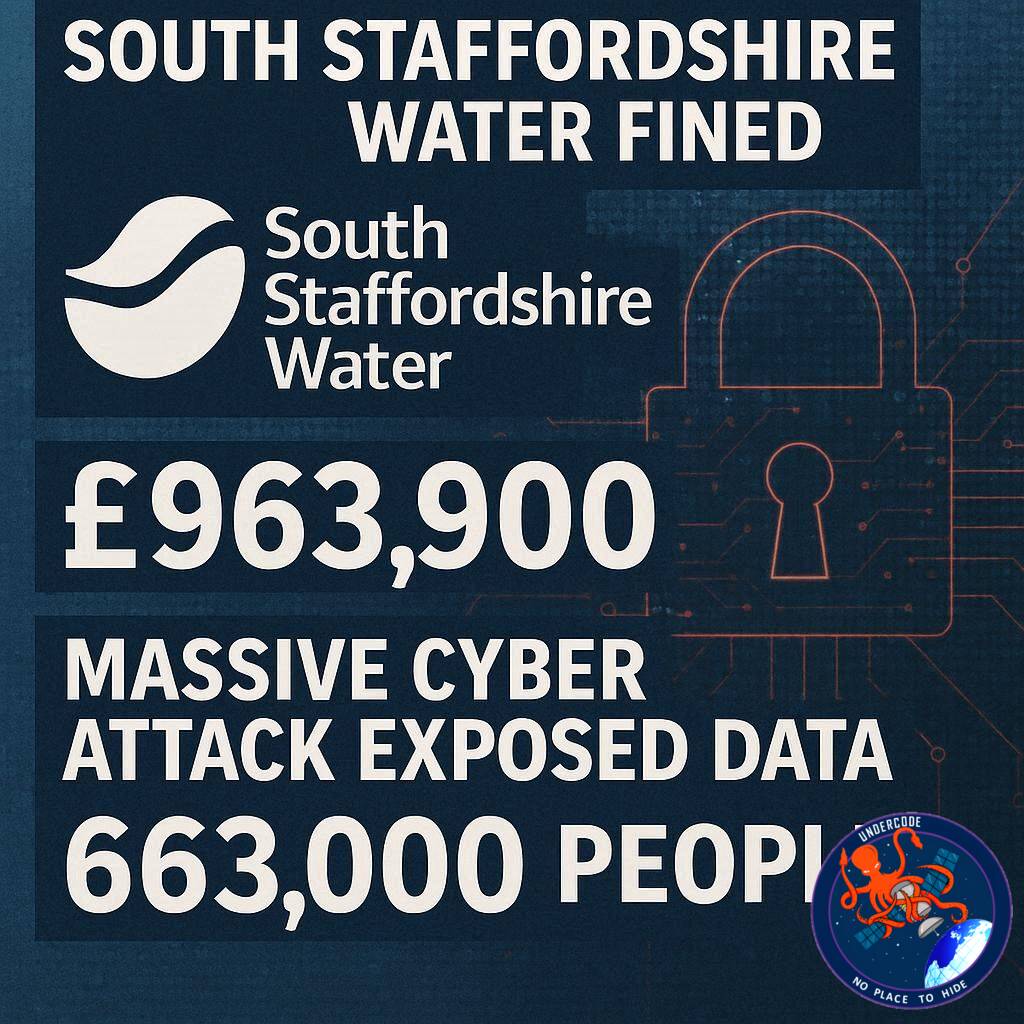
The UK Information Commissioner’s Office announced a £963,900 fine against South Staffordshire Water Plc and South Staffordshire Plc after a major cyberattack exposed the personal data of 663,887 individuals. The companies provide approximately 330 million liters of drinking water every day to around 1.6 million consumers, making the breach particularly alarming due to the critical nature of the infrastructure involved.
The attack first became publicly known in 2022 when the Cl0p ransomware gang claimed responsibility for infiltrating the organization’s systems. Initially, the company rejected the claims, partly because the attackers had incorrectly identified their victim in early announcements. However, leaked samples published online appeared authentic at the time, and the ICO’s investigation has now officially confirmed that the stolen information genuinely belonged to South Staffordshire Water Plc.
According to the regulator, the compromise actually began much earlier than previously believed. Investigators traced the initial breach back to September 2020, revealing that attackers had maintained access to the environment for nearly two years before discovery.
The ICO stated that the cyberattack largely unfolded between May and July 2022, during which threat actors escalated privileges throughout the network and eventually obtained domain administrator access. The intrusion was only detected after persistent IT performance problems triggered an internal investigation.
Authorities revealed that the breach started through a phishing attack that allowed attackers to deploy malware inside the company’s systems. Shockingly, the malware remained undetected for approximately 20 months.
The stolen information included highly sensitive personal and financial details such as full names, residential addresses, email addresses, phone numbers, dates of birth, customer account credentials, bank account information, and employee HR records. Employee data reportedly included National Insurance numbers and other confidential internal records.
During the investigation, the ICO uncovered multiple serious cybersecurity weaknesses that contributed to the incident. These included insufficient protections against privilege escalation, extremely limited monitoring capabilities covering only around 5% of the IT environment, and the continued use of outdated software such as Windows Server 2003.
The regulator also identified poor vulnerability management practices, missing security patches, and a failure to conduct regular internal and external security scans. Collectively, these weaknesses were found to violate UK data protection laws and cybersecurity expectations.
Although the original proposed penalty was significantly higher, the ICO reduced the fine by 40% because South Staffordshire admitted liability early, cooperated fully with investigators, and agreed to settle the case without appeal.
The incident serves as another warning sign for operators of critical national infrastructure, especially those managing water, electricity, healthcare, and transportation systems. Cybercriminal groups increasingly target these sectors because disruption can create pressure to pay ransoms quickly.
The report also appeared alongside broader cybersecurity discussions warning that many modern vulnerabilities remain unpatched globally. Security researchers continue to warn that advanced attackers are now chaining multiple zero-day vulnerabilities together to bypass modern security protections, making proactive defense more important than ever.
What Undercode Say:
The South Staffordshire breach is not just another ransomware story. It is a textbook example of how neglected cybersecurity hygiene can silently evolve into a catastrophic long-term compromise. The most disturbing aspect is not the phishing email itself, because phishing remains common across every industry. The real issue is that attackers reportedly remained inside the environment for nearly two years without detection.
That level of persistence indicates systemic defensive failures rather than a single technical mistake.
One of the biggest red flags in this case is the reported monitoring coverage of only 5% of the IT environment. In modern enterprise security, visibility is everything. If defenders cannot observe network behavior, lateral movement, privilege escalation, or anomalous authentication activity, attackers effectively operate invisibly.
The continued use of Windows Server 2003 is equally alarming. Microsoft ended extended support for Windows Server 2003 years ago, meaning the systems no longer received security updates or protections against newly discovered vulnerabilities. Running legacy infrastructure inside a critical utility environment dramatically increases organizational risk.
Another important detail is the timeline. Attackers allegedly gained initial access in September 2020, but the breach was not discovered until July 2022. That means threat actors potentially had unrestricted time to study internal architecture, collect credentials, map network segments, and identify high-value systems before launching broader operations.
This type of prolonged access is often associated with advanced ransomware operations that prioritize stealth before detonation. Modern ransomware groups rarely deploy encryption immediately. Instead, they spend weeks or months harvesting data, escalating privileges, disabling defenses, and preparing for maximum leverage.
The exposure of employee HR records alongside customer banking details also creates long-term identity theft risks. Unlike passwords, information such as birth dates, addresses, or National Insurance numbers cannot simply be reset. Victims may face fraud attempts years after the original breach.
The ICO’s decision to reduce the fine due to cooperation reflects a broader regulatory pattern. Regulators increasingly encourage transparency and collaboration after incidents occur. Companies that admit failures early and assist investigators often receive reduced penalties compared to organizations that obstruct investigations or delay disclosure.
However, the fine itself may still appear relatively small compared to the scale of the exposure. For critical infrastructure providers, reputational damage and operational disruption often cost far more than regulatory penalties alone.
This case also demonstrates why ransomware gangs increasingly target utility providers. Water companies, hospitals, and energy operators cannot tolerate prolonged outages because public services depend on continuous availability. Threat actors understand this pressure and exploit it strategically.
Another major lesson involves privilege escalation controls. Once attackers obtained domain administrator access, they effectively controlled the organization’s digital environment. Strong segmentation, privileged access management, multi-factor authentication, and zero-trust architecture could have significantly limited attacker movement.
The incident further reinforces the importance of proactive threat hunting. Traditional antivirus solutions alone are no longer sufficient against modern ransomware groups using living-off-the-land techniques and credential abuse. Organizations now require behavioral analytics, endpoint detection and response platforms, and continuous monitoring.
Cybersecurity is no longer simply an IT department responsibility. In sectors involving national infrastructure, cybersecurity failures become public safety issues. A compromise affecting water supply systems can rapidly escalate from a data breach into a national security concern.
The broader industry should view this enforcement action as a warning. Regulators are increasingly willing to penalize organizations not merely for being breached, but for failing to implement reasonable safeguards before attacks occur.
Ultimately, South Staffordshire’s experience highlights a harsh reality facing modern enterprises: attackers only need one successful phishing email, but defenders must continuously secure every vulnerable system, every outdated server, and every privileged account.
Fact Checker Results
✅ The ICO confirmed that personal data from more than 663,000 individuals was exposed during the South Staffordshire cyberattack.
✅ Investigators found the attackers had access to systems from September 2020 until discovery in July 2022.
❌ The breach was not caused by a sophisticated zero-day exploit alone; investigators stated the intrusion began through a phishing attack combined with weak security practices.
Prediction
🔮 Regulatory penalties against critical infrastructure operators will become significantly harsher over the next few years, especially when legacy systems and poor monitoring are involved.
🔮 Water, healthcare, and energy providers will increasingly adopt zero-trust security architectures and AI-driven threat detection platforms after seeing how long attackers remained undetected in incidents like this.
🔮 Ransomware groups will continue shifting toward stealth-focused intrusions where data theft and privilege escalation occur months before public discovery or encryption attacks.
🕵️📝Let’s dive deep and fact‑check.
References:
Reported By: www.bleepingcomputer.com
Extra Source Hub (Possible Sources for article):
https://www.reddit.com
Wikipedia
OpenAi & Undercode AI
Image Source:
Unsplash
Undercode AI DI v2
Bing
🔐JOIN OUR CYBER WORLD [ CVE News • HackMonitor • UndercodeNews ]
📢 Follow UndercodeNews & Stay Tuned:
𝕏 formerly Twitter 🐦 | @ Threads | 🔗 Linkedin | 🦋BlueSky | 🐘Mastodon


