
Listen to this Post
Introduction
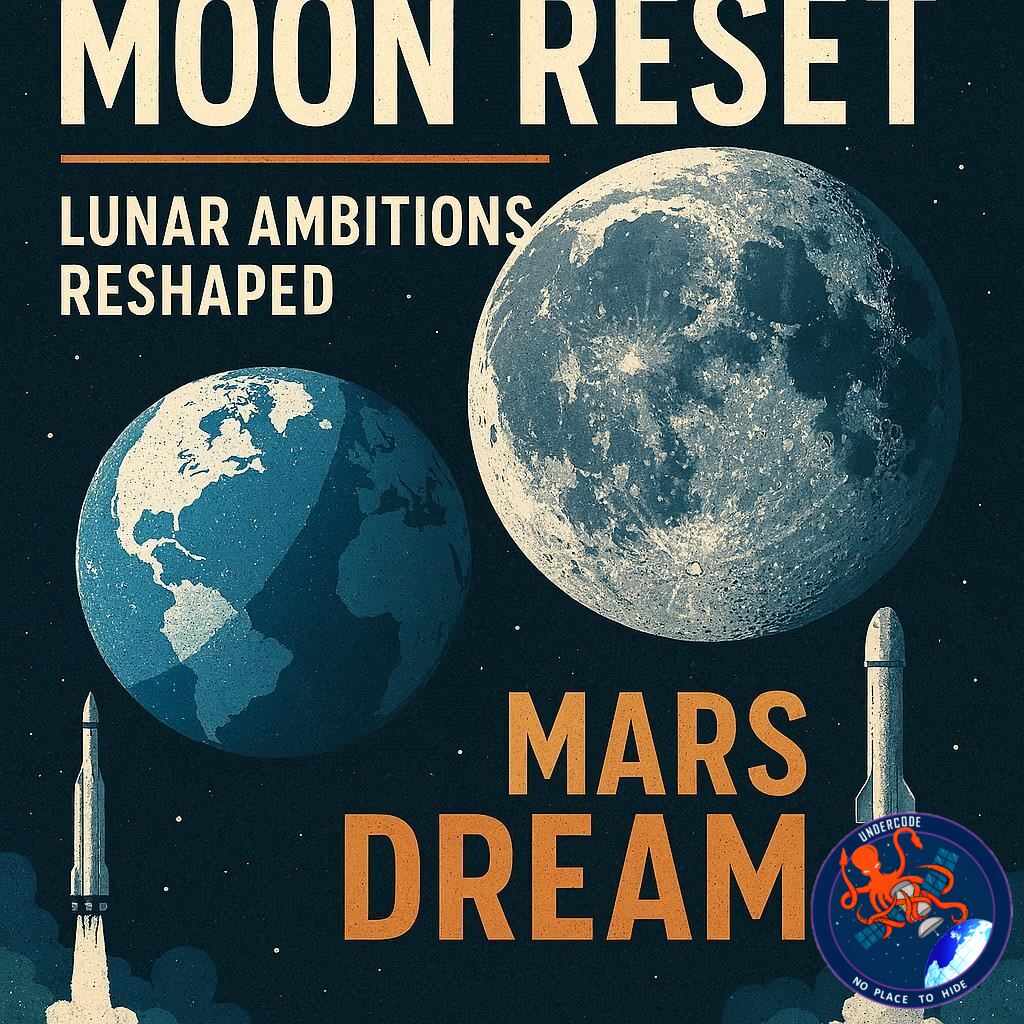
For years, Mars was the centerpiece of Elon Musk’s space narrative, a bold promise of humanity becoming a multi-planet species led by SpaceX and its massive Starship rockets. That vision seemed firmly locked to the late 2020s, driven by planetary alignments and Musk’s personal conviction that Mars mattered more than any other destination. But space exploration is never just about engineering. It is also about politics, budgets, national priorities, and timing. In a surprising turn, the moon has reclaimed center stage, forcing a recalibration not only for SpaceX, but also for its main rival, Jeff Bezos’ Blue Origin. What was once framed as a detour now looks like the main road.
the Original
SpaceX initially planned to send multiple Starship rockets to Mars in late 2026, taking advantage of a rare and favorable alignment between Earth and Mars. Elon Musk actively promoted this vision, even lobbying US President Donald Trump by arguing that a Mars landing would secure Trump’s legacy as a historic “president of firsts.” However, this strategy has shifted following pressure from NASA and other US government officials. According to reports, SpaceX has now redirected its immediate goals toward an unscrewed lunar landing in March 2027, bringing its timeline into closer alignment with NASA’s Artemis program.
This change reflects broader ambitions within Musk’s empire. SpaceX is now pursuing new projects such as space-based AI data centers, following its merger with Musk’s AI company xAI in a deal valuing the combined entities at $1.2 trillion USD. Musk has reframed the moon not as a distraction, but as a critical stepping stone. He argues that technologies developed for lunar infrastructure and space-based computing could generate funding and technical momentum for future self-sustaining bases on the Moon, permanent settlements on Mars, and eventually expansion beyond the solar system.
At the same time, Jeff Bezos’ Blue Origin has undergone its own strategic shift. In January, the company paused its suborbital space tourism operations to focus on developing a simpler and more competitive lunar lander. This move positions Blue Origin to compete directly with SpaceX for NASA contracts, particularly those involving transporting astronauts to the lunar surface.
NASA Administrator Jared Isaacman has publicly welcomed this growing rivalry, suggesting that competition between SpaceX and Blue Origin will accelerate innovation. The Artemis II mission, a planned lunar fly-by, is expected to pave the way for a crewed lunar landing around 2028, with either SpaceX or Blue Origin potentially supplying the lander. Political pressure from the White House, combined with NASA’s funding power and oversight, has reshaped both companies’ trajectories. Musk has embraced the moon as a launchpad for deeper space ambitions, while Bezos has refocused Blue Origin’s resources to challenge SpaceX directly in the renewed race to the Moon.
What Undercode Say:
This strategic pivot reveals a deeper truth about modern space exploration. Vision alone is not enough. Even the most powerful private space companies remain tightly bound to government priorities, funding structures, and political symbolism. Musk’s original dismissal of the moon as a distraction was not wrong from a purely technical standpoint. Mars offers a clearer long-term case for human settlement. But the moon offers something Mars does not, immediate political value, manageable risk, and continuous visibility.
NASA’s Artemis program is less about planting flags and more about building an operational space economy. Lunar landers, surface habitats, power systems, and logistics chains create repeatable contracts and predictable budgets. From NASA’s perspective, Mars is still too far, too expensive, and too uncertain to anchor near-term policy. By pulling SpaceX back toward the moon, the agency ensures that Starship development serves national goals rather than a single founder’s timeline.
The xAI merger adds another layer. Space-based data centers sound futuristic, but they solve real problems, energy availability, cooling, and global data latency. If Musk can turn orbit and cislunar space into profitable infrastructure zones, lunar operations become financially defensible rather than symbolic. The moon becomes a testing ground for industrial-scale space operations, not just a waypoint.
Blue Origin’s shift is equally telling. Suborbital tourism brought attention, but not strategic leverage. Lunar contracts bring long-term relevance. Bezos understands that NASA credibility matters more than celebrity launches. By simplifying its lander design and focusing on reliability, Blue Origin is signaling that it wants to be the institutional partner NASA can trust, not just a challenger brand.
The rivalry itself is perhaps the most important outcome. Competition between SpaceX and Blue Origin mirrors the dynamic that once drove rapid advances in commercial aviation and computing. Different engineering philosophies, different risk tolerances, and different corporate cultures will likely produce faster iteration and lower costs. For NASA, this is the ideal scenario.
In this context, Mars has not been abandoned. It has been delayed, strategically. The moon is no longer a distraction. It is the proving ground that determines who earns the right, and the resources, to go further.
Fact Checker Results
✅ SpaceX has shifted near-term focus toward a lunar mission aligned with NASA’s Artemis program.
✅ Blue Origin has paused suborbital tourism to prioritize lunar lander development.
❌ No official commitment confirms a crewed Mars landing timeline before the 2030s.
Prediction
📊 The late 2020s will be defined by lunar infrastructure, not Mars landings.
📊 SpaceX and Blue Origin will both secure major NASA contracts, creating a two-player lunar ecosystem.
📊 Mars will return to the spotlight only after the moon proves economically and operationally sustainable.
▶️ Related Video (80% Match):
🕵️📝✔️Let’s dive deep and fact‑check.
References:
Reported By: timesofindia.indiatimes.com
Extra Source Hub (Possible Sources for article):
https://stackoverflow.com
Wikipedia
OpenAi & Undercode AI
Image Source:
Unsplash
Undercode AI DI v2
Bing
🔐JOIN OUR CYBER WORLD [ CVE News • HackMonitor • UndercodeNews ]
📢 Follow UndercodeNews & Stay Tuned:
𝕏 formerly Twitter 🐦 | @ Threads | 🔗 Linkedin | 🦋BlueSky | 🐘Mastodon


