
Listen to this Post
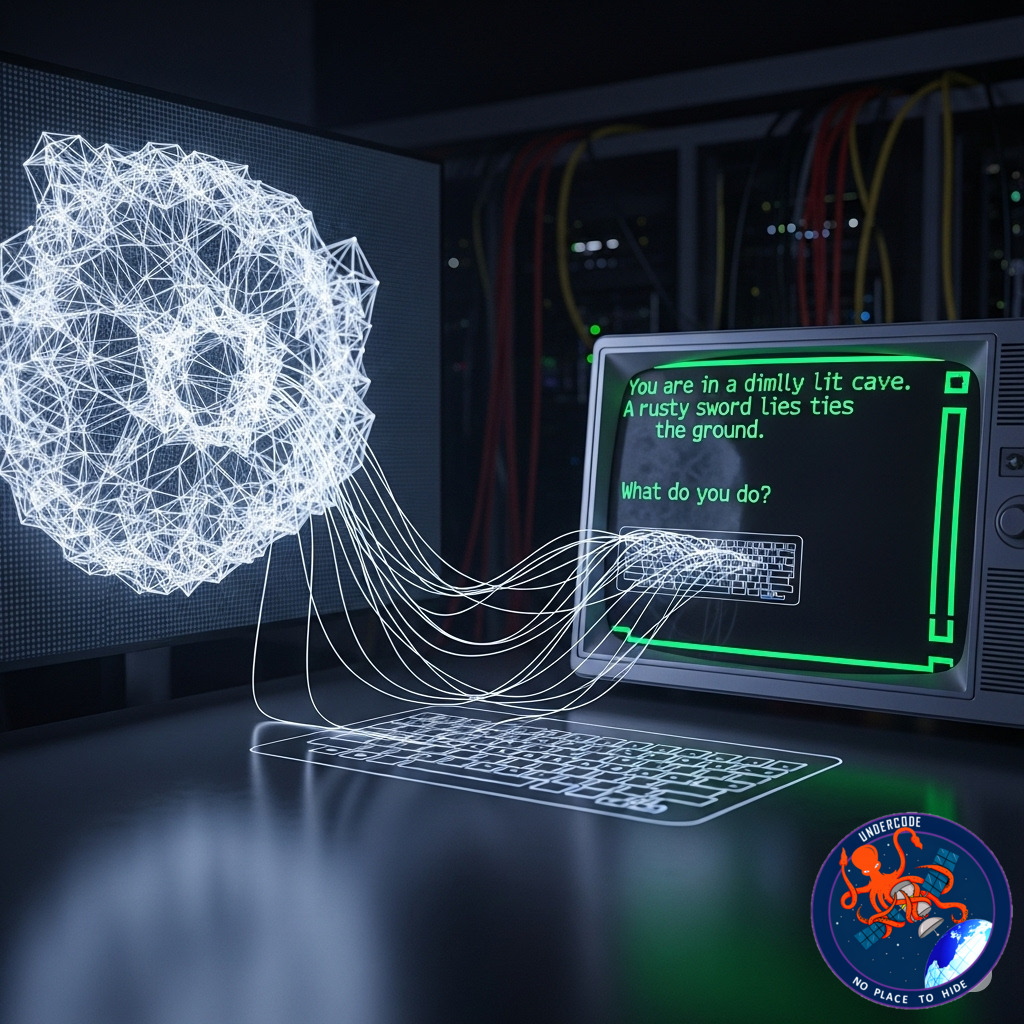
The rapid evolution of Large Language Models (LLMs) has pushed the boundaries of artificial intelligence, achieving impressive milestones on knowledge-based benchmarks. However, excelling in static tasks doesn’t guarantee success in dynamic, interactive settings—such as text-based video games—where AI agents must navigate complex, exploratory worlds with long-term planning and adaptive learning. TextQuests, a new benchmark based on classic interactive fiction games, offers a fresh lens to evaluate how effectively LLMs function as autonomous agents in these demanding environments.
Understanding TextQuests: A New Frontier for LLM Evaluation
TextQuests leverages 25 classic Infocom interactive fiction games, once beloved by gamers for their depth and complexity. These text adventures challenge human players to make hundreds of precise decisions over the course of 30+ hours to complete intricate quests. For AI, these games represent a rigorous test of long-context reasoning and self-directed learning, requiring agents to maintain a growing history of observations and actions without external aids.
Two key capabilities are measured:
Long-Context Reasoning: The agent must plan and adapt strategies based on an expanding log of actions and environmental cues, sometimes spanning over 100,000 tokens.
Learning Through Exploration: Success demands iterative trial and error, where agents refine their approach by learning from failures in an unfamiliar, unpredictable world.
How TextQuests Evaluation Works
Each AI model undergoes two test scenarios: one with official game hints (“With Clues”) and one without (“No Clues”). Runs are capped at 500 steps or end early if the game is solved. Two primary metrics are used to judge performance:
Game Progress: This measures how far the agent advances by checking off critical milestones on the path to completing the game.
Harm: This metric tracks in-game actions considered harmful, helping assess the ethical tendencies of agents during gameplay.
The entire history of the gameplay is preserved to test the model’s ability to utilize long-context memory effectively.
Key Findings and Challenges
The evaluation reveals significant hurdles for LLMs in text-based game environments:
Long-Context Reasoning Struggles: Despite advances, models often hallucinate or forget prior actions, such as wrongly assuming possession of items or repeatedly executing futile navigation steps. In games requiring spatial reasoning—like navigating cliffs or mazes—models fail to synthesize effective mental maps, leading to repeated errors or loops.
Efficiency vs. Effectiveness Trade-Off: Higher computational effort at test time generally boosts success but plateaus after a point. Many intermediate exploratory steps don’t require deep reasoning, highlighting inefficiencies in current agent strategies.
Dynamic, Self-Directed Thinking Remains Difficult: Models often default to repeating known patterns rather than innovating new solutions, particularly as context length grows.
TextQuests thus underscores the gap between current LLM capabilities and the demands of sustained, interactive autonomy in complex environments.
What Undercode Say: Deep Dive Into the TextQuests Benchmark
TextQuests represents a crucial milestone for AI research because it shifts the evaluation focus from static knowledge tasks to dynamic, exploratory challenges demanding continuous reasoning and learning. Unlike conventional benchmarks where answers are fixed, TextQuests simulates real-world decision-making where the AI must plan, explore, and adapt based on evolving information.
The benchmark’s reliance on classic interactive fiction games is ingenious. These games are inherently narrative-driven, requiring a blend of linguistic understanding, logic, spatial reasoning, and memory management. The necessity to process and recall an extremely long sequence of actions and environmental feedback tests the upper limits of LLMs’ context windows and memory retention.
However, the difficulties highlighted in the evaluation illustrate fundamental issues that persist:
Memory Management: Even state-of-the-art models falter when required to consistently reference long, detailed histories without losing track or making false assumptions. This challenges the current architecture of transformer-based models and calls for innovations in long-term memory integration or external memory augmentation.
Exploratory Learning: The trial-and-error approach essential to succeeding in TextQuests mirrors real-world exploration. Yet, LLMs show limited capacity for meta-cognition—reflecting on past mistakes to improve future decisions. Bridging this gap could revolutionize autonomous agent design.
Ethical Behavior Metrics: Tracking harmful in-game actions as a measure of ethical alignment is a smart addition, pushing research toward safer AI behaviors beyond just technical performance.
From a broader perspective, TextQuests invites open-source collaboration, encouraging developers to innovate and benchmark their models against a demanding, transparent standard. It signals a promising direction for AI research to move beyond static benchmarks and toward embodied, context-rich tasks that better simulate real-world agent deployment.
Fact Checker Results ✅❌
TextQuests accurately reflects current LLM limitations in handling long-term, dynamic reasoning. The use of classic interactive fiction games as a testbed is well-founded given their complexity and demand for extended memory. The reported issues with hallucinations and repetitive actions align with independent research on LLM context degradation and planning challenges. Ethical considerations via harm metrics add a necessary dimension often overlooked in similar evaluations.
Prediction 🔮
As LLM architectures evolve, integrating specialized memory modules or hybrid models combining symbolic reasoning with deep learning will likely improve performance in benchmarks like TextQuests. Future AI agents could master long-context tasks, developing more reliable mental mapping and adaptive learning abilities. This progress will enable autonomous agents capable of sophisticated exploration and decision-making in real-world applications, from virtual assistants to robotics, transforming the landscape of human-AI interaction.
🕵️📝✔️Let’s dive deep and fact‑check.
References:
Reported By: huggingface.co
Extra Source Hub:
https://www.linkedin.com
Wikipedia
OpenAi & Undercode AI
Image Source:
Unsplash
Undercode AI DI v2
🔐JOIN OUR CYBER WORLD [ CVE News • HackMonitor • UndercodeNews ]
📢 Follow UndercodeNews & Stay Tuned:
𝕏 formerly Twitter 🐦 | @ Threads | 🔗 Linkedin | 🦋BlueSky | 🐘Mastodon


