
Listen to this Post
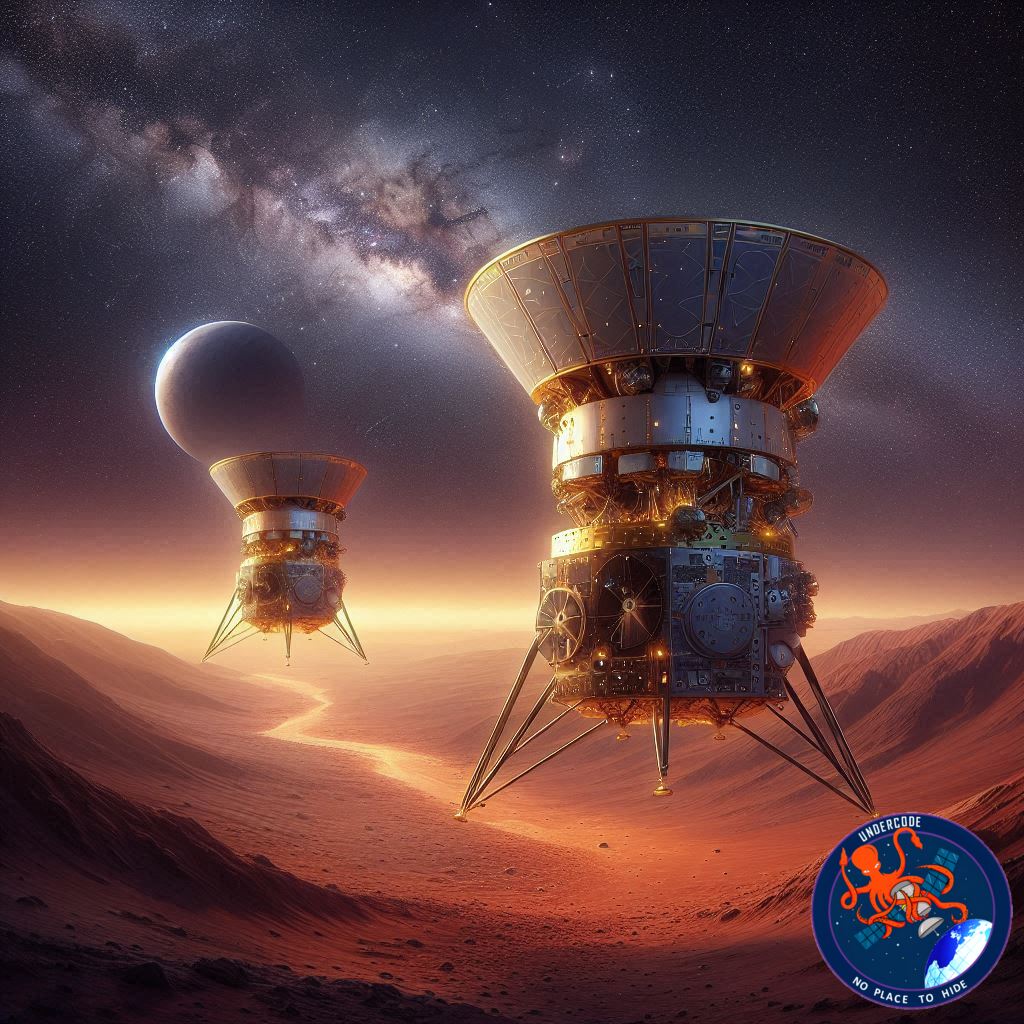
NASA has taken a bold step forward in planetary exploration with the successful deployment of its twin ESCAPADE (Escape and Plasma Acceleration and Dynamics Explorers) spacecraft from Blue Origin’s New Glenn second stage. Designed to study Mars’ magnetosphere and space weather environment, these twin orbiters mark the first coordinated multi-spacecraft orbital science mission to the Red Planet. Over the next few years, ESCAPADE will provide unprecedented insights into how energy and matter flow around Mars, revealing critical information for future human and robotic missions.
ESCAPADE Deployment and Mission Trajectory
After separating from the New Glenn rocket, the ESCAPADE spacecraft will enter an Earth-proximity orbit shaped like a kidney bean for roughly a year. This orbital phase allows mission teams to prepare the spacecraft for a trans-Mars injection burn scheduled for November 2026. By performing the burn at high velocity, the spacecraft will exploit the Oberth Effect—a principle in astrodynamics where a spacecraft gains maximum efficiency when engines fire at peak speed—propelling the twin explorers toward Mars.
Upon arrival in September 2027, ESCAPADE will enter a large capture orbit around the Red Planet. Teams will then carefully adjust and synchronize their orbits to begin scientific operations in Spring 2028. This multi-step orbital choreography ensures that both spacecraft can take simultaneous observations from different locations, providing a comprehensive view of Mars’ magnetospheric and atmospheric dynamics.
Scientific Objectives of ESCAPADE
ESCAPADE’s mission focuses on understanding Mars’ magnetosphere and how it interacts with solar wind. The twin spacecraft will monitor real-time changes in the planet’s magnetic field, track particle flows, and study how energy and momentum transfer from the solar wind to Mars’ environment. By observing these processes simultaneously from two locations, researchers hope to answer longstanding questions about how Mars’ atmosphere evolves and how its magnetic field channels charged particles.
This data is critical for planning future missions, as the Martian space environment can pose significant risks to astronauts and spacecraft. Understanding the planet’s magnetosphere helps predict solar storms and radiation exposure, allowing NASA to design better protective measures for human explorers and sensitive instruments.
Mission Background and Partnerships
ESCAPADE is part of NASA’s SIMPLEx (Small Innovative Missions for Planetary Exploration) program, managed by the agency’s Heliophysics Division. The mission is led by the University of California, Berkeley Space Sciences Laboratory, with spacecraft design by Rocket Lab. Launch services were provided through NASA’s Launch Services Program using the VADR (Venture-class Acquisition of Dedicated and Rideshare) contract.
The mission exemplifies NASA’s shift toward smaller, cost-effective spacecraft that can perform high-value science while leveraging commercial partnerships for launch and design. ESCAPADE demonstrates how agile mission planning and innovative engineering can expand scientific return while controlling costs.
What Undercode Say:
The ESCAPADE mission represents a major milestone in planetary exploration, both scientifically and operationally. Coordinated twin spacecraft provide a unique advantage over single-orbiter missions, offering simultaneous observations that can resolve complex space weather dynamics and magnetospheric structures. From an engineering perspective, deploying these spacecraft on a small budget through SIMPLEx highlights NASA’s increasing reliance on cost-effective, commercially integrated solutions.
Scientifically, ESCAPADE promises insights that extend far beyond Mars. Understanding how energy flows through Mars’ magnetosphere sheds light on fundamental planetary processes relevant to Earth, Venus, and Mercury. Moreover, the mission’s focus on real-time particle dynamics helps refine space weather models, which are crucial for protecting spacecraft and astronauts in deep space.
The mission also emphasizes the importance of timing and orbital mechanics in interplanetary travel. By leveraging the Oberth Effect during its trans-Mars injection, ESCAPADE maximizes propulsion efficiency—a technique that future missions to outer planets or asteroid targets will increasingly adopt. These strategic choices illustrate NASA’s commitment to combining high-level scientific goals with practical, innovative engineering solutions.
Operationally, the challenge of synchronizing two orbiters in Martian orbit underscores the growing sophistication of multi-spacecraft coordination. Simultaneous observations from different orbital locations provide richer datasets, enabling scientists to model Mars’ magnetospheric environment more accurately than ever before. The results will likely influence planning for human missions, particularly in designing safe transit routes and protective habitats.
Finally, ESCAPADE is a testament to collaborative innovation. By integrating efforts across academic institutions, commercial companies, and government agencies, NASA is not only advancing Mars science but also establishing a framework for future planetary exploration that is both ambitious and economically sustainable.
🔍 Fact Checker Results:
✅ ESCAPADE spacecraft successfully deployed from New Glenn rocket.
✅ The mission is part of NASA’s SIMPLEx program, led by UC Berkeley.
❌ The scientific mission will not begin immediately; operations start in Spring 2028.
📊 Prediction:
🚀 ESCAPADE’s twin-orbiter approach could become a standard for future planetary missions, particularly for magnetospheric and space weather studies.
🌌 Data from ESCAPADE may refine models for radiation protection, enabling safer human exploration of Mars by the early 2030s.
🛰️ The mission’s success could inspire more low-cost, high-efficiency interplanetary missions leveraging commercial launch services.
🕵️📝✔️Let’s dive deep and fact‑check.
References:
Reported By: science.nasa.gov
Extra Source Hub (Possible Sources for article):
https://www.discord.com
Wikipedia
OpenAi & Undercode AI
Image Source:
Unsplash
Undercode AI DI v2
Bing
🔐JOIN OUR CYBER WORLD [ CVE News • HackMonitor • UndercodeNews ]
📢 Follow UndercodeNews & Stay Tuned:
𝕏 formerly Twitter 🐦 | @ Threads | 🔗 Linkedin | 🦋BlueSky | 🐘Mastodon


